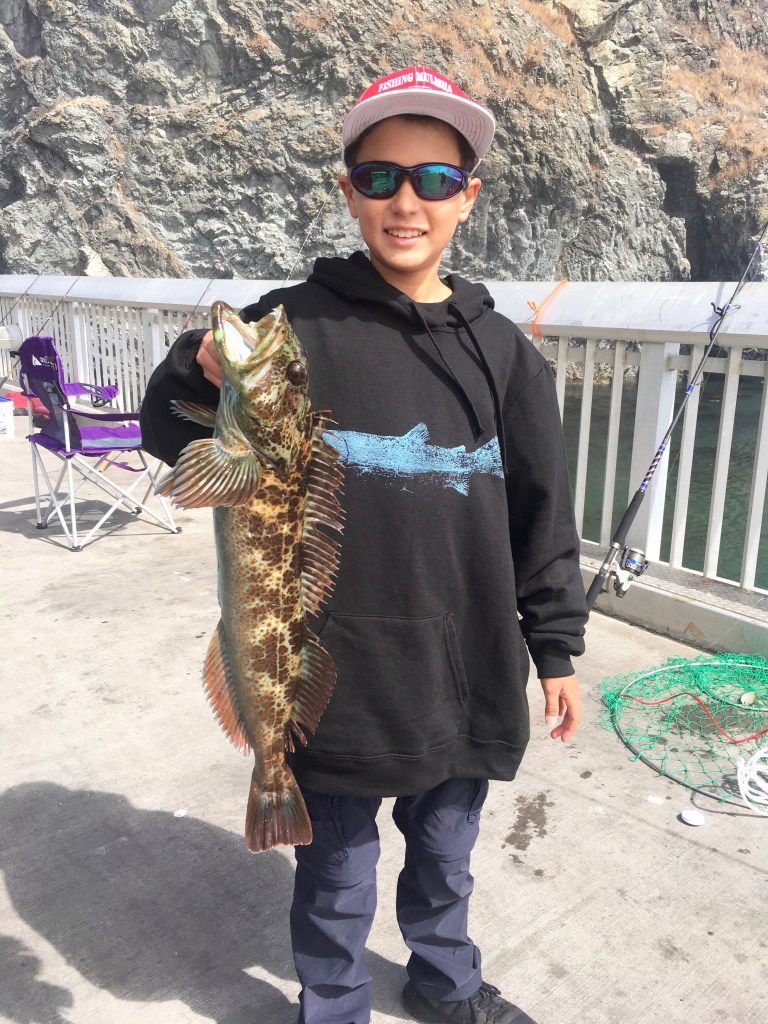
Sport crab season slated to open Saturday

The uber-popular recreational Dungeness crab season is slated to open state-wide this Saturday, Nov. 2. The season’s first traps can legally be deployed at 12:01 a.m. on Saturday morning. Anglers will get their first peak into the health and weight of this season’s crop as the pre-season quality tests have not taken place or the results have yet to be made public. One thing we do know is the domoic acid levels shouldn’t be an issue. Tests conducted in Eureka, Trinidad, and Crescent City all came back clean.

Word on the street is there’s plenty of crab, but they aren’t as meaty as we’d like. A typical year will find the meat content at around 20 percent, with the theory being that crabs will add one percent of meat a week and reach the 25 percent mark for the commercial opener of Dec. 1. Meaty crabs or not, we’re just happy that the season is opening on time.
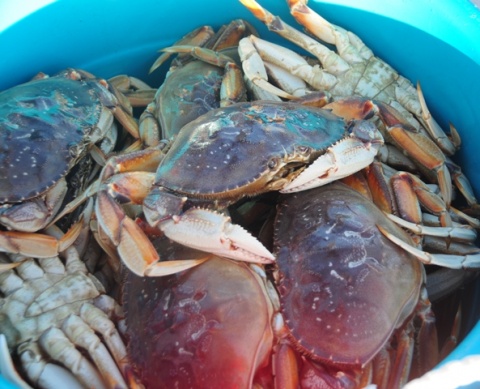
Submitted photo

The season runs from Saturday, Nov. 2 through July 30, 2020. The minimum size is five and three-quarter inches measured by the shortest distance through the body from edge of shell to edge of shell directly in front of and excluding the points (lateral spines) and the limit is 10. A valid California sport fishing license is required. For more information regarding recreational Dungeness crab fishing regulations and other crab species, visit http://www.eregulations.com/california/fishing/saltwater/invertebrate-regulations/

As of this writing, CDFW has not issued any information to the public regarding the upcoming sport season. We’re under the assumption here that it will open on time with no delays.

Below is a list of the state regulations that went into effect on Aug. 1 2016, regarding the crab fisheries and crab trap requirements. Dungeness crab size and bag limits are now uniform statewide.

1) Crab trap buoys must display the “GO ID” number of the operator of the trap.

2) Crab traps must contain at least one destruct device made from a single strand of untreated cotton twine size No. 120 or less that creates an unobstructed opening anywhere in the top or upper half of the trap that is at least 5 inches in diameter when this material corrodes or fails.

3) Crab traps must not be deployed or fished seven days prior to the opening of the Dungeness crab season.

4) Every crab trap must be outfitted with two rigid circular escape openings that are a minimum of 4.25 inches in diameter and located so that the lowest portion is at the most five (5) inches from the top of the trap. This is to allow small crabs to easily escape from the trap.

For a complete list of crab trap regulations, visit https://nrm.dfg.ca.gov/FileHandler.ashx?DocumentID=150181&inline

Crabbing locations
If you’re planning on heading offshore out of Eureka and leaving pots overnight, your best bet is to start setting gear in 100 to 150 feet of water. Historically, crabs tend to be in deeper water at the beginning of the season and will move in towards the beach later in the year. If you’re soaking for just a few hours and don’t have the equipment to go deep, dropping pots just outside the entrance in 50 feet is a good option.

If you don’t have means to head offshore, you can still find plenty of crab. One of the top spots to soak a few rings is Crab Park, located at the end of Cannibal Island Rd., in Loleta. There’s access to launch a kayak or canoe in the estuary of the Eel River. You can also launch your boat at Pedrazzini Park at the end of Cock Robin Island Rd., and make your way up the estuary towards the mouth of the Eel.

Humboldt Bay also has a few good locations to catch some crab. Out in front of the PG&E plant is a good spot as well as the flat off of the South Jetty parking lot. Another top location is either side of the channel leading into the South Bay. Up north, inside Trinidad Harbor is another popular spot among the locals. You can launch your small boat, kayak or canoe right off the beach and head out to Prisoner Rock, where the bottom is sandy and 40 to 50-ft deep. Launching here requires a relatively calm ocean, which looks to be the case this weekend.

Marine Forecast
Ocean conditions look good for Saturday’s crab opener, with no advisories posted as of Wednesday. Saturday’s forecast is calling for N winds to 5 knots with NW waves 3 feet at 7 seconds and NW 3 feet at 12 seconds. Sunday is looking a little rougher, with winds out of the NW to 5 knots and NW waves 4 feet at 5 seconds and NW 3 feet at 12 seconds. These conditions can and will change by the weekend. For an up-to-date weather forecast, visit www.weather.gov/eureka/ or https://www.windy.com. To monitor the latest Humboldt bar conditions, visit www.wrh.noaa.gov/eka/swan. You can also call the National Weather Service at (707) 443-7062 or the office on Woodley Island at (707) 443-6484.

Weekend Tides – Humboldt Bay
• Sat., Nov. 2 (High: 5:08 a.m. and 3:50 p.m.) (Low: 10:02 a.m. and 10:59 p.m.)

Standard time begins at 2:00 a.m. Sunday
• Sun., Nov. 3 (High: 5:14 a.m. and 3:49 p.m.) (Low: 10:12 a.m. and 10:59 p.m.)

North Coast all-depth recreational fishing to begin Nov. 1
In a press release issued last Friday, the CDFW announced a new recreational fishing opportunity for groundfish north of Point Arena from Nov. 1 through Dec. 31, 2019.

For two decades, recreational fishing for groundfish species in deep waters off the California coast has been completely off limits, driven by the need to protect certain stocks that have been overfished. This marks the first time anglers off the northern California coast will be allowed to fish for groundfish without needing to abide by fishing depth limit regulations.

The all-depth fishery will take place only in November and December 2019, and only north of Point Arena. The newly open areas will allow anglers to target groundfish species in the midwater column, such as widow and yellowtail rockfish, as well as species found on the bottom. There are no special gear requirements, though unless otherwise specified, regulations require anglers to use not more than two hooks and one line to target groundfish. All other season dates, bag limits, size limits and other special area closures still apply.

While the all-depth fishery has been proposed since 2017, encounters with yelloweye rockfish in 2017 and 2018 exceeded the federal limit. In-season regulatory action in those years was needed to restrict depth limits in most areas of the state and also prevented the all-depth fishery from occurring. Following the outcome of the most recent yelloweye stock assessment indicating the population is rebuilding much sooner than expected, the federal limit increased in 2019, allowing the all-depth fishery this year. For more information on all-depth fishing, visit https://cdfgnews.wordpress.com/2019/10/25/north-coast-all-depth-recreational-fishing-to-begin-nov-1/.

For more information regarding groundfish regulations, management and fish identification tools, please visit https://www.wildlife.ca.gov/Conservation/Marine/Groundfish

Weekend Weather forecast
Dry weather continues to dominate the North Coast, and it looks to be more of the same for the next seven days. “There aren’t any signs of rain through next week,” said Kathleen Zontos of Eureka’s National Weather Service. “But there is a possibility that we’ll begin to see a pattern change – possibly a wet one – beginning the week of Nov. 11.”

River Closures
Currently, all the North Coast rivers subjected to low flow fishing closures, including the Eel, Mad, Redwood Creek, Smith and Van Duzen are closed. Sections of rivers that are open include the main stem Eel River from the paved junction of Fulmor Road to its mouth, the main stem Mad River from the Hammond Trail Railroad Trestle to its mouth and the main stem Smith River from the mouth of Rowdy Creek to its mouth.

The Department of Fish and Game will make the information available to the public no later than 1 p.m. each Monday, Wednesday and Friday as to whether any river will be closed to fishing. The rivers can be opened up at any time. The low flow closure hotline for North Coast rivers is (707) 822-3164.

Smith River
The Smith remains closed to fishing above Rowdy Creek due to low flows, and the fishing has been really slow below according to Britt Carson of Crescent City’s Englund Marine. He said, “Very few salmon are being caught at the mouth, maybe one or two a day. There isn’t much happening at the Sand Hole either, it’s been slow all over.”

Chetco Estuary
“The Chetco estuary is fishing well, with lots of fish caught each day, especially at the beginning of the outgoing tide,” said Andy Martin of Wild Rivers Fishing. “Bigger numbers of hatchery fish arrived last week. A few fish to 35 pounds have been caught, but most are 15 to 20 pounds. With this week’s extra high tides, some of the fish are moving above the fishing deadline into the upper tidewater. The estuary will continue to fish until rain arrives.” From Oct. 1 through December 31, the daily bag limit for salmon is two adult fish per day. No more than one adult wild Chinook salmon may be harvested per day as part of the daily bag limit and no more than two total from Oct. 1 through December 3. Anglers may harvest adult hatchery Chinook salmon until their daily bag limit has been met. The daily limit for jack salmon is five fish per day and does not count towards the adult daily limit. Once the adult daily limit is harvested, anglers cannot continue to fish for jacks.

Find “Fishing the North Coast” on Facebook and fishingthenorthcoast.com for up-to-date fishing reports and North Coast river information. Questions, comments and photos can be emailed to kenny@fishingthenorthcoast.com
Humboldt Bay continues to kickout CA halibut

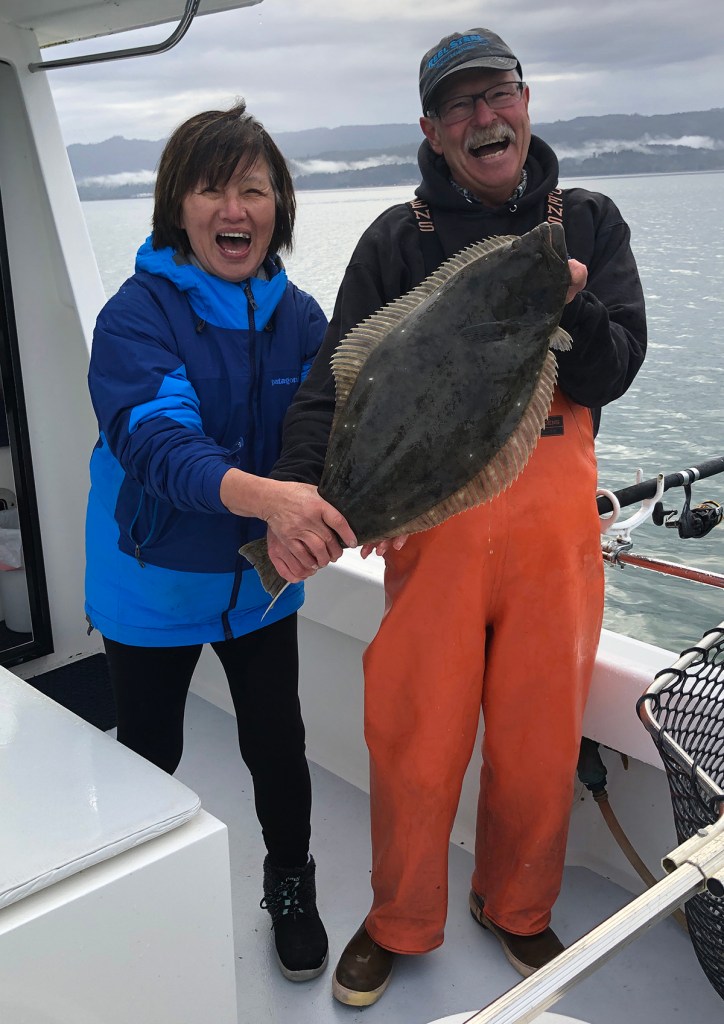
If you thought the California halibut season was over, you might want to rethink that. While the swells are too big to get offshore, and the rivers are too low to fish, Humboldt Bay just keeps producing. According to Tim Klassen of Reel Steel Sport Fishing, who fished the bay a couple times last week, there’s plenty of fish around to make for a great day. “The fish aren’t in every spot like they were earlier in the year, so you may have to hunt around a little to find them,” said Klassen. “We’ve had some good success in the middle channel just above the bridge. The fishing should continue to be excellent as there’s still plenty of bait in the bay, which should keep the halibut close by.” According to Klassen, about the only thing that can slow the bite is the rain. Once the freshwater infiltrates the bay, both the halibut and the bait will likely head back to the ocean. The recreational fishery for California halibut is open year-round. The daily bag and possession limit is three fish, with a minimum size limit of 22 inches total length.

Betty Chinn of Eureka, left, is all smiles after landing her first-ever California halibut in Humboldt Bay last Thursday. Also pictured is Capt. Tim Klassen of Reel Steel Sport Fishing. Photo courtesy of Paul Shanahan

No rain in sight
We’re looking at dry weather at least through early November according to Kathleen Zontos of Eureka’s National Weather Service. “A ridge of high pressure continues to sit off our coast, which is moving systems to the north. As of now, there isn’t any rain forecasted through the first week in November,” Zontos added.

Focus group study seeks participants
The NNC is recruiting participants for focus group studies as part of a research project with NOAA about the use of National Weather Service flood forecast and warning tools. Nurture Nature Center (NNC) is a Pennsylvania-based nonprofit organization with a focus on flood issues, and has been working with NWS to help improve its flood forecast products. The focus groups, one for Humboldt County residents and the other for water resource and emergency management professionals, will help inform product recommendations to improve the display and delivery of forecast information in the region and nationally. The meeting for water and emergency professionals will be held from 10 a.m. to noon on Monday, November 4 at the Humboldt Bay Aquatic Center. The meeting for residents is Monday, November 4 at the Humboldt Bay Aquatic Center from 6 p.m. to 8 p.m. Participants should live or work in the Humboldt County area and be at least 18 years of age. To participate, contact Rachel Hogan Carr at rhogan@nurturenature.org or 610-253-4432 for more information. You can also register online at www.focusonfloods.org 

Willow Creek weir counts
For the trapping week of Oct 15 through Oct. 21, 42 jacks were trapped at the weir. To date, 646 jacks have been trapped compared to 251 for the entire 2018 trapping season. This past week, 122 adult Chinook were trapped, bringing the season total to 819. In 2018, 1,341 total adult Chinook were trapped. Twenty-eight were Coho trapped last week, bringing the season total to 61. In 2018, 25 adult Coho were trapped. The steelhead numbers picked up this week as well compared to the previous week. A total of 240 adult steelhead were trapped. The previous week 13 were trapped. For the season, 649 have been counted compared to 510 for the entire 2018 season.

Pacific Halibut season coming to the end
The recreational Pacific Halibut season will come to a close next Thursday, Oct. 31. As of Wednesday, 17,852 net pounds have been harvested towards the 39,000-pound quota.

Shelter Cove
Rockfish remain the focus for the few still fishing out of the Cove according to Jake Mitchell of Sea Hawk Sport Fishing. He said, “Rock fishing was good around the Old Man the couple days I went. We’re starting to see some nice ling cod move in on the reef. I didn’t hear of any salmon caught this week and only heard of one boat trying.”

Brookings
Ocean fishing has been fair out of Brookings, but a big swell and northwest winds have limited the window to fish early in the morning reports Andy Martin of Brookings Fishing Charters. He said, “We ran trips Monday and got limits of rockfish and a few lingcod, but had to run up the coast to Mack Arch. 

The Rivers:
River Closures
Currently, all the North Coast rivers subjected to low flow fishing closures, including the Eel, Mad, Redwood Creek, Smith and Van Duzen are closed. Sections of rivers that are open include the main stem Eel River from the paved junction of Fulmor Road to its mouth, the main stem Mad River from the Hammond Trail Railroad Trestle to its mouth and the main stem Smith River from the mouth of Rowdy Creek to its mouth.

The Department of Fish and Game will make the information available to the public no later than 1 p.m. each Monday, Wednesday and Friday as to whether any river will be closed to fishing. The rivers can be opened up at any time. The low flow closure hotline for North Coast rivers is (707) 822-3164.

Lower Klamath
A few fish are still being caught at the mouth, but the effort has dwindled. Same can be said for upriver where a total of four adult salmon were caught last week. Through Oct. 21, 2,473 adult kings have been harvested towards the quota of 3,819, leaving 1,346 left for harvest. The spit fishery still has plenty of fish to catch as well. Anglers have harvested 718 adult kings below the 101 bridge, leaving 427 left to catch. Anglers may keep track of the Klamath and Trinity river quotas by calling 800-564-6479.

Lynn Mimidas of Lancaster, Pa., and Kathie Jeffery of Emerson, N.J., hold a pair of king salmon caught Sunday on the Smith River with guide Rye Phillips They used 4.0 MagLip plugs. Submitted

Smith
Enough rain fell late last week to open the Smith River to fishing last Friday. Reportedly, fishing was slow on the lower river although a few fish were caught. Most of the fish landed were on the small side. The river closed on Tuesday morning, and with no rain in the forecast, it probably won’t open again until sometime in November.

Chetco
The Chetco estuary slowed with higher water, which is allowing salmon to move into the upper tidewater according to Martin “Fishing should improve as the river drops. Tides are ideal this week, with an incoming in the morning. A few salmon were caught early in the week on the Rogue Bay,” added Martin.

Find “Fishing the North Coast” on Facebook and fishingthenorthcoast.com for up-to-date fishing reports and North Coast river information. Questions, comments and photos can be emailed to kenny@fishingthenorthcoast.com

More rain on the way, Smith may open to fishing

If you’ve been waiting for your shot at some Smith River kings, you may get your wish this weekend. It seems likely there won’t be enough rain to open the Humboldt rivers that are currently closed due to low flows, but up in Crescent City, the Smith River could come into play. According to Kathleen Zontos of Eureka’s National Weather Service, the Smith River basin could see up to two inches of rain at the coast and possibly three in the higher elevations. If that comes to fruition, the levels could jump substantially.

As of Wednesday, flows were predicted to push well over the minimum flow of 600 cfs at the Jed Smith gauge. After a small rise on Thursday, the river is forecasted to reach nearly 2,500 cfs by late Saturday night. On paper, it looks like the river could open sometime Saturday late morning and close again on Monday. Whether the Dept. of Fish and Wildlife chooses to open the river to fishing will likely be a game-time decision.

Here in Humboldt, rainfall totals will be much less. In the Mad and Eel basins, we could see anywhere from a quarter on the coast and up to an inch in the mountains. Not nearly enough to open the Mad or Eel rivers to fishing. For low flow closure information, call the hotline at 707-822-3164.

Weekend marine forecast
Gusty south winds and steep seas will build into Thursday and gradually diminish through the weekend. South winds are forecasted for Friday 5 to 10 knots with waves NW 13 feet at 13 seconds. Saturday forecast is calling for S winds 5 to 10 knots and waves NW 12 feet at 13 seconds. Sunday is looking a little better, with SE winds up to 5 knots and NW waves 9 feet at 13 seconds. These conditions can and will change by the weekend. For an up-to-date weather forecast, visit www.weather.gov/eureka/ or https://www.windy.com. To monitor the latest Humboldt bar conditions, visit www.wrh.noaa.gov/eka/swan. You can also call the National Weather Service at (707) 443-7062 or the office on Woodley Island at (707) 443-6484.

Local crabs being tested for domoic acid
The season’s first domoic acid crab survey was taken on Oct. 2 in Eureka and Trinidad. Six crab were tested in the Trinidad north region, and another six in the south region. Six crabs were also tested to the north and south of Eureka. Zero percent of the crab’s samples exceeded action levels. Crescent City’s tests were pending as of Wednesday. Results of future testing can be found here: https://www.cdph.ca.gov/Programs/CEH/DFDCS/Pages/FDBPrograms/FoodSafetyProgram/DomoicAcid.aspx

Entire Oregon coast now open for razor clamming
In a press release issued last Friday, the Oregon Department of Agriculture has opened the Razor clam season for the entire Oregon coast. The elevated presence of domoic acid kept the coastal area between the south jetty of the Umpqua River and the Coquille River closed to shellfish harvesting, but recent samples revealed an amount below the closure limit. Now all areas of the Oregon coast are opening for razor clamming. For more information on shellfish safety, call the ODA hotline at 800-448-2427 or the agency’s food safety division at 503-986-4720. For more information, visit https://www.dfw.state.or.us/news/2019/10_Oct/100419b.asp

Mussels off limits in Humboldt/Mendocino counties
In a press release issued on Tuesday, Oct. 15, The California Department of Public Health (CDPH) is advising consumers not to eat sports-harvested mussels, clams, or whole scallops from Humboldt and Mendocino Counties due to dangerous levels of domoic acid. The naturally occurring toxin is also referred to as Amnesic Shellfish Poisoning (ASP) and can cause illness or death in humans. This shellfish safety notification is in addition to the annual mussel quarantine. The annual quarantine applies to all species of mussels harvested along the California coast, as well as all bays and estuaries, and will continue through at least October 31. The warning against eating sport-harvested razor clams in Del Norte and Humboldt counties also remains in effect, due to continued elevated levels of domoic acid. You can get the most current information on shellfish advisories and quarantines by calling CDPH’s toll-free Shellfish Information Line at 800-553-4133. For additional information, visit: https://www.cdph.ca.gov/Programs/CEH/DRSEM/Pages/EMB/Shellfish/Marine-Biotoxin-Monitoring-Program.aspx

Fishing vessel drill conductor training
The Alaska Marin Safety Education Association (AMSEA) will be conducting hands-on survival skills on Oct. 28 and 29 from 7:30 a.m. to 5:00 p.m. at the Woodley Island Marina in Eureka. The training will include: Cold-water survival skills, EPIRBs, signal flares and mayday calls, man overboard recovery, firefighting and more. Fees are $95 to commercial fisherman, $195 to all others. Training meets the U.S. Coast Guard requirements for drill conductors on commercial fishing vessels, 46 CFR 28.270(c). Register online at www.amsea.org or call 907-747-3287.

Klamath River quota update
According to Dan Troxel, an Environmental Scientist on the Klamath River Project, we’re just about two-thirds through the lower river quota, with angler effort dwindling. Through Oct. 14, 2,463 adult kings have been harvested towards the quota of 3,819, leaving 1,356 left for harvest. The spit fishery still has plenty of fish to catch as well. Anglers have harvested 711 adult kings below the 101 bridge, leaving 434 left to catch. Once this quota is met, only the spit area will close to fishing. Fishing will remain open upriver of the spit until the 3,819 quota is met. Once the lower river quota is wrapped up, anglers may still retain a limit of Chinook salmon under 22 inches in length. Anglers may keep track of the Klamath and Trinity river quotas by calling 800-564-6479.

Trinity flows dropping
Flows coming out of Lewiston Dam were reduced beginning Monday, Oct. 14, going from 450 cfs down to 300 cfs by Wednesday, Oct. 16.

The Oceans:
Eureka
This week’s calm conditions allowed what’s left of the ocean fleet to get back on the water. According to Tim Klassen of Reel Steel Sport Fishing, the rock fish at the Cape are still biting and there were a few Pacific halibut caught over the weekend. “There’s a real good variety of rockfish coming out of the Cape right now, and they’re a good grade as well,” said Klassen. “The ling cod bite has been a little tougher, but most days we’re getting at least one per angler. The Pacific halibut bite has been a little up and down. One day we boated limits for five and the next day we only landed one. Most of the action has been a little north on the 50-line in 250 to 350 feet of water.” As of Oct. 13, 17,852 net pounds have been harvested towards the 39,000-pound quota.

Shelter Cove
Rockfish has been the choice for the few boats fishing out of the Cove this week. According to Jake Mitchell of Sea Hawk Sport Fishing, it’s still worth the effort. He said, “We fished up at Gorda three days and one down at the Hat this past week. Rock fishing was great up north, but the lingcod bite was tough, although we did get limits. There seems to be a lot more ling cod around the Hat, but the quality of snappers down there isn’t as great as up north. There were a few pacific halibut caught over the weekend as well. A couple were caught outside of the Old Man and a handful were caught at Gorda. A couple salmon were also caught this week near the whistle.”

Brookings
“The ocean has fished very well for rockfish and lingcod in recent days, but swells to 15 feet will keep boats at the docks through the weekend,” said Andy Martin of Brookings Fishing Charters.

The Rivers:
Lower Klamath
Fishing on the lower Klamath has slowed considerably. A few kings are still around, and some more steelhead showed up. There’s also some Coho that are starting to show. Boat pressure has been light as most guides have moved on.

Smith River
A few salmon were caught at the mouth on Tuesday evening according to Britt Carson of Crescent City’s Englund Marine. He said, “So far, that’s the most fish I’ve seen caught, with most of them coming on Cleo’s. Not many fish have made it up to the Sand Hole yet.”

Glen Green of Montana and Janae and Chris Nelson of Denio, Nev., and deckhand Shane Brooks hold salmon caught Oct. 5 at the mouth of the Chetco River while fishing with guide Andy Martin of Wild Rivers Fishing. The Chetco, along with the Smith, should see a push of fresh salmon with the rise in flows. Photo courtesy of Andy Martin

Chetco Estuary
The Chetco estuary fished well over the weekend before the action slowed Monday and Tuesday according to Martin. “Big swells and strong southerly winds likely will make it tough to fish the rest of the week. With dry weather expected to return next week, the estuary could heat up again, although a portion of the run will shoot upriver with increased flows from this week’s rain,” Martin added.

Find “Fishing the North Coast” on Facebook and fishingthenorthcoast.com for up-to-date fishing reports and North Coast river information. Questions, comments and photos can be emailed to kenny@fishingthenorthcoast.com

Fisheries roundtable to be held this Saturday in Arcata

Congressman Jared Huffman (D-San Rafael), Chair of the House Subcommittee on Water, Oceans, and Wildlife, announced last Saturday that his first two fisheries roundtable discussions will be held in Northern California; the first this Saturday, October 5th, from 2:30-4:30 p.m. in Arcata, and the second on Monday, October 7th, at 1:00 p.m. in San Francisco. These are the initial stops on a nationwide listening tour on federal fisheries management designed to engage diverse perspectives, interests, and needs of individuals who have a stake in management of federal ocean and fisheries resources. The events are both free and open to the public and press. The Arcata event will be held at the D Street Community Center, 1301 D Street.

Each of Huffman’s roundtable panel discussions with experts and stakeholders will include a detailed, technical examination of current and future challenges in federal fisheries management and will explore potential solutions. Guests will be able to submit written questions during the roundtable and provide public comments at its conclusion. Members of the public can register for the events and submit questions ahead of time at https://www.eventbrite.com/e/rep-huffman-roundtable-on-magnuson-stevens-act-and-federal-fisheries-tickets-74157562265. The ideas Huffman receives from this listening tour, and from other stakeholder outreach that is already underway, will inform his introduction of a reauthorization of the Magnuson-Stevens Act, the primary law governing fisheries management in U.S. federal waters.

Emma Sobrehad of McKinleyville caught a nice kelp greenling while participating in last year’s Trinidad Pier Youth Fishing Tourney. The 2019 event is scheduled for this Saturday, Oct. 5 from 11 a.m. to 2:00 p.m. The free event is open to all children ages 6 to 15. Photo courtesy of Ken Jones
Six year-old Rex Bertrand of Arcata with a brown rockfish. Photo courtesy of Ken Jones

Young Anglers Tournament this Saturday
The Trinidad Pier Youth Fishing Tourney will take place this Saturday, Oct. 5 from 11 a.m. to 2:00 p.m. The free event is open to all children ages 6 to 15. Prizes will be awarded in each category and fishing gear and bait will be provided. An adult must accompany children.

Twelve year-old David Shigematsu of Davis with a lingcod. Photo courtesy of Ken Jones

Hot dogs and refreshments will be served following the event. Catch and release is encouraged and no fishing license is required. Look for the sign-up table on the Trinidad Pier. For more information, contact Ken Jones at kenjones@pierfishing.com

Low Flow River Closures now in effect
North Coast rivers that are regulated by low flow closures, including sections of the Eel, Mad, Redwood Creek, Smith and Van Duzen are all closed to fishing as of Oct. 1 due to low flows. The Mattole, also falls under low flow regulations, but doesn’t open to fishing until Jan. 1, 2020. For more information and up-to-date closure info, call the North Coast low-flow closure hotline at 707-822-3164 or visit https://bit.ly/2QsZUQ9

Klamath River quota update
According to Dan Troxel, an Environmental Scientist on the Klamath River Project, we’re just about halfway through the sub-area quota below 101 bridge, and just under halfway through the Lower River quota. Through Sept. 30, 1,872 adult kings have been harvested towards the Lower River quota of 3,819, leaving 1,947 left for harvest. The spit fishery still has plenty of fish to catch as well. Anglers have harvested 581 adult kings below the 101 bridge, leaving 564 left to catch. Once this quota is met, only the spit area will close to fishing. Fishing will remain open upriver of the spit until the 3,819 quota is met. Once the lower river quota is wrapped up, anglers may still retain a limit of Chinook salmon under 22 inches in length. Anglers may keep track of the Klamath and Trinity river quotas by calling 800-564-6479.

Weekend marine forecast
The ocean looks to be fishable through the weekend, with Sunday looking like the best day. Friday’s forecast is calling for N winds 5 to 10 knots with waves NW 7 feet at 11 seconds. Saturday is calling for winds out of the N 5 to 10 knots and NW waves 6 feet at 8 seconds. Sunday looks better, with N winds up to 5 knots and W waves 4 feet at 9 seconds. These conditions can and will change by the weekend. For an up-to-date weather forecast, visit www.weather.gov/eureka/ or https://www.windy.com. To monitor the latest Humboldt bar conditions, visit www.wrh.noaa.gov/eka/swan. You can also call the National Weather Service at (707) 443-7062 or the office on Woodley Island at (707) 443-6484.

The Oceans:
Eureka
Ocean conditions finally improved, allowing boats to once again head offshore. On Tuesday, Tim Klassen of Reel Steel Sport Fishing took advantage of the weather and made a run to the Cape. He said, “Fishing was pretty good, but we didn’t find a lot of variety. We were able to limit on blues, blacks and canaries. We also had a few Cabazon as well as a few lings. Prior to the weather lying down, we spent most of our time in the bay targeting California halibut. The fishing is still good if you’re in the right location. Most days we had limits or close to it. There’s still lots of anchovies in the bay.

Brookings
“This week’s return of calm seas and light winds allowed boats to get offshore again for lingcod and rockfish, with good fishing,” said Andy Martin of Brookings Fishing Charters. “Crabbing also has been very good out of Brookings, especially in deeper water. Tuna remain too far out for sports boats in Brookings, but charters in Newport and Depoe Bay did very well over the weekend.”

The Rivers:
Chetco Estuary
Salmon fishing is off to a good start in the Chetco estuary, with several fish a day being caught reports Martin. “Jacks comprise most of the catch, but fish topping 20 pounds also are being caught. The Chetco is closed above river mile 2.2, but will open after significant fall rains increase flows,” added Martin.

Smith River
Last Sunday was pretty good at the mouth of the Smith according to Britt Carson of Crescent City’s Englund Marine. He said, “I saw a total of five salmon caught, which is the best day so far this year. Most of the fish are being caught tossing Cleo’s on the outgoing tide. Not many fish have made it up to the Sand Hole yet.”

Lower Klamath
There are still plenty of fresh salmon pouring into the Klamath and the fishing remains excellent. There’s still plenty of jacks around to make for a great day, and more adults are showing up all the time. The grade also seems to be improving.

Lower Rogue
According to Martin, salmon fishing has slowed on the Rogue Bay, but a few adult kings and wild Coho are still around.

Chetco low flow angling closures
The Chetco will be closed to angling upstream of River Mile 2.2 until opened following arrival of fall rains and increased river flows. This closure may be lifted when fall-run Chinook salmon have distributed and forecasted flows are expected to remain high enough to allow fish to migrate, expected for early to mid-November based on historical river flows. From Oct. 1 through December 31, anglers are allowed one adult salmon daily, and two total.

Find “Fishing the North Coast” on Facebook and fishingthenorthcoast.com for up-to-date fishing reports and North Coast river information. Questions, comments and photos can be emailed to kenny@fishingthenorthcoast.com