All-Depth Groundfish Fishing Now Open Statewide

Fresno resident Jerry Urzua landed a nice lingcod on a recent trip out of Shelter Cove. Lingcod, as well as rockfish, cabezon, greenlings can now be harvested at all depths through Dec. 31st. Photo courtesy of Jake Mitchell/Sea Hawk Sport Fishing

Just in time for the ever-popular crab/rockfish/halibut combo trips starting in November, NOAA Fisheries announced on Sept. 18 that in state and federal waters between the Oregon/California border and Point Conception (34° 27′ N. Lat.), anglers may now take the RCG Complex (rockfish, cabezon, greenlings) and lingcod at all depths through December 31, 2025.

New scientific data show stronger-than-expected numbers of quillback rockfish off California, prompting the California Fish and Game Commission to take emergency action on August 28 to reopen access in state waters. NOAA Fisheries / NMFS matched those changes in federal waters effective Sept. 18, 2025.

Key changes for recreational anglers:

  • Two-fish sub-bag limit on canary rockfish statewide.
  • Vermilion and sunset rockfish combined: both species count toward the same sub-bag limit.
  • Prohibited species remain closed: no retention of quillback rockfish, bronzespotted rockfish, cowcod, or yelloweye rockfish.
  • Management area realignment: the Lopez Point boundary has been removed, creating the new Central Groundfish Management Area from 37° 11′ N. (Pigeon Point) to 34° 27′ N. (Point Conception).
  • Descending devices required: all vessels taking or possessing federal groundfish must carry one to minimize barotrauma and safely return fish to depth.

For the most up-to-date regulations, visit wildlife.ca.gov/Fishing/Ocean/Regulations/Groundfish-Summary.

Weekend marine forecast
Some rough ocean conditions are on tap for the next several days. As of Thursday, the forecast out 10 nautical miles for Friday is calling for winds out of the north 20 to 25 knots with northwest waves 9 feet at nine seconds. Saturday is calling for winds from the northwest 5 to 10 knots and northwest waves 9 feet at 15 seconds. Sunday the winds will be out of the south 5 to 10 knots and northwest waves 7 feet at 12 seconds. These conditions can and will change by the weekend. For an up-to-date weather forecast, visit www.weather.gov/eureka/ or www.windy.com. You can also call the National Weather Service at 443-7062 or the office on Woodley Island at 443-6484.

Ruth Lake Fall Bass tournament coming Oct. 4
The Alderpoint Volunteer Fire Department is hosting the Fallen Fire Fighters Memorial Bass Tournament on Saturday October 4th at Ruth Lake. Check in is Friday night between 4:30 p.m. and 6:30 p.m. at Ruth Lake Marina or at Journey’s End between 6:30 p.m. and 8:30 p.m. This is a catch and release tournament with a 13-inch minimum length. Blast off is 6 a.m. or at first safe light. For more information, call Thomas Bruce at 707-223-6258 or Roger Coleman Jr. at 707-223-3858.

CDPH lifts warning for sport-harvested Del Norte County Bivalve Shellfish
The California Department of Public Health (CDPH) has lifted the shellfish safety notifications today related to sport-harvested bivalve shellfish from Del Norte County.

CDPH Statement:

“The safety notification for Del Norte County was issued on July 3, 2025, due to dangerous levels of paralytic shellfish poisoning toxins in mussels. These naturally occurring toxins can cause illness or death in humans. Recent testing shows paralytic shellfish poisoning toxins have decreased to safe levels in mussels in this area. 

While this warning has been lifted, the annual mussel quarantine remains in effect, which means that while scallops, clams, and oysters can be harvested from Del Norte County, mussels remain under quarantine. The annual quarantine prohibits the sport-harvest of mussels for human consumption and applies to all species of mussels harvested along the California coast, as well as all bays and estuaries, and will continue through at least October 31. 

safety notification issued September 9, 2025, for sport-harvested mussels, scallops, clams, and oysters from Humboldt County remains in effect due to the presence of domoic acid in mussels. 

This warning does not apply to commercially sold mussels, clams, scallops, or oysters from approved sources. State law permits only state-certified commercial shellfish harvesters or dealers to sell these products. Shellfish sold by certified harvesters and dealers are subject to frequent mandatory testing to monitor for toxins

Paralytic shellfish poisoning toxins affect the nervous system, producing a tingling around the mouth and fingertips within a few minutes to a few hours after eating toxic shellfish. These symptoms are typically followed by loss of balance, lack of muscular coordination, slurred speech and difficulty swallowing. In severe poisonings, complete muscular paralysis and death from asphyxiation can occur.”

You can get the most current information on shellfish advisories and quarantines by calling CDPH’s toll-free Shellfish Information Line at (800) 553-4133 or viewing the recreational bivalve shellfish advisory interactive map. For additional information, please visit the CDPH Marine Biotoxin Monitoring web page. ​​​

The Oceans:
Eureka
It’s been a fairly quiet week for the Eureka fleet since last Saturday’s tuna run. A handful of boats made a 55-mile run south and after several hours of nothing, the bite turned on. One of the local charters boated 24 albies, all between 15 and 25 pounds. It doesn’t look like we’ll see another opportunity for quite a few days. Pacific halibut are still being caught north of the entrance near the 51 line, but the effort has slowed. Weather permitting, the rockfish bite at the Cape is still good.

Tim Klassen of Reel Steel Sport Fishing submitted a proposal at the recent PFMC meeting to open up the Pacific halibut season in April instead of May. According to Klassen, the proposal was approved, and will be voted on at the Nov. Pacific Fishery Management Council (PFMC) meeting. It would then need approval by International Pacific Halibut Commission.

Shelter Cove
According to Jake Mitchell of Sea Hawk Sport Fishing, rock fishing has been excellent with quick limits of rockfish and lingcod every day this week. “Most of the effort was at the Hat,” said Mitchell. “Pacific halibut remains slow and there was a one-day tuna window on Saturday, but the boats that went did not do very well.”

Crescent City
“Not much has changed since last week, the weather hasn’t been great and not many boats are getting out,” said Will Moore of Crescent City’s Englund Marine. “When the boats do get out, the rockfish and lingcod bite is still really good. We haven’t seen the bite slow down at all. Both the California and Pacific halibut effort has dwindled to nothing.”

Brookings
According to Andy Martin of Brookings Fishing Charters, the Pacific halibut fishing is fair out of Brookings. He said, “Winds subside this weekend, but bigger swells could stall the action. Rockfish action is good, with plenty of lingcod in the mix. Sport crabbing remains very good.”

ODFW Hosting Public Meetings on 2026 Bottomfish and Halibut Seasons
The Oregon Department of Fish and Wildlife will hold a series of in-person meetings Oct. 6–8 to discuss the 2026 recreational bottomfish and Pacific halibut seasons with anglers. The Oct. 8 meeting in Newport will also offer a virtual option via Microsoft Teams.

Meeting Schedule:

  • Oct. 6 – Brookings: 5:30–7:30 p.m., Port Meeting Room, Port of Brookings, 16330 Lower Harbor Rd.
  • Oct. 7 – North Bend: 6–8 p.m., North Bend Public Library, 1800 Sherman Ave.
  • Oct. 8 – Newport: 6–8 p.m., Hatfield Marine Science Center, Gladys Valley Marine Studies Building, Classroom 176, 2030 SE Marine Science Dr. (Virtual option available)

Topics for Discussion

  • Review of 2025 bottomfish harvest with lower guidelines and stricter bag limits for black rockfish and canary rockfish.
  • Pros and cons of a year-round fishery vs. a four-fish daily marine species limit with a one-fish sub-bag limit for canary rockfish.
  • Pacific halibut proposals including:
    • Restructuring the Columbia River subarea nearshore fishery.
    • “Frontloading” the Central Oregon Coast quota to the spring all-depth fishery for added flexibility.

ODFW will post meeting materials on its recreational bottomfish and Pacific halibut webpages by Friday, Oct. 3. More information can be found here.

Low flow river closures in effect since Sept. 1
As Sept. 1, All North Coast rivers subjected to low flow fishing closures, including the Eel, Mad, Redwood Creek, Smith, and Van Duzen were closed to fishing. The Department of Fish and Game will make the information available to the public by a telephone recorded message updated, as necessary, no later than 1 p.m. each Monday, Wednesday and Friday as to whether any stream will be closed to fishing. The rivers can be opened up at any time. The low flow closure hotline for North Coast rivers is 707-822-3164. You can also find river openings and closures online at https://wildlife.ca.gov/Fishing/Inland/Low-Flow/North-Coast.
NOTE: The main stem Eel from the South Fork to Cape Horn Dam, the Mad River from the mouth to 200 yards upstream and the Mattole River will be closed until January 1, 2026.

The Rivers:
Lower Klamath
The fishing slowed dramatically this week on the lower Klamath, with the bulk of the run now upriver. The mouth also has been sanding over, which has slowed the numbers of fish making their way in. With some rain in the forecast, the mouth should open back up and we should we some fresh fish enter the system. To date, there hasn’t been much, if any, coho in the river, which typically means the king run is nearing the end.
The daily bag limit is two hatchery steelhead or hatchery trout per day on both the Klamath and Trinity rivers, with a possession limit of four. Anglers must have a Steelhead Report/Restoration Card in their possession while fishing for steelhead trout in anadromous waters. Both the Klamath and Trinity rivers are closed to the take and possession of Chinook salmon. More information, can be found here.

Chetco/Lower Rogue
Salmon fishing is fair on the Chetco, with a handful of nice adults and numerous jacks being caught daily by boaters trolling along the jetties reports Martin. “The estuary has been crowded. Still too early for bobber fishing upriver. 
Salmon also are still being caught on the Rogue Bay, with a mix of wild and hatchery kings, lots of wild coho and a few hatchery coho. Crowds have thinned, but there is still plenty of boat activity. Summer steelhead are beginning to show upriver near Agness.”

Kenny Priest operates Fishing the North Coast, a fishing guide service out of Humboldt specializing in salmon and steelhead. Find it on Facebook, Instagram, YouTube and fishingthenorthcoast.com. For up-to-date fishing reports and North Coast river information, email kenny@fishingthenorthcoast.com.

Estuary Action Heating Up for Chetco Salmon

Mike Phillips holds a Chetco River king salmon caught Wednesday with guide Rye Phillips of Brookings Fishing Charters. Photo courtesy of Brookings Fishing Charters

If you’ve been missing the taste of ocean-fresh salmon, keep your eyes on the Chetco River estuary. Salmon have been staging in the tidewater since early September, waiting for enough rain to push upriver. According to Andy Martin of Wild Rivers Fishing, action is improving. “Salmon action has improved in the Chetco River estuary, with a mix of hatchery and wild adults and jacks,” Martin said. “The second half of the incoming tide has been best, with most fish caught near the tips of the jetties. Anchovies fished behind 360 flashers are working best.” Heavy boat traffic is already present, and more anglers from the Rogue are expected soon.

Regulations

  • Daily bag limit: two adult salmon, no more than one adult wild Chinook.
  • Anglers may harvest adult hatchery Chinook until reaching the daily limit; after that, jack salmon fishing must stop.
  • From RM 2.2 to Nook Creek (Sep. 1–Nov. 3): angling restricted to fly fishing (must include a strike indicator) or bobber fishing only.
  • Full rules at eregulations.com/oregon/fishing/southwest-zone.

Weekend marine forecast
Ocean conditions are looking like they could be tuna worthy starting Saturday. As of Thursday, out 10 to 60 nautical miles, Friday’s forecast is calling for winds out of the north 20 to 25 knots with north waves 11 feet at 10 seconds. Saturday, winds will be out of the north 10 to 15 knots with north waves 4 feet at five seconds and northwest 5 feet at 13 seconds. Sunday looks similar, with winds coming from the north 5 to 10 knots and north waves 3 feet at five seconds and northwest 5 feet at 12 seconds. These conditions can and will change by the weekend. For an up-to-date weather forecast, visit www.weather.gov/eureka/ or www.windy.com. You can also call the National Weather Service at 443-7062 or the office on Woodley Island at 443-6484.

Fall ocean salmon quota met – remaining 2025 dates canceled
The CDFW issued a press release Wednesday, Sept. 17 regarding the ocean salmon fishery and the fall harvest quota. The inseason action in the recreational salmon fishery South of Cape Falcon is as follows:

  • Effective September 29, 2025, at 12:01 a.m., the recreational ocean salmon fishery between Point Reyes and Pigeon Point, previously scheduled for September 29-30, October 1-5, and October 27-31 is closed.
  • Effective September 29, 2025, at 12:01 a.m., the recreational ocean salmon fishery between Pigeon Point and Point Sur, previously scheduled for September 29-30 is closed.

CDFW Statement:

Capitalizing on good weather and even better fishing, the 7,500 Chinook fall harvest guideline was reached during the Sept. 4-7 recreational ocean salmon fishery. The California Department of Fish and Wildlife (CDFW) estimates that 12,000 Chinook salmon were taken by 12,400 anglers in the brief fall season between Pt. Reyes and Pt. Sur. The National Marine Fisheries Service took in-season action on Sept. 17 to close the remaining 2025 fall dates of Sept 29-30, October 1-5, and October 27-31. 

The use of harvest guidelines and in-season management in California’s ocean salmon sport fishery management is new this year. The guidelines were developed as part of the Pacific Fishery Management Council’s pre-season process using catch and effort information from prior years along with expected performance this year. The guidelines serve to ensure that impacts from the fishery to stocks of particular concern – Klamath River fall Chinook and Central Valley Spring and Sacramento River Winter Chinook – are minimized. In-season monitoring to actively manage commercial and recreational ocean salmon fisheries to align with pre-season harvest forecasts is also identified as a priority action item in the California Salmon Strategy for a Hotter Drier Future

 During the Sept. 4-7 fall season, docks and launch ramps were bustling with activity as many anglers were eager to get back out on the water and fish for salmon after a spectacular 2-day summer season in June. CDFW met boat captains and anglers on the docks to collect fishery and biological data used to create catch estimates, abundance forecasts, and stock-specific information on the catch. CDFW continues to appreciate the cooperation of anglers during these surveys. 

For more information on ocean salmon fishing regulations, please visit CDFW’s website at https://wildlife.ca.gov/Fishing/Ocean/Regulations/Salmon or call the Ocean Salmon Hotline at 707-576-3429.

For information on the preseason management process and how to get involved, visit CDFW’s preseason page at https://wildlife.ca.gov/Fishing/Ocean/Regulations/Salmon/Preseason.  

Oregon Coast rockfish bag limits reduced
In a press release issued on Sept. 16 by the Oregon Dept. of Fish and Wildlife, the General Marine Species daily bag limit is reduced from four to three fish beginning Sept. 18 to lower the risk of an early season closure.

ODFW Statement:

“The one-fish sub-bag limit for cabezon and the one-fish sub-bag limit for canary rockfish remain in place, and retention of quillback and yelloweye rockfishes remains prohibited.

Great weather and ocean conditions since mid-July led to high fishing effort and success. In August, an estimated 53 metric tons (mt) of black rockfish and 8.5 mt of blue and deacon rockfish were caught, exceeding projections for the month despite the bag limit returning to a four-fish bag on Aug. 18. A bag limit reduction from four to three fish on Sept. 18 will reduce the risk of an early season closure.

More information on the recreational bottomfish fishery can be found on the ODFW sport bottomfish webpage. The sport groundfish harvest estimates are available online.

As a reminder, other bag limits remain the same, which include:

• Lingcod daily bag limit: 2

• Sablefish daily bag limit: 10

• Flatfish daily bag limit: 25

• Long-leader daily bag limit: 10, with a sub-bag limit of 1 canary rockfish.

Additionally, Pacific halibut fishing remains open. Visit the ODFW sport Pacific halibut webpage for more information on seasons and subareas.”

The Oceans:
Eureka
According to Tim Klassen of Reel Steel Sport Fishing, tuna fishing over the weekend was fair, with some boats doing well and others catching a few. “It sounded like the boats that fished further south found quite a few more fish,” said Klassen. “As has been the case all season, the fish are all good size, with some 30-pounders in the mix. Tuna was an option again on Tuesday, but I didn’t hear of any reports. It sounds like the Pacific halibut bite may have picked up a little. There were some fish caught around the 51 line over the weekend. Looking ahead, this coming weekend is shaping up to be another opportunity at tuna.”

Shelter Cove
“The rock fishing remains solid, with easy limits most days,” said Jake Mitchell of Sea Hawk Sport Fishing. “We’ve been able to spread our effort out from Rodgers Break down to the Hat. There was a little break in the weather Tuesday and some boats ran for tuna but scores were very dismal. A few boats also tried for halibut Tuesday but there were none caught.”

Crescent City
“We didn’t have great weather this week, so there wasn’t much going on,” said Will Moore of Crescent City’s Englund Marine. “The effort has also slowed down on all fronts. When the boats can get out, the rockfish bite is still really good. It hasn’t slowed down at all. The California halibut has slowed, but I don’t think many are trying for them anymore.”

Brookings
“Lingcod, rockfish and halibut action is good out of Brookings,” said Andy Martin of Brookings Fishing Charters. “Sport crabbing also is good. The daily rockfish limit dropped to three fish beginning Thursday.”

Low flow river closures in effect since Sept. 1
As Sept. 1, All North Coast rivers subjected to low flow fishing closures, including the Eel, Mad, Redwood Creek, Smith, and Van Duzen were closed to fishing. The Department of Fish and Game will make the information available to the public by a telephone recorded message updated, as necessary, no later than 1 p.m. each Monday, Wednesday and Friday as to whether any stream will be closed to fishing. The rivers can be opened up at any time. The low flow closure hotline for North Coast rivers is 707-822-3164. You can also find river openings and closures online at https://wildlife.ca.gov/Fishing/Inland/Low-Flow/North-Coast.

NOTE: The main stem Eel from the South Fork to Cape Horn Dam, the Mad River from the mouth to 200 yards upstream and the Mattole River will be closed until January 1, 2026.

The Rivers:
Lower Klamath
Fresh steelhead and salmon continue to make their way into the lower Klamath. Fishing has been excellent from the Glen all the way past Blue Creek where boats are finding a good mix of jacks, adult kings, and adult steelhead. Fishing pressure has been light.

The daily bag limit is two hatchery steelhead or hatchery trout per day on both the Klamath and Trinity rivers, with a possession limit of four. Anglers must have a Steelhead Report/Restoration Card in their possession while fishing for steelhead trout in anadromous waters. Both the Klamath and Trinity rivers are open to fishing, but take and possession of Chinook salmon is prohibited. More information, can be found here.

Lower Rogue
According to Martin, the Rogue Bay saw a jump in catch rates after the weekend rain, with hatchery and wild coho and lots of kings moving through the bay. “Action has improved near Grants Pass, and fish that had been held up in the bay bolted upstream.”  

Kenny Priest operates Fishing the North Coast, a fishing guide service out of Humboldt specializing in salmon and steelhead. Find it on Facebook, Instagram, YouTube and fishingthenorthcoast.com. For up-to-date fishing reports and North Coast river information, email kenny@fishingthenorthcoast.com.

Eureka Tuna Fleet Finally Gets Its Turn!

Robert Waddell of Fortuna hold a nice albacore tuna caught Sunday out of Eureka. Eureka boats finally got in on the bite and enjoyed a weekend of wide-open tuna action. Photo courtesy of Melissa Shifflett

The Eureka fleet finally got its shot at the albacore over the weekend — and they made it count. Flat seas, warm water, and a zone known to be holding fish came together perfectly. Charters and a convoy of sport boats ran about 40 miles southwest of the jaws on Saturday and Sunday and absolutely loaded up. Scores hit as high as 50 fish per boat, with most reporting 20–30, and plenty of albies pushing 15–20 pounds. Many boats also saw bruisers topping 30 pounds coming over the rails.

After a break on Monday, a smaller fleet returned Tuesday to find good fishing still on tap. One boat heading south to Eureka stopped roughly 23 miles off Trinidad and quickly stacked 12 big tuna aboard.

Looking ahead, Saturday may be the next shot for anglers who haven’t had their fill, with many eyeing the water off Trinidad. After watching other ports enjoy wide-open albacore action, it’s finally Eureka’s turn — and the bite didn’t disappoint.

Weekend marine forecast
A long period, NW swell of 5-6 is forecast to fill in Friday morning. Combined seas may reach 7-9 feet by Friday with the combination of the swell and the wind waves. Sea conditions are expected to ease slightly Saturday afternoon through Sunday as another weather system enters the area easing marine winds.

As of Thursday, out 10 nautical miles, the Friday forecast is calling for winds out of the north 5 to 10 knots with north waves 5 feet at six seconds and northwest 2 feet at 10 seconds. Saturday is calling for winds from the west up to 5 knots and north waves 2 feet at five seconds and northwest 5 feet at 13 seconds. Sunday, the winds will be from the north 10 to 15 knots and west waves 5 feet at 11 seconds and south 1 foot at 13 seconds. These conditions can and will change by the weekend. For an up-to-date weather forecast, visit www.weather.gov/eureka/ or www.windy.com. You can also call the National Weather Service at 443-7062 or the office on Woodley Island at 443-6484.

Low flow river closures in effect since Sept. 1
As Sept. 1, All North Coast rivers subjected to low flow fishing closures, including the Eel, Mad, Redwood Creek, Smith, and Van Duzen were closed to fishing. The Department of Fish and Game will make the information available to the public by a telephone recorded message updated, as necessary, no later than 1 p.m. each Monday, Wednesday and Friday as to whether any stream will be closed to fishing. The rivers can be opened up at any time. The low flow closure hotline for North Coast rivers is 707-822-3164. You can also find river openings and closures online at https://wildlife.ca.gov/Fishing/Inland/Low-Flow/North-Coast.
NOTE: The main stem Eel from the South Fork to Cape Horn Dam, the Mad River from the mouth to 200 yards upstream and the Mattole River will be closed until January 1, 2026.

Pacific halibut quota update
There hasn’t been any updates to the Pacific halibut quota in three weeks. As of August 17, California’s share of Area 2A’s quota, which includes Washington and Oregon, is at 41 percent, with just 16,176 net pounds harvested against the 39,280 net pound quota. (500 pounds are set aside for the area south of Point Arena). The Pacific halibut fishery will run through Nov. 15 or until the quota is reached, whichever is earlier. To view the latest catch projection information, visit wildlife.ca.gov/conservation/marine/pacific-halibut#31670772-in-season-tracking.

CDPH Advises Consumers Not to Eat Sport-Harvested Bivalve Shellfish from Humboldt County 
Statement from CDPH:
“The California Department of Public Health (CDPH) is advising consumers not to eat sport-harvested mussels, clams, scallops, or oysters from Humboldt County. This warning does not apply to commercially sold mussels, clams, scallops, and oysters from approved sources.  

Dangerous levels of domoic acid, also referred to as amnesic shellfish poisoning, have been detected in mussels from Humboldt County. The naturally occurring domoic acid can cause illness or death in humans. Cooking does not destroy the toxin. 

This shellfish safety notification is in addition to the annual mussel quarantine. The annual quarantine prohibits the sport-harvest of mussels for human consumption and applies to all species of mussels harvested for human consumption along the California coast, as well as all bays and estuaries, and will continue through at least October 31. 

This warning does not apply to commercially sold mussels, clams, scallops, and oysters from approved sources. State law permits only state-certified commercial shellfish harvesters or dealers to sell these products. Shellfish sold by certified harvesters and dealers are subject to frequent mandatory testing to monitor for biotoxins.”

You can get the most current information on shellfish advisories and quarantines by calling CDPH’s toll-free Shellfish Information Line at (800) 553-4133 or viewing the recreational bivalve shellfish advisory interactive map. For additional information, please visit the CDPH Marine Biotoxin Monitoring web page. ​​​

Trinidad launch closing for the season
The launch facility will close after Saturday, Sept. 13 for the season. The floating dock and moorings will be removed starting Monday.

The Oceans:
Eureka
According to Tim Klassen of Reel Steel Sport Fishing, excellent ocean conditions allowed the boats to spread out over the weekend. “Tuna, halibut, and rockfish were all available,” said Klassen. “Tuna was probably the most popular given the conditions. A few of the charters ran Saturday and did really well, with up to 50 tuna landed. And Sunday was just as good. Most of the action was southwest off Cape Mendocino. The Pacific halibut bite was good too, with the bite happening between Eureka and Trinidad. There were plenty of boats that made their way to the Cape for rockfish too. The fishing down there was excellent with lots of lingcod and a wide variety of healthy rockfish.”

Ron Circe with a 27lb Halibut caught on the sand dab rig caught over the weekend out of Trinidad.

Shelter Cove
“The rock fishing was pretty wide-open as we were able to travel out to deeper waters,” said Jake Mitchell of Sea Hawk Sport Fishing. “The lingcod bite was pretty good out there as well. The tuna fishing was hit and miss this week, pretty good one day, and tough the next. We had 50 Tuesday and the trip before that (Saturday) we had 11. The fish seem to be spread out and finding out where the schools are located has been the tricky part. We’ve spent most of our time heading southwest 20-30 miles, just inside of the Knoll. It looks like we may be done for a week or so, but maybe a slight chance we get out one day this weekend.”

Crescent City
“The rockfish and lingcod bite are still going strong,” said Will Moore of Crescent City’s Englund Marine. “We’re seeing some really nice lings come in now that we can fish all depths. The Pacific halibut bite remains slow, with not much in the way of effort. California halibut is slowing down, but a few are being caught by boats trolling South Beach. A couple boats ran long distance for tuna on Saturday and were skunked.”

Brookings
“Halibut, lingcod, crab and rockfish action is good out of Brookings, with calm weather expected this weekend,” said Andy Martin of Brookings Fishing Charters. “Halibut fishing is best beyond 200 feet. The best crabbing is 90 to 100 feet. Lingcod are in shallow water.”

The Rivers:
Lower Klamath
Fishing for steelhead and salmon remains solid on the lower Klamath river. There’s a mix of adult salmon around, along with plenty of jacks. A few more adult steelhead have also showed up this week. Flows were dropping as of Thursday after increasing nearly 800 cfs from the rain earlier in the week. Fishing should remain excellent through the weekend.

Craig Vallely of Redding landed a nice Chinook salmon last Saturday on the Klamath River. Photo courtesy of Kenny Priest/Fishing the North Coast Guide Service

The daily bag limit is two hatchery steelhead or hatchery trout per day on both the Klamath and Trinity rivers, with a possession limit of four. Anglers must have a Steelhead Report/Restoration Card in their possession while fishing for steelhead trout in anadromous waters. Both the Klamath and Trinity rivers are closed to the take and possession of Chinook salmon. More information, can be found here.

Chetco/Lower Rogue
According to Martin, salmon fishing has picked up in the Chetco estuary, where it’s still early in the season, but a mix of jacks and adults are being caught. “With slower fishing on the Rogue, more guides have arrived on the Chetco. The incoming tide has fished best. Morning low tides have led to grassy conditions the last few days until the tide pushes the debris upriver. 

The Rogue is producing a mix of kings and coho salmon, but overall action is fair at best. Cooler weather has allowed many of the kings to blast upriver. Summer steelhead half-pounders also are moving up.”

Kenny Priest operates Fishing the North Coast, a fishing guide service out of Humboldt specializing in salmon and steelhead. Find it on Facebook, Instagram, YouTube and fishingthenorthcoast.com. For up-to-date fishing reports and North Coast river information, email kenny@fishingthenorthcoast.com.

North Coast Fishing Outlook: Tuna Takes the Spotlight

Arcata resident Brandi Easter holds a 50-pound Pacific halibut caught on Labor Day out of Eureka while fishing aboard the Reel Steel with Tim Klassen. Photo courtesy of Brandi Easter

It’s a great time to be a saltwater angler on the North Coast. Right now, the options are wide open — Pacific halibut, rockfish, and tuna. And this weekend, tuna will take center stage. With flat seas and warm water within range, boats from Shelter Cove to Crescent City will be making the run offshore in hopes of loading the decks. The season has been hit-or-miss so far, but anglers are optimistic this window could finally deliver the big numbers needed to top off freezers and canning jars before fall.

Halibut fishing has been up and down, but limits are still coming in. The favorable weekend forecast should give plenty of opportunity for those chasing a few more flatties. Rockfish action has been excellent all season, particularly around Cape Mendocino, with solid catches reported coastwide. Lingcod fishing has been steady as well, with a few giants taken off Reading Rock by the Trinidad fleet, and Crescent City continuing to live up to its reputation for consistent lings.

If you haven’t scratched your saltwater itch yet, this weekend is shaping up to be your best shot.

Weekend marine forecast
Excellent tuna conditions are on tap for the next few days, although light winds will be coming out of the south starting Sunday. Out 10 to 60 nautical miles, Friday’s forecast is calling for northwest winds 5 to 10 knots and waves out of the northwest 4 feet at six seconds and northwest 2 feet at 12 seconds. Saturday is calling for southwest winds up to 5 knots and waves west 2 feet at eight seconds and south 2 feet at 13 seconds. Sunday, winds will be out of the south 5 to 10 knots and waves southwest 2 feet at seven seconds and northwest 2 feet at 12 seconds. These conditions can and will change by the weekend. For an up-to-date weather forecast, visit www.weather.gov/eureka or www.windy.com. You can also call the National Weather Service at 443-7062 or the office on Woodley Island at 443-6484.

The Oceans:
Eureka
“We have some pretty good options out of Eureka for the next few days as the ocean conditions are looking excellent,” said Tim Klassen of Reel Steel Sport Fishing. “The Pacific halibut bite continues to be decent, but there doesn’t seem to be any real concentration of fish. I think they’re moving around a lot. As it’s been all season, you do really well one day, and the next it’s belly up. The rockfish bite is still really good at the Cape. And when the weather allows you to get to the spots where the lings live, that’s been good too. The big story will be the tuna for the next several days. Boats are planning on running starting Friday. The water looks to be about 30 to 35 miles from Eureka, and even closer out of Trinidad. The water coming from the south we know has fish in it, so hopefully we’ll see some good scores.”

Shelter Cove
Rock fishing was a little hit and miss this week according to Jake Mitchell of Sea Hawk Sport Fishing. He said, “One day it was really easy and the next day, we really had to work for them. Not many boats out this week due to weather, but it looks like we got some decent weather heading our way for the weekend. We should also get a shot at tuna the next few days.”

Crescent City
“We finally saw an uptick in Pacific halibut this week,” said Will Moore of Crescent City’s Englund Marine. “We’ve seen seven or eight come in this week, with most coming off the reef in 250 to 350 feet of water. It sounds like they were a bit deeper than where the boats had been targeting them. The California halibut bite has slowed down along South Beach, but there’s been a couple Thresher sharks caught by guys trolling for halibut. Quite a few boats will be running for tuna this weekend as the conditions look excellent. A few boats ran last weekend roughly 50 miles and did really well. The rockfish and lingcod fishing are still producing easy limits. The all-depth regulations opened up some new water and we’re seeing some good grades of fish.”

Brookings
“Halibut fishing is peaking out of Brookings, with charters catching a fish per rod, with some two-fish limits being caught,” said Andy Martin of Brookings Fishing Charters. “Pacific halibut season runs through Oct. 31. September is prime time, as the fish have migrated in close, to around 200 feet. Lingcod and rockfish action has been good, while sport crabbing is very good.”

North Coast river closures
All North Coast rivers subjected to low flow fishing closures, including the Eel, Mad, Redwood Creek, Smith, and Van Duzen were closed to fishing. The Department of Fish and Game will make the information available to the public by a telephone recorded message updated, as necessary, no later than 1 p.m. each Monday, Wednesday and Friday as to whether any stream will be closed to fishing. The rivers can be opened up at any time. The low flow closure hotline for North Coast rivers is 707-822-3164. You can also find river openings and closures online at https://wildlife.ca.gov/Fishing/Inland/Low-Flow/North-Coast.

NOTE: The main stem Eel from the South Fork to Cape Horn Dam, the Mad River from the mouth to 200 yards upstream and the Mattole River will be closed until January 1, 2026.

The Rivers:
Lower Klamath
The increased flows settle down over the weekend, and the fishing really turned on. There’s salmon, and a few steelhead, scattered throughout the lower river. Supposedly there are still quite a few fish hanging out in the estuary, so fishing should remain good for the next couple weeks, or longer.

The daily bag limit is two hatchery steelhead or hatchery trout per day on both the Klamath and Trinity rivers, with a possession limit of four. Anglers must have a Steelhead Report/Restoration Card in their possession while fishing for steelhead trout in anadromous waters. Both the Klamath and Trinity rivers are closed to the take and possession of Chinook salmon. More information, can be found here.

Lower Rogue/Chetco
According to Martin, the Rogue Bay had some of its best days of the season this past week, although action is still hit and miss. “Hatchery and wild coho are now showing up, along with decent numbers of kings. The bite has been off and on, with a few good days per week, and plenty of slow fishing too. Lots of boats continue to fish the bay. 
The Chetco estuary has produced some nice kings and jacks, but overall fishing remains slow, as the action typically doesn’t pick up until late September. A few kings a day are being caught.”

Kenny Priest operates Fishing the North Coast, a fishing guide service out of Humboldt specializing in salmon and steelhead. Find it on Facebook, Instagram, YouTube and fishingthenorthcoast.com. For up-to-date fishing reports and North Coast river information, email kenny@fishingthenorthcoast.com
Big Push of Salmon and Steelhead Follows Klamath Flow Increase

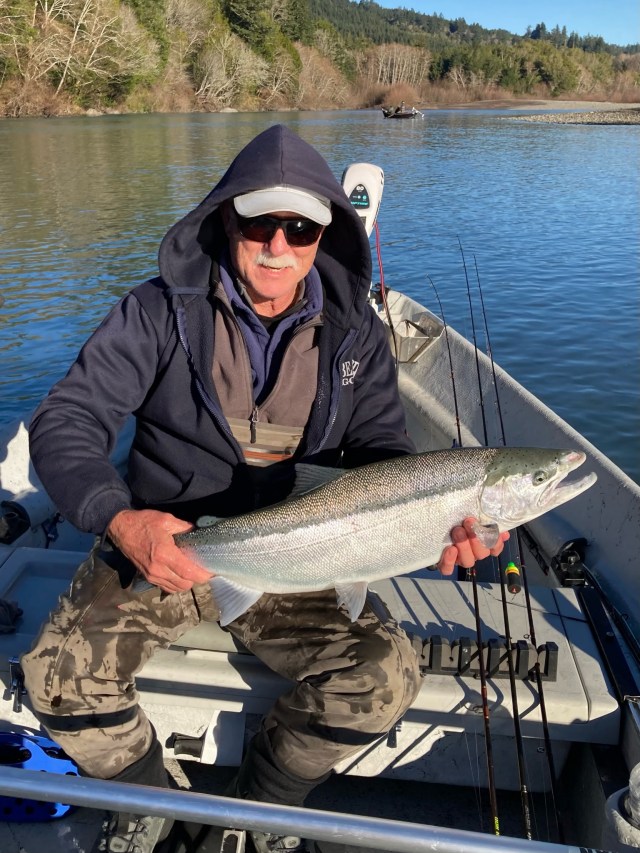
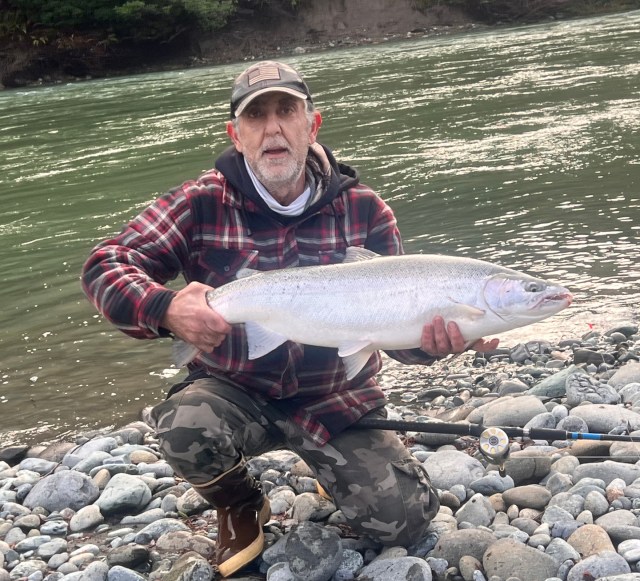
Eureka resident Tim Call landed a nice steelhead on a recent outing on the Klamath River. Photo courtesy of Alan Borges/Alan’s Guide Service

As soon as increased flows hit the lower Klamath, big schools of salmon and steelhead charged upriver. Fishing was excellent earlier in the week, and small pulses of fish should continue moving in over the next few weeks. Flows peaked at 4,172 cfs Wednesday and are now dropping but will remain high through the holiday weekend, around 3,100 cfs Saturday morning. Angling pressure has been light so far, but expect that to change as the holiday crowd arrives.

The daily bag limit is two hatchery steelhead or hatchery trout per day on both the Klamath and Trinity rivers, with a possession limit of four. Anglers must have a Steelhead Report/Restoration Card in their possession while fishing for steelhead trout in anadromous waters. Both the Klamath and Trinity rivers are closed to the take and possession of Chinook salmon. More information, can be found here.

Yurok gill net quota reached
On Monday, the Yurok Tribe announced that their fall personal subsistence gill net quota has been reached within the Yurok Reservation. Tribal fishery employees will continue to gill net for the 300 elder’s fish quota.

Weekend marine forecast
Conditions are looking excellent the next few days for those looking to hit the tuna grounds. Out 10 to 60 nautical miles, Friday’s forecast is calling for southeast winds up to 5 knots and waves out of the northwest 2 feet at seven seconds and south 2 feet at 16 seconds. Saturday is calling for north winds 5 to 10 knots and waves north 1 foot at 6 seconds and south 3 feet at 16 seconds. Sunday, winds will be out of the south 10 to 15 knots and waves north 3 feet at 5 seconds and northwest 2 feet at 10 seconds. These conditions can and will change by the weekend. For an up-to-date weather forecast, visit www.weather.gov/eureka or www.windy.com. You can also call the National Weather Service at 443-7062 or the office on Woodley Island at 443-6484.

Pikeminnow Fishing Derby ends Saturday
There are just a few days remaining to bring home some cash as the Eel River Pikeminnow Fishing Derby ends after Sunday, Aug. 31. Visit https://tribresearch.org/pikeminnow/ to learn more, sign up for the derby, and submit your catch to the contest before it ends.

Saturday is statewide Free Fishing Day
The last chance of the year to fish for free arrives over the Labor Day holiday weekend. Free Fishing Day is offered by the California Department of Fish and Wildlife Saturday, Aug. 30. While no fishing license is required on free fishing days, all fishing regulations, such as bag and size limits, gear restrictions, report card requirements, fishing hours and stream closures remain in effect. Every angler must have an appropriate report card if they are fishing for steelhead or sturgeon anywhere in the state or salmon in the Smith River system. For more information, visit wildlife.ca.gov/Licensing/Fishing/Free-Fishing-Days

Bay Area ocean salmon season reopens Sept. 4
The ocean sport salmon season will re-open on Sept. 4 in two Bay Area subareas.

  • Point Reyes to Pigeon Point (San Francisco Subarea):
    • September 4-7 & 29-30; October 1-5 & 27-31 – Minimum size limit: 20 inches total length. Two salmon of any species except coho
  • Pigeon Point to Point Sur (Monterey Subarea)
    • September 4-7 & 29-30 – Minimum size limit: 20 inches total length. Two salmon of any species except coho

Fall Harvest Guideline: 7,500 Chinook. In-season action may be taken to close remaining September – October days when the total harvest is approaching a statewide limit of 7,500 Chinook salmon. More information can be found here.

The oceans:
Eureka
Tuna anglers reported Thursday that the warm water is now at least 60 miles out of Eureka. They also reported the fishing wasn’t very good. Tim Klassen of Reel Steel Sport Fishing, along with many others were planning on heading out Friday, but plans are likely changing for some. “The weather looks excellent for Friday and Saturday, hopefully we get a good SST shot to see where the water is,” said Klassen. The Pacific halibut bite has been good when we can get out. Quite a few limits are being caught near the 55-line. Cape Mendocino has been producing some really good rock fishing, and it should be an easy ride down there the next few days.”

Shelter Cove
“Rock fishing remains solid, with limits coming every day,” said Jake Mitchell of Sea Hawk Sport Fishing. “Most of the effort this week was around the Old Man. Pacific halibut has been slow, although there were a couple caught this week. Boats will be trying for albacore the next couple days for the first time in a week. We haven’t had a good satellite shot in a week or so, we’re expecting to close to 50 miles out.”

Crescent City
According to Chris Hegnes of Crescent City’s Englund Marine, the fishing effort has slowed. He said, “There’s been a couple boats out for tuna, but the fishing hasn’t been. Most guys are headed north to Charleston. The rockfish and lingcod bite remain excellent, no change there. The California halibut bite has slowed down as well as the effort. There have been a couple Thresher sharks caught off of South Beach last few weeks.”

Brookings
“The best halibut fishing of the season is happening right now,” said Andy Martin of Brookings Fishing Charters. “Boats are focusing on 200 to 250 feet of water off of Bird Island. Combinations of squid and herring are working best. Lingcod and rockfish action also is good, while sport crabbing has improved in recent weeks.” 

Low Flow River Closures begin Sept. 1
North Coast rivers that are regulated by low flow closures, including the Eel, Mad, Mattole, Redwood Creek, Smith and Van Duzen begin angling restrictions on Sept. 1 and will run through April 30 2026. As a reminder, in 2022, a low-flow angling restriction was added to the section of the Eel River from the mouth to Fulmor Road (Eel estuary) at its paved junction with the south bank of the Eel River. When a low-flow closure occurs in this section of the Eel, it will be closed to hook-and-line fishing; other legal fishing methods are allowed during this timeframe.

The Department of Fish and Game will make the information available to the public by a telephone recorded message updated, as necessary, no later than 1 p.m. each Monday, Wednesday and Friday as to whether any stream will be closed to fishing. The rivers can be opened up at any time. The low flow closure hotline for North Coast rivers is 707-822-3164. NOTE: The main stem Eel from the South Fork to Cape Horn Dam and the Mattole River will be closed until January 1, 2026.

Areas subject to low flow closures:

Mad River: The main stem Mad River from the Hammond Trail Railroad Trestle to Cowan Creek. Minimum flow: 200 cfs at the gauging station at the Highway 299 bridge. The Mad River from the mouth to 200 yards upstream is closed until Jan. 1, 2026.

The main stem Eel River: New in 2022, a low-flow angling restriction was added to the section of the Eel River from the mouth to Fulmor Road at its paved junction with the south bank of the Eel River, Sept. 1 through April 30. The stream flow will be monitored as follows: Minimum Flow: 350 cubic feet per second at the gauging station near Scotia.

The South Fork of the Eel River: The South Fork of the Eel River downstream from Rattlesnake Creek and the Middle Fork Eel River downstream from the Bar Creek. Minimum flow: 340 cfs at the gauging station at Miranda.

Van Duzen River: The main stem Van Duzen River from its junction with the Eel River to the end of Golden Gate Drive near Bridgeville (approximately 4,000 feet upstream of Little Golden Gate Bridge. Minimum flow: 150 cfs at the gauging station near Grizzly Creek Redwoods State Park.

Mattole River: The main stem of the Mattole River from the mouth to Honeydew Creek. Minimum flow: 320 cfs at the gauging station at Petrolia.

Redwood Creek: The main stem of Redwood Creek from the mouth to its confluence with Bond Creek. Minimum flow: 300 cfs at the gauging station near the Highway 101 bridge.

Smith River: The main stem Smith River from the mouth of Rowdy Creek to its confluence with Patrick Creek; the South Fork Smith River from the mouth upstream approximately 1000 ft to the County Road (George Tyron) bridge and Craigs Creek to its confluence with Jones Creek; and the North Fork Smith River from the mouth to its confluence with Stony Creek. Minimum flow: 600 cfs at the Jedediah Smith State Park gauging station.

The Rivers
Lower Rogue/Chetco
According to Martin, the first kings of the season have been caught in the Chetco estuary. “Salmon to 25 pounds have been weighed in, along with numerous jacks. Bottom fish anglers are encountering salmon along the coast of Brookings, but the ocean is now closed to both kings and coho. The Rogue Bay has been fair, with lots of boats and a few good days each week. Labor Day Weekend is peak season on the Rogue Bay.”

Kenny Priest operates Fishing the North Coast, a fishing guide service out of Humboldt specializing in salmon and steelhead. Find it on Facebook, Instagram, YouTube and fishingthenorthcoast.com. For up-to-date fishing reports and North Coast river information, email kenny@fishingthenorthcoast.com.

Eureka Tuna Action Falls Short of Expectations

Robin Brown of Benbow shows off a nice albacore caught over the weekend while fishing out of Shelter Cove with Sea Hawk Sport Fishing. Photo courtesy of Jake Mitchell/Sea Hawk Sport Fishing.

Heading into last weekend, anticipation was sky-high for a wide-open tuna bite off Eureka. With flat seas and warm water in place, conditions looked perfect for an epic run. While the action didn’t quite live up to those lofty expectations, there were still some bright spots—and plenty of lessons learned for next time.

The best water was sitting southwest of Eureka near Cape Mendocino, roughly 30 miles from the entrance to Humboldt Bay. Many boats made the run and put in serious effort, but scores were generally modest. The crews that landed the most fish found success drifting live bait immediately after hooking up on the troll—a tactic you can expect to see more of on future trips.

Looking ahead, the next shot might take a little patience. Winds are forecasted through at least Tuesday, which will likely keep the fleet on shore for a few days. The good news? The warm water appears to be holding in place offshore. If that continues, round two could shape up by the middle of next week—and with a few adjustments, the bite could turn on in a big way.

Weekend marine forecast
After some really good conditions earlier in the week, the wind will make a return, sidelining the tuna fleet through the weekend and early next week. On Friday, within 10 nautical miles, winds will be out of the northwest 5 to 10 knots. Waves will be from the northwest 6 feet at seven seconds. Saturday is calling for northwest winds up to 5 knots and waves northwest 4 feet at seven seconds. Sunday’s forecast looks a little better, with winds out of the northwest 5 to 10 knots and waves northwest 3 feet at seven seconds. These conditions can and will change by the weekend. For an up-to-date weather forecast, visit www.weather.gov/eureka or www.windy.com. You can also call the National Weather Service at 443-7062 or the office on Woodley Island at 443-6484.

August 30 is statewide Free Fishing Day
The last chance of the year to fish for free arrives over the Labor Day holiday weekend. Free Fishing Day is offered by the California Department of Fish and Wildlife Saturday, Aug. 30. While no fishing license is required on free fishing days, all fishing regulations, such as bag and size limits, gear restrictions, report card requirements, fishing hours and stream closures remain in effect. Every angler must have an appropriate report card if they are fishing for steelhead or sturgeon anywhere in the state or salmon in the Smith River. For more information, visit wildlife.ca.gov/Licensing/Fishing/Free-Fishing-Days

Pacific halibut quota update
As of August 17, California’s share of Area 2A’s quota, which includes Washington and Oregon, is at 41 percent, with just 16,176 net pounds harvested against the 39,280 net pound quota. (500 pounds are set aside for the area south of Point Arena). The Pacific halibut fishery will run through Nov. 15 or until the quota is reached, whichever is earlier. To view the latest catch projection information, visit wildlife.ca.gov/conservation/marine/pacific-halibut#31670772-in-season-tracking.

Trinity River water release
Beginning Friday, Aug. 22, the Bureau of Reclamation will begin to increase flows to the Trinity River for the Hoopa Valley Tribe’s Ceremonial Boat Dance. Lewiston Dam releases are scheduled to gradually increase from the summer base flow of 450 cubic feet per second and are expected to reach a peak flow of 2,300 cfs on Aug. 25 before gradually returning to summer base flows later in the week.

River recreators can expect a higher volume of water and increased turbidity in the Trinity River during the ceremonial flow. As always, the public is urged to exercise caution when recreating in or around the Trinity River. For more information, contact Reclamation’s Northern California Area Office at 530-247-8500 (TTY 800-877-8339)

An angler aboard Eureka’s Fishy Business is all smiles after boating a couple Tuna Monday. Photo courtesy of Matt Dallam/Northwind Charters

The oceans:
Eureka
“The tuna bite never really exploded over the weekend, but there were some decent scores put up,” said Tim Klassen of Reel Steel Sport Fishing. “If I had to rate the fishing, I’d say it was a 5 out of 10. Some boats got 4 or 5, or less, with some of the top scores in the low twenties. The best bite was southwest of the entrance about 30 to 35 miles. The water was plenty warm, but there wasn’t much bait around. That might have had something to do with the slow bite. We had our best success on live bait stops, and I think that was the case for the other boats as well. Though there weren’t big numbers of fish, they were all really good size. They averaged 15 to 25 pounds with no peanuts in the mix.

The halibut got a little bit of a reprieve with a lot of boats focusing on tuna. The boats that did target halibut did well, with most putting in limits. We ran to the Cape last Friday chasing rockfish, and the bite was really good. Not a ton of variety but we did get limits of rockfish and lingcod. There’s some really big and healthy black rockfish down there now.”

Shelter Cove
The weather laid down for a tuna run on Monday and boats did ok reports Jake Mitchell of Sea Hawk Sport Fishing. He said, “Scores ranged from 5 to 30 fish for boats targeting tuna in the Gorda Valley area. Rock fishing remains solid, but the lingcod are really hit and miss lately.”

Crescent City
“The tuna fishing out of Crescent City has not taken off,” said Will Moore of Crescent City’s Englund Marine. “A few commercial boats went out and didn’t find anything until they got way north. Because of that, there hasn’t been much effort from the sport guys. The California halibut bite has slowed a little, but they’re still here. The same can’t be said for the Pacific Halibut. The rockfish and lingcod fishing continues to sizzle, with easy limits coming for anglers targeting the Sisters and the cans out front. Some really big vermilion are being caught.”

Brookings
“Ocean salmon season closes Sunday on the Southern Oregon Coast,” said Andy Martin of Brookings Fishing Charters. “Fishing has been slow, with a few hatchery coho still being caught and plenty of wild coho. Fishing is already closed for kings. Halibut action improved this week out of Brookings, with a few charters averaging a fish per rod, and two-fish limits some days. The best fishing has been in 250 to 300 feet. Herring and squid combinations are working best. Sport crabbing is good out of Brookings. Lingcod and rockfish also are biting well.”

The Rivers:
Lower Klamath
The river is in good shape as flows have dropped under 2,800 cfs as of Thursday. The water being released from Lewiston is forecast to reach the lower Klamath Sunday morning, raising the cfs’s to just over 3,000. This should bring in some fish from the ocean/estuary and we should see the first real good push of salmon moving upriver. Fishing for steelhead was decent last weekend, with boats hooking 3 to 6 fish a day. The daily bag limit is two hatchery steelhead or hatchery trout per day on both the Klamath and Trinity rivers, with a possession limit of four. Anglers must have a Steelhead Fishing Report and Restoration Card in their possession while fishing for steelhead trout in anadromous waters More information can be found here.

Lower Rogue/Chetco
According to Martin, the Rogue Bay has been fair, with good catches one day and then a couple of slow days. “Large kings to 40 pounds are being caught. The crowds have arrived, with well over 100 boats a day trolling the bay.”

Kenny Priest operates Fishing the North Coast, a fishing guide service out of Humboldt specializing in salmon and steelhead. Find it on Facebook, Instagram, YouTube and fishingthenorthcoast.com. For up-to-date fishing reports and North Coast river information, email kenny@fishingthenorthcoast.com.

California Fish and Game Commission Increases Fishing Opportunities for the 2025 Recreational Groundfish Season

All Depths could start as early as Sept. and run through Dec. 31

On August 14, 2025, the California Fish and Game Commission (Commission) adopted emergency changes to the state’s groundfish regulations so that recreational ocean fisheries are no longer constrained by quillback rockfish (Sebastes maliger). Fishing opportunities in northern and central California were reduced in 2023 due to low estimated quillback rockfish abundance. A new stock assessment completed earlier this summer indicates it is no longer necessary to restrict groundfish fishing to specific depths north of Point Conception in order to avoid quillback rockfish, allowing anglers to take advantage of expansions to open fishing areas. The Commission acted to rapidly change the regulations to allow additional opportunities before summer’s end.  

Over the last few years, the California Department of Fish and Wildlife (CDFW) collaborated with federal partners, fishing groups, and anglers to gather data and improve scientific knowledge of quillback rockfish off California. The information was crucial in informing the new stock assessment, which indicates the stock is at a healthy level and not overfished. This finding reverses results from a 2021 stock assessment which relied on very limited data from the California stock. Retention of quillback rockfish, however, remains prohibited in all waters statewide until recommendations for sport and commercial fishery catch limits are developed for California quillback rockfish in conjunction with those for other nearshore groundfish species. 

“This action is the result of hard work by a lot of people,” said Tim Klassen, an appointed advisory member for the groundfish sport fishery and a charter boat captain in Eureka. “The Commission and CDFW moved quickly to implement these changes and worked collaboratively with fishermen to achieve a result that protects our fisheries and the people that depend on them. This is what good fishery management looks like.” 

CDFW Director Charlton H. Bonham remarked, “CDFW is pleased with the new assessment, which reflects what California anglers have been seeing, and is committed to restoring fishing access as quickly as possible. We appreciate all our fishing industry partners who participated in scientific data collections that contributed to this positive outcome – it was a true collaboration.”   

With restored access to all-depth fishing for northern and central California, a sub-bag limit for canary rockfish (Sebastes pinniger) is necessary to keep catches within the federal California recreational harvest guideline for this species. Therefore, a new two fish sub-bag limit will apply for canary rockfish, statewide. Additionally, vermilion (Sebastes miniatus) and sunset rockfish (Sebastes crocotulus) will be managed together as a species complex, meaning that they are considered the same species for regulatory purposes (e.g., sub-bag limit) due to their nearly indistinguishable appearance. 

These changes are intended to roll back restrictions that were put into place to avoid quillback rockfish, which are very rarely seen south of Point Conception. Since fishing in the Southern Groundfish Management Area [(GMA) south of Point Conception, 34° 27’ N. Lat. to the US/Mexico border] is constrained by copper (Sebastes caurinus) and vermilion/sunset rockfish, there are no changes to the current fishing seasons in the Southern GMA. Groundfish fishing in the Southern GMA is currently open shoreward of the 50 fathom Rockfish Conservation Area boundary until September 30. The Map Viewer application can be used to view updated GMA boundaries and the 50 fathom Rockfish Conservation Area boundary. 

The following summary details the changes adopted by the Commission: 

  • Boat-Based Fishery Season Dates and Depths – North of Point Conception (34° 27’ N. Lat.; within the Northern, Mendocino, San Francisco, and Central GMAs), groundfish fishing will be authorized in all water depths through December 31, 2025.  
  • Species Retention – Nearshore, shelf, and slope rockfishes, lingcod, cabezon, and greenlings may be retained during the all-depth fishery.
    • Canary rockfish will have a new two fish sub-bag limit statewide. 
    • Quillback rockfish will remain prohibited (no retention) statewide. 
    • Vermilion and sunset rockfish in combination are limited to two fish south of 40° 10’ N. Lat. (near Cape Mendocino), and four fish between the OR/CA border and 40° 10’ N. Lat 
  • Management Line at Lopez Point Removed – The Central GMA will revert to a single management area. The split at Lopez Point (36° N. Lat.) between the Central – North and Central – South GMA is no longer needed. The Central GMA remains at the same northern and southern borders from 37° 11’ N. Lat. (Pigeon Point) to 34° 27’ N. Lat. (Point Conception). 

With all-depth fishing opportunity, anglers will experience greater flexibility on fishing trips when targeting species in addition to groundfish. Combination trips are no longer limited by depth constraints when targeting additional species or transiting between GMAs that do not have depth constraints. Note when transiting between GMAs it is still unlawful to exceed the bag limit of a GMA even if the fish are caught in another GMA (§27.20(b)(1)(A)(1). Meaning, anglers cannot catch four vermilion/sunset rockfish in the Northern GMA, then possess or land them in the Mendocino or another GMA with a two fish vermilion/sunset sub-bag limit. Similarly, anglers cannot take nearshore rockfish, cabezon, or greenling north of Point Conception and land them in the Southern GMA October through December when inshore fishing is closed.  

CDFW will notify the public when the new regulations take effect through the Marine Management News blog; please subscribe to receive the notification or check back regularly for the announcement confirming the new regulations are in effect. Anglers should review the Summary of Recreational Groundfish Regulations page for the most up-to-date information before going fishing. If anglers encounter a quillback rockfish, CDFW strongly encourages using a descending device to return it to depth. When fishing in ocean waters from a vessel a landing net is always required, and when fishing for or possessing groundfish, a descending device is required to be carried aboard. Questions? Contact Ask Marine

Weather Window Opens for Tuna

Livermore resident Michael Hollingshaus holds a pair of Albacore tuna caught last season while fishing with Jake Mitchell of Sea Hawk Sport Fishing. Tuna fishing out of the Cove has been excellent, and should only get better as ocean conditions improve this week. Photo courtesy of Sea Hawk Sport Fishing.

Halibut and rockfish can take a breather because tuna is about to steal the show this week. The weather window is wide open, and the ocean will be flat for the next few days. Warm water is within reach and still pushing in, and there should be plenty of fish riding with it.

The only catch? We haven’t had a good SST shot in the last few days thanks to cloud cover. But there’s plenty of real-time intel from boats and buoys. Buoy 13, sitting off Cape Mendocino about 36 miles from Humboldt Bay, was showing 60-degree water on Wednesday, though it’s cooled a bit since—definitely worth watching.

As for the bite, it’s already happening. Since Monday, boats out of Fort Bragg have been stacking tuna, with scores running 20 to 40 fish. Shelter Cove crews are seeing the same, or even better action. In short— you can catch as many as you can handle. Up north, one Trinidad boat ran 17 miles and found a few fish, and last week a few Eureka boats made the long run and did okay.

With calm seas and great weather lined up through at least Monday, now’s the time to fuel up and make a run. The tuna are here!

Weekend marine forecast
Nearshore conditions, out 10 nautical miles, look excellent for the weekend. But since most anglers will be further offshore, we’ll post conditions out 10 to 60 nautical miles. Friday’s forecast is calling for northwest winds 5 to 10 knots and northwest waves 4 feet at six seconds and southwest 3 feet at 14 seconds. Saturday is calling for northwest winds 5 to 10 knots and northwest waves 5 feet at 9 seconds and south 2 at 14. Sunday winds will be out of the north 5 to 10 knots and northwest waves 6 feet at 10 seconds and south 2 feet at 14 seconds. These conditions can and will change by the weekend. For an up-to-date weather forecast, visit www.weather.gov/eureka/ or www.windy.com. You can also call the National Weather Service at 443-7062 or the office on Woodley Island at 443-6484.

Trinity River water release
Beginning Friday, Aug. 22, the Bureau of Reclamation will begin to increase flows to the Trinity River for the Hoopa Valley Tribe’s Ceremonial Boat Dance. Lewiston Dam releases are scheduled to gradually increase from the summer base flow of 450 cubic feet per second and are expected to reach a peak flow of 2,300 cfs on Aug. 25 before gradually returning to summer base flows later in the week.

River recreators can expect a higher volume of water and increased turbidity in the Trinity River during the ceremonial flow. As always, the public is urged to exercise caution when recreating in or around the Trinity River. For more information, contact Reclamation’s Northern California Area Office at 530-247-8500 (TTY 800-877-8339)

California Fish and Game Commission increases fishing opportunities for the 2025 recreational groundfish season
On August 14, 2025, the California Fish and Game Commission (Commission) adopted emergency changes to the state’s groundfish regulations so that recreational ocean fisheries are no longer constrained by quillback rockfish.

CDFW Statement:

“Fishing opportunities in northern and central California were reduced in 2023 due to low estimated quillback rockfish abundance. A new stock assessment completed earlier this summer indicates it is no longer necessary to restrict groundfish fishing to specific depths north of Point Conception in order to avoid quillback rockfish, allowing anglers to take advantage of expansions to open fishing areas. The Commission acted to rapidly change the regulations to allow additional opportunities before summer’s end.  

Over the last few years, the California Department of Fish and Wildlife (CDFW) collaborated with federal partners, fishing groups, and anglers to gather data and improve scientific knowledge of quillback rockfish off California. The information was crucial in informing the new stock assessment, which indicates the stock is at a healthy level and not overfished. This finding reverses results from a 2021 stock assessment which relied on very limited data from the California stock. 

Retention of quillback rockfish, however, remains prohibited in all waters statewideuntil recommendations for sport and commercial fishery catch limits are developed for California quillback rockfish in conjunction with those for other nearshore groundfish species. 

“This action is the result of hard work by a lot of people,” said Tim Klassen, an appointed advisory member for the groundfish sport fishery and a charter boat captain in Eureka. “The Commission and CDFW moved quickly to implement these changes and worked collaboratively with fishermen to achieve a result that protects our fisheries and the people that depend on them. This is what good fishery management looks like.” 

CDFW Director Charlton H. Bonham remarked, “CDFW is pleased with the new assessment, which reflects what California anglers have been seeing, and is committed to restoring fishing access as quickly as possible. We appreciate all our fishing industry partners who participated in scientific data collections that contributed to this positive outcome – it was a true collaboration.”   

With restored access to all-depth fishing for northern and central California, a sub-bag limit for canary rockfish is necessary to keep catches within the federal California recreational harvest guideline for this species. Therefore, a new two fish sub-bag limit will apply for canary rockfish, statewide. Additionally, vermilion and sunset rockfish will be managed together as a species complex, meaning that they are considered the same species for regulatory purposes (e.g., sub-bag limit) due to their nearly indistinguishable appearance. 

These changes are intended to roll back restrictions that were put into place to avoid quillback rockfish, which are very rarely seen south of Point Conception. Since fishing in the Southern Groundfish Management Area [(GMA) south of Point Conception, 34° 27’ N. Lat. to the US/Mexico border] is constrained by copper and vermilion/sunset rockfish, there are no changes to the current fishing seasons in the Southern GMA. Groundfish fishing in the Southern GMA is currently open shoreward of the 50 fathom Rockfish Conservation Area boundary until September 30. The Map Viewer application can be used to view updated GMA boundaries and the 50 fathom Rockfish Conservation Area boundary. 

The following summary details the changes adopted by the Commission: 

  • Boat-Based Fishery Season Dates and Depths – North of Point Conception (34° 27’ N. Lat.; within the Northern, Mendocino, San Francisco, and Central GMAs), groundfish fishing will be authorized in all water depths through December 31, 2025.  
  • Species Retention – Nearshore, shelf, and slope rockfishes, lingcod, cabezon, and greenlings may be retained during the all-depth fishery.
    • Canary rockfish will have a new two fish sub-bag limit statewide. 
    • Quillback rockfish will remain prohibited (no retention) statewide. 
    • Vermilion and sunset rockfish in combination are limited to two fish south of 40° 10’ N. Lat. (near Cape Mendocino), and four fish between the OR/CA border and 40° 10’ N. Lat 
  • Management Line at Lopez Point Removed – The Central GMA will revert to a single management area. The split at Lopez Point (36° N. Lat.) between the Central – North and Central – South GMA is no longer needed. The Central GMA remains at the same northern and southern borders from 37° 11’ N. Lat. (Pigeon Point) to 34° 27’ N. Lat. (Point Conception). 

With all-depth fishing opportunity, anglers will experience greater flexibility on fishing trips when targeting species in addition to groundfish. Combination trips are no longer limited by depth constraints when targeting additional species or transiting between GMAs that do not have depth constraints. Note when transiting between GMAs it is still unlawful to exceed the bag limit of a GMA even if the fish are caught in another GMA (§27.20(b)(1)(A)(1). Meaning, anglers cannot catch four vermilion/sunset rockfish in the Northern GMA, then possess or land them in the Mendocino or another GMA with a two fish vermilion/sunset sub-bag limit. Similarly, anglers cannot take nearshore rockfish, cabezon, or greenling north of Point Conception and land them in the Southern GMA October through December when inshore fishing is closed.  

CDFW will notify the public when the new regulations take effect through the Marine Management News blog; please subscribe to receive the notification or check back regularly for the announcement confirming the new regulations are in effect. Anglers should review the Summary of Recreational Groundfish Regulations page for the most up-to-date information before going fishing. If anglers encounter a quillback rockfish, CDFW strongly encourages using a descending device to return it to depth. When fishing in ocean waters from a vessel a landing net is always required, and when fishing for or possessing groundfish, a descending device is required to be carried aboard. Questions? Contact Ask Marine.”

Oregon Coast rockfish bag limits may be reduced
“Beginning Monday, August 18, 2025, the General Marine Species bag limit will return to a 4-fish bag limit pending approval by the Oregon Fish and Wildlife Commission (OFWC) on Friday, August 15. The 1-fish sub-bag limit for cabezon and the 1-fish sub-bag limit for canary rockfish will remain in place, and retention of quillback and yelloweye rockfishes remains prohibited.

Harvest limits for both black rockfish and canary rockfish are projected to be exceeded if the bag limit remains at five fish. A bag limit reduction from five to four during the month of August decreases the risk of an early season closure or a three-fish bag limit.

Additional information on the recreational rock fish fishery can be found on the ODFW sport rockfish webpage.

The General Marine Species group is made up of all rockfish species, greenlings, cabezon, skates, and other marine species not listed on page 81 of the 2025 Oregon Sport Fishing Regulations Book. Sablefish have been pulled out of the General Marine Species group and have a species-specific bag limit of 10 fish per angler.”

The Oceans:
Eureka
According to Tim Klassen of Reel Steel Sport Fishing, the weather looks good for tuna starting Friday. “We haven’t got a real good SST shot, but it did look like the water was moving north towards us,” said Klassen. “Once we get a shot, we’ll be able to put together a plan. The rockfish bite at the Cape has been good, but the lingcod remain a little harder to come by. We’re still seeing a good variety of rockfish. The Pacific halibut bite is much improved, though effort has gone down. Most of the effort is near the 55 line.”

Shelter Cove
The rock fishing was a little bit tougher this week reports Jake Mitchell, of Sea Hawk Sport Fishing. “We had some heavy current, which I think shut down the bite a little bit,” said Mitchell. “We still managed to limit both days, but really had to work for them. The Pacific halibut was also pretty dead. A few boats ran out for tuna outside Gorda Valley and did pretty well with scores up to 70 fish.”

Crescent City
According to Will Moore of Crescent City’s Englund Marine, the California halibut bite is getting better each week. “Last week was really good, but this week we saw even more caught than last week,” said Moore. The Pacific halibut bite however, remains dead. The rockfish and lingcod bite are still excellent, with easy limits of both. And we’re seeing some big lings too. The redtail perch bite has been good at both Kellogg and Enderts Beach.

Brookings
Salmon fishing has been slow out of Brookings, where hatchery coho may be kept reports Andy Martin of Brookings Fishing Charters. “Kings must be released, and along with wild coho, have made up most of the salmon catch,” said Martin. “Hatchery coho are few and far between, as the bulk of the run is closing in on the Columbia River, where coho fishing is nearly wide open. 

Lingcod and rockfish action, along with sport crabbing, is good out of Brookings. With over weather expected this weekend, some boats may head offshore for tuna. Albacore fishing was a bust last week. A handful of boats headed out, and returned with just a couple of fish total, with most boats failing to find any tuna.”

The Rivers:
Lower Klamath
Steelhead fishing remains spotty on the Lower Klamath. The fish are still trickling in, with some days better than others. Fishing should only get better as we head into the first few weeks of August. The daily bag limit is two hatchery steelhead or hatchery trout per day on both the Klamath and Trinity rivers, with a possession limit of four. Anglers must have a Steelhead Fishing Report and Restoration Card in their possession while fishing for steelhead trout in anadromous waters. More information can be found here.

Lower Rogue
According to Martin, salmon fishing is now good on the Rogue Bay, with a fish per rod or better for most guide boats. “The bay is crowded. With better fishing, expect even more boats. Guides are getting fish with 360 flashers fished ahead of anchovies or small herring.”

Kenny Priest operates Fishing the North Coast, a fishing guide service out of Humboldt specializing in salmon and steelhead. Find it on Facebook, Instagram, YouTube and fishingthenorthcoast.com. For up-to-date fishing reports and North Coast river information, email kenny@fishingthenorthcoast.com.

Pacific Halibut Bite Hit and Miss

Shellby House of Arcata holds a 46-inch Pacific halibut caught out of Brookings in late July while jigging for lingcod. Photo courtesy of Marc Hazel

Around this same time the past few years, our Pacific halibut seasons were coming to a close as red-hot fishing made quick work of the quotas. Much like last year, the same cannot be said for 2025. Though we’ve had some pretty good flurries, the bite remains fairly inconsistent. Boats have been covering a lot of ground, searching from Trinidad south to the Eel River Canyon in looking for schools, but have to yet to locate any spots that will offer consistent fishing day after day. As of the end of July, our projected catch rate stood at 16,731 net pounds harvested against the 39,280 quota. But we know we’ve caught quite a few since the catch estimate was last updated.

Now, with the tuna water in clear view, anglers will shift their focus to the longfins giving the halibut a bit of a breather. This should set the stage for halibut, rockfish, and Dungeness crab combo trips come November.

Tuna update
A handful of boats made the run west out of Eureka on Tuesday and Wednesday looking for tuna. Scored ranged from a couple to mid-teens. The water is currently sitting at roughly 38 miles straight west of Eureka. After the wind blows through this weekend, early next week could be a possibility to head offshore again.

Weekend marine forecast
Breezy conditions are in the forecast for the next few days, but things look much better starting Monday. For coastal waters out 10 nautical miles, Friday’s forecast is calling for north winds 20 to 25 knots and north waves 8 feet at seven seconds and west 3 feet at 10 seconds. Saturday is calling for north winds 10 to 15 knots and waves out of the north 7 feet at seven seconds. Sunday looks better, with winds out of the west 5 to 10 knots and waves north 6 feet at eight seconds and northwest 3 feet at 13 seconds. These conditions can and will change by the weekend. For an up-to-date weather forecast, visit www.weather.gov/eureka/ or www.windy.com. You can also call the National Weather Service at 443-7062 or the office on Woodley Island at 443-6484.

The Oceans:
Eureka
According to Tim Klassen of Reel Steel Sport Fishing, the Pacific halibut bite is still decent, but not red hot. “You really need to grind on them,” said Klassen. “There are some limits coming, but it’s not every day. If you land on a good spot, you’ll do well. Boats have mostly been fishing between the 51 and 55-lines. The rockfish bite at the Cape wasn’t great the last couple days, mostly due to the wonky current. We caught lots of black rockfish, but the lings and other varieties were tougher to come by. The fish are there, just need better conditions. The tuna water is sitting about 41 miles off of Eureka, so we may get an opportunity early next week when the ocean lays down.”

Shelter Cove
Not much has changed at the Cove reports Jake Mitchell of Sea Hawk Sport Fishing. He said, “Rock fishing remains solid with the lingcod being hit and miss. The weather hasn’t allowed to get back to the halibut grounds this week. Most rock fishing effort was around the whistle buoy. It’s looking like we may get a shot at tuna Monday and Tuesday.”

Crescent City
The California halibut bite really turned on this week reports Will Moore of Crescent City’s Englund Marine. “I’ve seen close to 20 caught myself,” said Moore. “Boats trolling South Beach are doing well along with anglers fishing off the rock wall across from the launch. The Pacific halibut bite is not really happening. The rockfish and lingcod bite are still on fire, with limits coming pretty easily The Sisters and right out front at the cans have both been very productive. One boat went out for tuna on Wednesday and got one at 30 miles. We should get some better opportunities in the coming week.”

Brookings
“Fishing remains open for hatchery coho salmon, but action has been slow, as the bulk of the run has migrated north, headed back to the Columbia River,” said Andy Martin of Brookings Fishing Charters. “Fishing for coho has picked up considerably out of Coos Bay, Winchester Bay and Newport as the run moves north. King fishing is closed, but they are around in good numbers, and anglers continue to encounter them while bottom fishing. Halibut action is good at times out of Brookings, but large numbers of small black cod have made soaking baits difficult. Lingcod and rockfish action is good, along with sport crabbing.”

The Rivers:
Lower Klamath
Steelhead fishing is hit and miss on the Lower Klamath. The fish seem to be trickling in, offering decent fishing one day and very slow the next. Fishing should only get better as we head into the first few weeks of August. The daily bag limit is two hatchery steelhead or hatchery trout per day on both the Klamath and Trinity rivers, with a possession limit of four. Anglers must have a Steelhead Fishing Report and Restoration Card in their possession while fishing for steelhead trout in anadromous waters. More information can be found here.

Lower Rogue
According to Martin, the Rogue Bay has improved, but is fair at best. “Some boats are catching a few fish a day, while many are returning without fish. New kings are arriving daily, and can be seen splashing and rolling along the jetties.”

Ken Wood of the Bay Area holds a king salmon caught trolling the Rogue Bay with guide Rye Phillips of Brookings Fishing Charters.

Kenny Priest operates Fishing the North Coast, a fishing guide service out of Humboldt specializing in salmon and steelhead. Find it on Facebook, Instagram, YouTube and fishingthenorthcoast.com. For up-to-date fishing reports and North Coast river information, email kenny@fishingthenorthcoast.com.

Halibut Anglers Have Plenty of Quota to Fill

Dave Brazil, along with buddies Jim Collins and Larry Kryla, landed this monster halibut while fishing out of Eureka on July 9. The big halibut is currently sitting atop the leader board at Englund Marine big halibut contest. Photo courtesy of Larry Kryla

Though we’ve had some spectacular ocean conditions the last several days, it’s been a fairly breezy summer. Which is by no means out of the ordinary. The one upside of a summer full of windy, non-fishable weather – a Pacific halibut quota that still has plenty of poundage left to fill. Maybe the catch-rates have been too low that CDFW didn’t feel the need to update the in-season tracking “Thermometer.” Whatever the reason, CDFW finally posted last week the first catch estimate since the season started back on May 1. As of July 31, California’s share of Area 2A’s quota, which includes Washington and Oregon, is at 26 percent, with only 10,122 net pounds harvested against the 39,280 quota. (500 pounds are set aside for the area south of Point Arena). There’s a real good chance the quota will last through the summer and into fall, especially if the warm tuna water comes within reach.

The Pacific halibut season will be open until Nov. 15 or until the quota is reached, whichever is earlier. To monitor the in-season tracking, visit https://wildlife.ca.gov/Conservation/Marine/Pacific-Halibut#31670772-in-season-tracking. The daily bag and possession limit for Pacific halibut is one fish. There is no minimum size limit.
When angling, no more than one line with two hooks attached may be used. A harpoon, gaff, or net may be used to assist in taking a Pacific halibut that has been legally caught by angling.

Weekend Marine Forecast
After a pretty good stretch of calm seas, the breeze is returning to the North Coast. Although the winds won’t be strong, it will make for some choppy seas. Out 10 nautical miles, Friday’s forecast is calling for north winds 5 to 10 knots and waves north 4 feet at five seconds. Saturday, the winds will be from the northwest 5 to 10 knots with north waves 3 feet at five seconds. Sunday’s forecast looks to be a repeat of Saturday. These conditions can and will change by the weekend. For an up-to-date weather forecast, visit www.weather.gov/eureka/ or www.windy.com. You can also call the National Weather Service at 443-7062 or the office on Woodley Island at 443-6484.

Razor Clam fishery opens back up in Del Norte
In a press release issued Wednesday, July 30, the California Department of Fish and Wildlife (CDFW) has re-opened the recreational razor clam fishery in Del Norte County following a recommendation from state health agencies that domoic acid no longer poses a significant threat.

Statement from CDFW:

“The razor clam fishery was closed in Del Norte County due to elevated levels of domoic acid in November 2023. State health agencies have continued to monitor domoic acid levels in razor clams since the closure, but test results consistently showed elevated levels, exceeding the federal action level (≥20 parts per million (ppm)). Clams collected in June and July 2025 from Crescent Beach, Del Norte County all had domoic acid concentrations lower than the federal action level, allowing the fishery to reopen.

DFW reminds clammers that the daily bag limit for razor clams is 20 and the first 20 clams dug must be retained regardless of size or condition. The fishery in odd-numbered years is open north of Battery Point, Crescent City in Del Norte County. Each person is required to keep a separate container for their clams and is not allowed to commingle their take with another person when digging and transporting clams to shore.”

Sport Crab season comes to a close
The 2025 sport Dungeness crab season in Humboldt, Mendocino and Del Norte counties is closed as of Wednesday, July 30. The season is expected to reopen Nov. 1.

Junior Angler fishing program coming this Sunday
The Redwood National and State Parks, along with California Fish and Wildlife experts will be hosting a Junior Angler Fishing Program this Sunday, Aug. 3. The event, which runs from 8:00 a.m. until 10:00 a.m. will be held at Freshwater Beach with anglers meeting at the Thomas H. Kuchel Visitor Center. Address is 119441 Highway 101 N. in Orick. This is a free event and fishing equipment will be provided. Participants 16 years and older are required to have a fishing license. For more information, call 707-951-5388.

The Oceans:
Eureka
We’ve had a good stretch of weather, but the Pacific halibut bite hasn’t been red hot out of Eureka reports Tim Klassen of Reel Steel Sport Fishing. “There’s been days where some boats limited out, but it wasn’t every day,” said Klassen. “There’s been an early morning bite, then it’s been really slow until the afternoon. I don’t think there’s big concentrations of fish. You’ll fish a spot and do really well one day and the next day it’s dried up. They’ve been caught from Trinidad all the way to Blunt’s reef, so they seem really spread out. We’re also starting to see some fish caught in closer now, around 240 feet. So, they may be moving in. The rockfish bite at the Cape has been really good. The variety of fish has been excellent with lots of blacks, and blues in shallow and plenty of canaries and vermillion out deeper. Looks like we’re going to be dealing with choppy conditions the next few days, which isn’t good for the chance at tuna. The water has been sitting about 46 miles out for a few days now.”

Shelter Cove
“Rock fishing remains very good and were still getting limits of ling cod most days as well,” said Jake Mitchell of Sea Hawk Sport Fishing. “The Pacific halibut bite slowed down a little this week, but the weather wasn’t that great. Most rock fishing effort was in tight right out front.”

Crescent City
The rockfish bite is still wide-open reports Chris Hegnes of Crescent City’s Englund Marine. “Boats going down to the Sisters or north to the lighthouse are finding easy limits of rockfish,” said Hegnes. “The lingcod bite has been really good too. A half-dozen Pacific halibut were caught this week, including a 65-pounder. The California halibut bite has slowed down.”

Brookings
Ocean coho fishing has been slow out of Brookings, but a few hatchery silvers are being caught reports Andy Martin of Brookings Fishing Charters. “The bulk of the coho have now migrated north off of Coos Bay and Winchester Bay,” said Martin. “A few keepers are being caught near Mack Arch in 300 feet of water, near the surface. Halibut fishing has been good at times off of Brookings, but large schools of small black cod have slowed catch rates, and made it difficult to fish baits without getting hooks picked clean soon after reaching the bottom. Lingcod and rockfish action has been good, while sport crabbing also is good out of Brookings.”

Lower Rogue
According to Martin, the Rogue Bay slowed in recent days, with fish seen splashing and rolling, but overall catch rates slow for late July. “Hot weather inland has kept salmon schooled up in the bay. Anglers are now awaiting a fresh wave of fish.”

Kenny Priest operates Fishing the North Coast, a fishing guide service out of Humboldt specializing in salmon and steelhead. Find it on Facebook, Instagram, YouTube and fishingthenorthcoast.com. For up-to-date fishing reports and North Coast river information, email kenny@fishingthenorthcoast.com.