All-Depth Groundfish Fishing Now Open Statewide

Fresno resident Jerry Urzua landed a nice lingcod on a recent trip out of Shelter Cove. Lingcod, as well as rockfish, cabezon, greenlings can now be harvested at all depths through Dec. 31st. Photo courtesy of Jake Mitchell/Sea Hawk Sport Fishing

Just in time for the ever-popular crab/rockfish/halibut combo trips starting in November, NOAA Fisheries announced on Sept. 18 that in state and federal waters between the Oregon/California border and Point Conception (34° 27′ N. Lat.), anglers may now take the RCG Complex (rockfish, cabezon, greenlings) and lingcod at all depths through December 31, 2025.

New scientific data show stronger-than-expected numbers of quillback rockfish off California, prompting the California Fish and Game Commission to take emergency action on August 28 to reopen access in state waters. NOAA Fisheries / NMFS matched those changes in federal waters effective Sept. 18, 2025.

Key changes for recreational anglers:

  • Two-fish sub-bag limit on canary rockfish statewide.
  • Vermilion and sunset rockfish combined: both species count toward the same sub-bag limit.
  • Prohibited species remain closed: no retention of quillback rockfish, bronzespotted rockfish, cowcod, or yelloweye rockfish.
  • Management area realignment: the Lopez Point boundary has been removed, creating the new Central Groundfish Management Area from 37° 11′ N. (Pigeon Point) to 34° 27′ N. (Point Conception).
  • Descending devices required: all vessels taking or possessing federal groundfish must carry one to minimize barotrauma and safely return fish to depth.

For the most up-to-date regulations, visit wildlife.ca.gov/Fishing/Ocean/Regulations/Groundfish-Summary.

Weekend marine forecast
Some rough ocean conditions are on tap for the next several days. As of Thursday, the forecast out 10 nautical miles for Friday is calling for winds out of the north 20 to 25 knots with northwest waves 9 feet at nine seconds. Saturday is calling for winds from the northwest 5 to 10 knots and northwest waves 9 feet at 15 seconds. Sunday the winds will be out of the south 5 to 10 knots and northwest waves 7 feet at 12 seconds. These conditions can and will change by the weekend. For an up-to-date weather forecast, visit www.weather.gov/eureka/ or www.windy.com. You can also call the National Weather Service at 443-7062 or the office on Woodley Island at 443-6484.

Ruth Lake Fall Bass tournament coming Oct. 4
The Alderpoint Volunteer Fire Department is hosting the Fallen Fire Fighters Memorial Bass Tournament on Saturday October 4th at Ruth Lake. Check in is Friday night between 4:30 p.m. and 6:30 p.m. at Ruth Lake Marina or at Journey’s End between 6:30 p.m. and 8:30 p.m. This is a catch and release tournament with a 13-inch minimum length. Blast off is 6 a.m. or at first safe light. For more information, call Thomas Bruce at 707-223-6258 or Roger Coleman Jr. at 707-223-3858.

CDPH lifts warning for sport-harvested Del Norte County Bivalve Shellfish
The California Department of Public Health (CDPH) has lifted the shellfish safety notifications today related to sport-harvested bivalve shellfish from Del Norte County.

CDPH Statement:

“The safety notification for Del Norte County was issued on July 3, 2025, due to dangerous levels of paralytic shellfish poisoning toxins in mussels. These naturally occurring toxins can cause illness or death in humans. Recent testing shows paralytic shellfish poisoning toxins have decreased to safe levels in mussels in this area. 

While this warning has been lifted, the annual mussel quarantine remains in effect, which means that while scallops, clams, and oysters can be harvested from Del Norte County, mussels remain under quarantine. The annual quarantine prohibits the sport-harvest of mussels for human consumption and applies to all species of mussels harvested along the California coast, as well as all bays and estuaries, and will continue through at least October 31. 

safety notification issued September 9, 2025, for sport-harvested mussels, scallops, clams, and oysters from Humboldt County remains in effect due to the presence of domoic acid in mussels. 

This warning does not apply to commercially sold mussels, clams, scallops, or oysters from approved sources. State law permits only state-certified commercial shellfish harvesters or dealers to sell these products. Shellfish sold by certified harvesters and dealers are subject to frequent mandatory testing to monitor for toxins

Paralytic shellfish poisoning toxins affect the nervous system, producing a tingling around the mouth and fingertips within a few minutes to a few hours after eating toxic shellfish. These symptoms are typically followed by loss of balance, lack of muscular coordination, slurred speech and difficulty swallowing. In severe poisonings, complete muscular paralysis and death from asphyxiation can occur.”

You can get the most current information on shellfish advisories and quarantines by calling CDPH’s toll-free Shellfish Information Line at (800) 553-4133 or viewing the recreational bivalve shellfish advisory interactive map. For additional information, please visit the CDPH Marine Biotoxin Monitoring web page. ​​​

The Oceans:
Eureka
It’s been a fairly quiet week for the Eureka fleet since last Saturday’s tuna run. A handful of boats made a 55-mile run south and after several hours of nothing, the bite turned on. One of the local charters boated 24 albies, all between 15 and 25 pounds. It doesn’t look like we’ll see another opportunity for quite a few days. Pacific halibut are still being caught north of the entrance near the 51 line, but the effort has slowed. Weather permitting, the rockfish bite at the Cape is still good.

Tim Klassen of Reel Steel Sport Fishing submitted a proposal at the recent PFMC meeting to open up the Pacific halibut season in April instead of May. According to Klassen, the proposal was approved, and will be voted on at the Nov. Pacific Fishery Management Council (PFMC) meeting. It would then need approval by International Pacific Halibut Commission.

Shelter Cove
According to Jake Mitchell of Sea Hawk Sport Fishing, rock fishing has been excellent with quick limits of rockfish and lingcod every day this week. “Most of the effort was at the Hat,” said Mitchell. “Pacific halibut remains slow and there was a one-day tuna window on Saturday, but the boats that went did not do very well.”

Crescent City
“Not much has changed since last week, the weather hasn’t been great and not many boats are getting out,” said Will Moore of Crescent City’s Englund Marine. “When the boats do get out, the rockfish and lingcod bite is still really good. We haven’t seen the bite slow down at all. Both the California and Pacific halibut effort has dwindled to nothing.”

Brookings
According to Andy Martin of Brookings Fishing Charters, the Pacific halibut fishing is fair out of Brookings. He said, “Winds subside this weekend, but bigger swells could stall the action. Rockfish action is good, with plenty of lingcod in the mix. Sport crabbing remains very good.”

ODFW Hosting Public Meetings on 2026 Bottomfish and Halibut Seasons
The Oregon Department of Fish and Wildlife will hold a series of in-person meetings Oct. 6–8 to discuss the 2026 recreational bottomfish and Pacific halibut seasons with anglers. The Oct. 8 meeting in Newport will also offer a virtual option via Microsoft Teams.

Meeting Schedule:

  • Oct. 6 – Brookings: 5:30–7:30 p.m., Port Meeting Room, Port of Brookings, 16330 Lower Harbor Rd.
  • Oct. 7 – North Bend: 6–8 p.m., North Bend Public Library, 1800 Sherman Ave.
  • Oct. 8 – Newport: 6–8 p.m., Hatfield Marine Science Center, Gladys Valley Marine Studies Building, Classroom 176, 2030 SE Marine Science Dr. (Virtual option available)

Topics for Discussion

  • Review of 2025 bottomfish harvest with lower guidelines and stricter bag limits for black rockfish and canary rockfish.
  • Pros and cons of a year-round fishery vs. a four-fish daily marine species limit with a one-fish sub-bag limit for canary rockfish.
  • Pacific halibut proposals including:
    • Restructuring the Columbia River subarea nearshore fishery.
    • “Frontloading” the Central Oregon Coast quota to the spring all-depth fishery for added flexibility.

ODFW will post meeting materials on its recreational bottomfish and Pacific halibut webpages by Friday, Oct. 3. More information can be found here.

Low flow river closures in effect since Sept. 1
As Sept. 1, All North Coast rivers subjected to low flow fishing closures, including the Eel, Mad, Redwood Creek, Smith, and Van Duzen were closed to fishing. The Department of Fish and Game will make the information available to the public by a telephone recorded message updated, as necessary, no later than 1 p.m. each Monday, Wednesday and Friday as to whether any stream will be closed to fishing. The rivers can be opened up at any time. The low flow closure hotline for North Coast rivers is 707-822-3164. You can also find river openings and closures online at https://wildlife.ca.gov/Fishing/Inland/Low-Flow/North-Coast.
NOTE: The main stem Eel from the South Fork to Cape Horn Dam, the Mad River from the mouth to 200 yards upstream and the Mattole River will be closed until January 1, 2026.

The Rivers:
Lower Klamath
The fishing slowed dramatically this week on the lower Klamath, with the bulk of the run now upriver. The mouth also has been sanding over, which has slowed the numbers of fish making their way in. With some rain in the forecast, the mouth should open back up and we should we some fresh fish enter the system. To date, there hasn’t been much, if any, coho in the river, which typically means the king run is nearing the end.
The daily bag limit is two hatchery steelhead or hatchery trout per day on both the Klamath and Trinity rivers, with a possession limit of four. Anglers must have a Steelhead Report/Restoration Card in their possession while fishing for steelhead trout in anadromous waters. Both the Klamath and Trinity rivers are closed to the take and possession of Chinook salmon. More information, can be found here.

Chetco/Lower Rogue
Salmon fishing is fair on the Chetco, with a handful of nice adults and numerous jacks being caught daily by boaters trolling along the jetties reports Martin. “The estuary has been crowded. Still too early for bobber fishing upriver. 
Salmon also are still being caught on the Rogue Bay, with a mix of wild and hatchery kings, lots of wild coho and a few hatchery coho. Crowds have thinned, but there is still plenty of boat activity. Summer steelhead are beginning to show upriver near Agness.”

Kenny Priest operates Fishing the North Coast, a fishing guide service out of Humboldt specializing in salmon and steelhead. Find it on Facebook, Instagram, YouTube and fishingthenorthcoast.com. For up-to-date fishing reports and North Coast river information, email kenny@fishingthenorthcoast.com.
Estuary Action Heating Up for Chetco Salmon

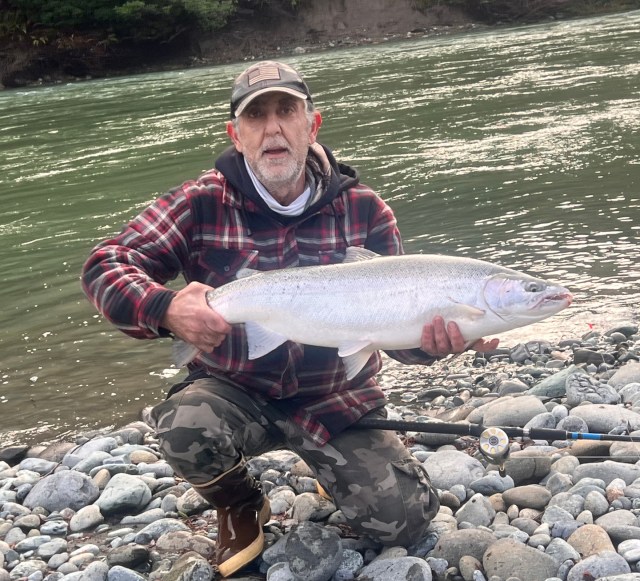
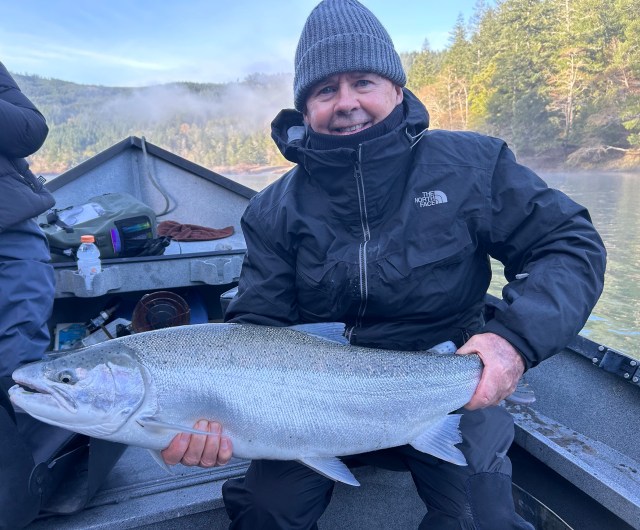
Mike Phillips holds a Chetco River king salmon caught Wednesday with guide Rye Phillips of Brookings Fishing Charters. Photo courtesy of Brookings Fishing Charters

If you’ve been missing the taste of ocean-fresh salmon, keep your eyes on the Chetco River estuary. Salmon have been staging in the tidewater since early September, waiting for enough rain to push upriver. According to Andy Martin of Wild Rivers Fishing, action is improving. “Salmon action has improved in the Chetco River estuary, with a mix of hatchery and wild adults and jacks,” Martin said. “The second half of the incoming tide has been best, with most fish caught near the tips of the jetties. Anchovies fished behind 360 flashers are working best.” Heavy boat traffic is already present, and more anglers from the Rogue are expected soon.

Regulations

  • Daily bag limit: two adult salmon, no more than one adult wild Chinook.
  • Anglers may harvest adult hatchery Chinook until reaching the daily limit; after that, jack salmon fishing must stop.
  • From RM 2.2 to Nook Creek (Sep. 1–Nov. 3): angling restricted to fly fishing (must include a strike indicator) or bobber fishing only.
  • Full rules at eregulations.com/oregon/fishing/southwest-zone.

Weekend marine forecast
Ocean conditions are looking like they could be tuna worthy starting Saturday. As of Thursday, out 10 to 60 nautical miles, Friday’s forecast is calling for winds out of the north 20 to 25 knots with north waves 11 feet at 10 seconds. Saturday, winds will be out of the north 10 to 15 knots with north waves 4 feet at five seconds and northwest 5 feet at 13 seconds. Sunday looks similar, with winds coming from the north 5 to 10 knots and north waves 3 feet at five seconds and northwest 5 feet at 12 seconds. These conditions can and will change by the weekend. For an up-to-date weather forecast, visit www.weather.gov/eureka/ or www.windy.com. You can also call the National Weather Service at 443-7062 or the office on Woodley Island at 443-6484.

Fall ocean salmon quota met – remaining 2025 dates canceled
The CDFW issued a press release Wednesday, Sept. 17 regarding the ocean salmon fishery and the fall harvest quota. The inseason action in the recreational salmon fishery South of Cape Falcon is as follows:

  • Effective September 29, 2025, at 12:01 a.m., the recreational ocean salmon fishery between Point Reyes and Pigeon Point, previously scheduled for September 29-30, October 1-5, and October 27-31 is closed.
  • Effective September 29, 2025, at 12:01 a.m., the recreational ocean salmon fishery between Pigeon Point and Point Sur, previously scheduled for September 29-30 is closed.

CDFW Statement:

Capitalizing on good weather and even better fishing, the 7,500 Chinook fall harvest guideline was reached during the Sept. 4-7 recreational ocean salmon fishery. The California Department of Fish and Wildlife (CDFW) estimates that 12,000 Chinook salmon were taken by 12,400 anglers in the brief fall season between Pt. Reyes and Pt. Sur. The National Marine Fisheries Service took in-season action on Sept. 17 to close the remaining 2025 fall dates of Sept 29-30, October 1-5, and October 27-31. 

The use of harvest guidelines and in-season management in California’s ocean salmon sport fishery management is new this year. The guidelines were developed as part of the Pacific Fishery Management Council’s pre-season process using catch and effort information from prior years along with expected performance this year. The guidelines serve to ensure that impacts from the fishery to stocks of particular concern – Klamath River fall Chinook and Central Valley Spring and Sacramento River Winter Chinook – are minimized. In-season monitoring to actively manage commercial and recreational ocean salmon fisheries to align with pre-season harvest forecasts is also identified as a priority action item in the California Salmon Strategy for a Hotter Drier Future

 During the Sept. 4-7 fall season, docks and launch ramps were bustling with activity as many anglers were eager to get back out on the water and fish for salmon after a spectacular 2-day summer season in June. CDFW met boat captains and anglers on the docks to collect fishery and biological data used to create catch estimates, abundance forecasts, and stock-specific information on the catch. CDFW continues to appreciate the cooperation of anglers during these surveys. 

For more information on ocean salmon fishing regulations, please visit CDFW’s website at https://wildlife.ca.gov/Fishing/Ocean/Regulations/Salmon or call the Ocean Salmon Hotline at 707-576-3429.

For information on the preseason management process and how to get involved, visit CDFW’s preseason page at https://wildlife.ca.gov/Fishing/Ocean/Regulations/Salmon/Preseason.  

Oregon Coast rockfish bag limits reduced
In a press release issued on Sept. 16 by the Oregon Dept. of Fish and Wildlife, the General Marine Species daily bag limit is reduced from four to three fish beginning Sept. 18 to lower the risk of an early season closure.

ODFW Statement:

“The one-fish sub-bag limit for cabezon and the one-fish sub-bag limit for canary rockfish remain in place, and retention of quillback and yelloweye rockfishes remains prohibited.

Great weather and ocean conditions since mid-July led to high fishing effort and success. In August, an estimated 53 metric tons (mt) of black rockfish and 8.5 mt of blue and deacon rockfish were caught, exceeding projections for the month despite the bag limit returning to a four-fish bag on Aug. 18. A bag limit reduction from four to three fish on Sept. 18 will reduce the risk of an early season closure.

More information on the recreational bottomfish fishery can be found on the ODFW sport bottomfish webpage. The sport groundfish harvest estimates are available online.

As a reminder, other bag limits remain the same, which include:

• Lingcod daily bag limit: 2

• Sablefish daily bag limit: 10

• Flatfish daily bag limit: 25

• Long-leader daily bag limit: 10, with a sub-bag limit of 1 canary rockfish.

Additionally, Pacific halibut fishing remains open. Visit the ODFW sport Pacific halibut webpage for more information on seasons and subareas.”

The Oceans:
Eureka
According to Tim Klassen of Reel Steel Sport Fishing, tuna fishing over the weekend was fair, with some boats doing well and others catching a few. “It sounded like the boats that fished further south found quite a few more fish,” said Klassen. “As has been the case all season, the fish are all good size, with some 30-pounders in the mix. Tuna was an option again on Tuesday, but I didn’t hear of any reports. It sounds like the Pacific halibut bite may have picked up a little. There were some fish caught around the 51 line over the weekend. Looking ahead, this coming weekend is shaping up to be another opportunity at tuna.”

Shelter Cove
“The rock fishing remains solid, with easy limits most days,” said Jake Mitchell of Sea Hawk Sport Fishing. “We’ve been able to spread our effort out from Rodgers Break down to the Hat. There was a little break in the weather Tuesday and some boats ran for tuna but scores were very dismal. A few boats also tried for halibut Tuesday but there were none caught.”

Crescent City
“We didn’t have great weather this week, so there wasn’t much going on,” said Will Moore of Crescent City’s Englund Marine. “The effort has also slowed down on all fronts. When the boats can get out, the rockfish bite is still really good. It hasn’t slowed down at all. The California halibut has slowed, but I don’t think many are trying for them anymore.”

Brookings
“Lingcod, rockfish and halibut action is good out of Brookings,” said Andy Martin of Brookings Fishing Charters. “Sport crabbing also is good. The daily rockfish limit dropped to three fish beginning Thursday.”

Low flow river closures in effect since Sept. 1
As Sept. 1, All North Coast rivers subjected to low flow fishing closures, including the Eel, Mad, Redwood Creek, Smith, and Van Duzen were closed to fishing. The Department of Fish and Game will make the information available to the public by a telephone recorded message updated, as necessary, no later than 1 p.m. each Monday, Wednesday and Friday as to whether any stream will be closed to fishing. The rivers can be opened up at any time. The low flow closure hotline for North Coast rivers is 707-822-3164. You can also find river openings and closures online at https://wildlife.ca.gov/Fishing/Inland/Low-Flow/North-Coast.

NOTE: The main stem Eel from the South Fork to Cape Horn Dam, the Mad River from the mouth to 200 yards upstream and the Mattole River will be closed until January 1, 2026.

The Rivers:
Lower Klamath
Fresh steelhead and salmon continue to make their way into the lower Klamath. Fishing has been excellent from the Glen all the way past Blue Creek where boats are finding a good mix of jacks, adult kings, and adult steelhead. Fishing pressure has been light.

The daily bag limit is two hatchery steelhead or hatchery trout per day on both the Klamath and Trinity rivers, with a possession limit of four. Anglers must have a Steelhead Report/Restoration Card in their possession while fishing for steelhead trout in anadromous waters. Both the Klamath and Trinity rivers are open to fishing, but take and possession of Chinook salmon is prohibited. More information, can be found here.

Lower Rogue
According to Martin, the Rogue Bay saw a jump in catch rates after the weekend rain, with hatchery and wild coho and lots of kings moving through the bay. “Action has improved near Grants Pass, and fish that had been held up in the bay bolted upstream.”  

Kenny Priest operates Fishing the North Coast, a fishing guide service out of Humboldt specializing in salmon and steelhead. Find it on Facebook, Instagram, YouTube and fishingthenorthcoast.com. For up-to-date fishing reports and North Coast river information, email kenny@fishingthenorthcoast.com.