Low-Flow River Information for the North Coast – 2024/2025


Low Flow River Closures begin Sept. 1 and run through April 30, 2025.
North Coast rivers that are regulated by low flow closures, including the Eel River, Mad River, Mattole River, Redwood Creek, Smith River and Van Duzen River will begin angling restrictions on September 1st, and run through April 30th 2025. . As a reminder, in 2022, a low-flow angling restriction was added to the section of the Eel River from the mouth to Fulmor Road (Eel estuary) at its paved junction with the south bank of the Eel River. When a low-flow closure occurs in this section of the Eel, it will be closed to hook-and-line fishing; other legal fishing methods are allowed during this timeframe. The Department of Fish and Game will make the information available to the public by a telephone recorded message updated, as necessary, no later than 1 p.m. each Monday, Wednesday and Friday as to whether any stream will be closed to fishing. The rivers can be opened up at anytime. Rivers will not automatically open to fishing once minimum flows are reached. The low flow closure hotline for North Coast rivers is (707) 822-3164. NOTE: The main stem Eel from the South Fork to Cape Horn Dam and the Mattole River will be closed until January 1, 2025.

Section of river that is open to fishing is the main stem Smith River from the mouth of Rowdy Creek to its mouth.

Areas subject to low flow closures:

Mad River: The main stem Mad River from the Hammond Trail Railroad Trestle to Cowan Creek. Minimum flow: 200 cfs at the gauging station at the Highway 299 bridge. The Mad River from the mouth to 200 yards upstream is closed until Jan. 1, 2025.

The main stem Eel River: New in 2022, a low-flow angling restriction was added to the section of the Eel River from the mouth to Fulmor Road at its paved junction with the south bank of the Eel River, Sept. 1 through April 30. The stream flow will be monitored as follows: Minimum Flow: 350 cubic feet per second at the gauging station near Scotia.

The South Fork of the Eel River: The South Fork of the Eel River downstream from Rattlesnake Creek and the Middle Fork Eel River downstream from the Bar Creek. Minimum flow: 340 cfs at the gauging station at Miranda.

Van Duzen River: The main stem Van Duzen River from its junction with the Eel River to the end of Golden Gate Drive near Bridgeville (approximately 4,000 feet upstream of Little Golden Gate Bridge. Minimum flow: 150 cfs at the gauging station near Grizzly Creek Redwoods State Park.

Mattole River: The main stem of the Mattole River from the mouth to Honeydew Creek. Minimum flow: 320 cfs at the gauging station at Petrolia.

Redwood Creek: The main stem of Redwood Creek from the mouth to its confluence with Bond Creek. Minimum flow: 300 cfs at the gauging station near the Highway 101 bridge.

Smith River: The main stem Smith River from the mouth of Rowdy Creek to its confluence with Patrick Creek; the South Fork Smith River from the mouth upstream approximately 1000 ft to the County Road (George Tyron) bridge and Craigs Creek to its confluence with Jones Creek; and the North Fork Smith River from the mouth to its confluence with Stony Creek. Minimum flow: 600 cfs at the Jedediah Smith State Park gauging station.

North Coast Rivers Likely to Remain Closed

Incoming Storm Won’t Pack Enough Punch To Open Rivers

The Chetco estuary continues to be the hot spot for kings, with plenty of big ones being landed daily. Pictured above is Capt. Rye Phillips, right, of Brookings Fishing Charters holding a client’s salmon. Photo courtesy of Brookings Fishing Charters

The good news is we’re about to see a weather pattern shift, bringing with it the first rainstorm of the season. Unfortunately, it looks like it will fall well short of what we need to open up the rivers to fishing. The bulk of the rain is forecast to fall south of the Mad River. The main stem Eel could see up to a half inch on Saturday while the South Fork Eel may see up to three-quarters of an inch. While this will help, the parched rivers will need inches of rain along with consistent storms to open them up. Hopefully this is just the beginning and the storm door has been pushed open. In the meantime, the Chetco continues to be the bright spot on the coast for kings. If you’re looking for big fish, you’ll want to get there before the rains come and they all make their way upriver.

Weekend marine forecast
South winds, albeit slight, are in the forecast for Friday and Saturday. As of Thursday afternoon, out 10 nautical miles, Friday’s forecast is calling for winds out of the south 5 to 10 knots with northwest waves 4 feet at 11 seconds and southwest 2 feet at 14 seconds. Saturday, winds will be out of the southeast 10 to 15 knots with south waves 4 feet at five seconds and west 6 feet at 11 seconds. Sunday, winds will be up to 5 knots out of the northwest with west waves 6 feet at 11 seconds and south 2 feet at 13 seconds. These conditions can and will change by the weekend. For an up-to-date weather forecast, visit www.weather.gov/eureka/ or https://www.windy.com. You can also call the National Weather Service at (707) 443-7062 or the office on Woodley Island at (707) 443-6484.

Expired marine flare collection events
In an Oct. 9 press release issued by California Product Stewardship Council (CPSC), the Make the Electronic Marine Flare Switch campaign have partnered with CalRecycle, and the California State Parks and Coastal Commission’s California Boating Clean and Green Program to collect expired marine flares and educate residents about marine flare management safety, including the advantages of reusable distress signals, to protect California communities and the local environment.
Residents and boaters berthing their boats in Alameda County, Del Norte County, Humboldt County, West Contra Costa County, Marin County, the City of Morro Bay, the Port of LA, and the Port of San Diego can take their expired marine flares to their county’s designated marine flare collection events in the fall.

A collection date for Del Norte and Humboldt County has been set for  Saturday, November 2, from 10 a.m. to 2 p.m. at 1700 State Street, Crescent City. For more information, visit www.calpsc.org/marineflareswitchcampaign

Warnings lifted for some shellfish in Humboldt County
According to a press release issued by the California Department of Public Health (CDPH), shellfish safety notifications have been lifted for sport-harvested mussels, scallops, and most types of clams from Humboldt County. A warning against eating sport-harvested razor clams from Humboldt County remains in effect as razor clams are a high risk for long-term elevated levels of domoic acid. Razor clams are known to retain domoic acid toxin in their meat and tissues much longer than other species of bivalve shellfish. More information can be found here.

Dungeness crab testing continues
Domoic acid testing in Dungeness crabs continues on the California coast. To date, samples from Half Moon Bay/San Francisco (Pidgeon and Pillar Point) and four collection sites off Bodega Bay have been reported. Only the Russian River site exceeded the action level of 30 parts per million. For more information, visit www.cdph.ca.gov/Programs/CEH/DFDCS/Pages/FDBPrograms/FoodSafetyProgram/DomoicAcid.aspx

The Oceans:
Eureka
“Excellent ocean conditions last weekend allowed boats to venture out to the deep water for rockfish where the fishing was excellent,” said Tim Klassen of Reel Steel Sport Fishing. “The Pacific halibut bite was slow over the weekend, but there wasn’t much effort. “Ocean conditions are looking good again this weekend.”

Shelter Cove
According to Jake Mitchell of Sea Hawk Sport Fishing, the deep water rock fishing was really good over the weekend with easy limits, but only a lingcod per rod. “Looks like we have some decent weather coming up this weekend again,” said Mitchell. “Most of the effort was along the edge of the canyon.”

Brookings
Halibut fishing remains decent out of Brookings, while lingcod and rockfish action has been good reports Andy Martin of Brookings Fishing Charters. “Sport crabbing also is good,” said Martin. “The forecast looks promising this weekend.”

North Coast river closures
Currently, all North Coast rivers subjected to low flow fishing closures, including the Eel, Mad, Redwood Creek, Smith and Van Duzen are closed. Sections of rivers that are open include the main stem Smith River from its mouth to the mouth of Rowdy Creek.

The Department of Fish and Game will make the information available to the public no later than 1 p.m. each Monday, Wednesday and Friday as to whether any river will be closed to fishing. The rivers can be opened up at any time. The low flow closure hotline for North Coast rivers is 707-822-3164. NOTE: The main stem Eel from the South Fork to Cape Horn Dam, the Mad River from the mouth to 200 yards upstream and the Mattole River will be closed until January 1, 2025.

The Rivers:
Lower Klamath
Water conditions on the lower Klamath remain off color and unfishable. Conditions should begin to improve soon as dam removal work has finished and water clarity is improving upriver. It’s not likely conditions will improve enough for steelhead fishing before the rains come.

The daily bag limit is two hatchery steelhead or hatchery trout per day on both the Klamath and Trinity rivers, with a possession limit of four. Anglers must have a Steelhead Fishing Report and Restoration Card in their possession while fishing for steelhead trout in anadromous waters. The recreational fall salmon fishery is closed to the take of Chinook. More information, can be found here.

Chetco/Rogue
According to Martin, lots of big salmon are being caught in the Chetco estuary, while a few salmon also have moved into the tidewater. “The good fishing has attracted big crowds, with more than 30 boats crammed into the small area between the jetties. Fish to 40 pounds are being caught daily. With no major rain in the forecast, the estuary fishing is expected to last for another few weeks. Salmon fishing has slowed in the Rogue Bay, but kings and coho are still moving through.”

Kenny Priest operates Fishing the North Coast, a fishing guide service out of Humboldt specializing in salmon and steelhead. Find it on Facebook, Instagram, YouTube and fishingthenorthcoast.com. For up-to-date fishing reports and North Coast river information, email kenny@fishingthenorthcoast.com.

Waiting For Rain – and Late Fall Kings

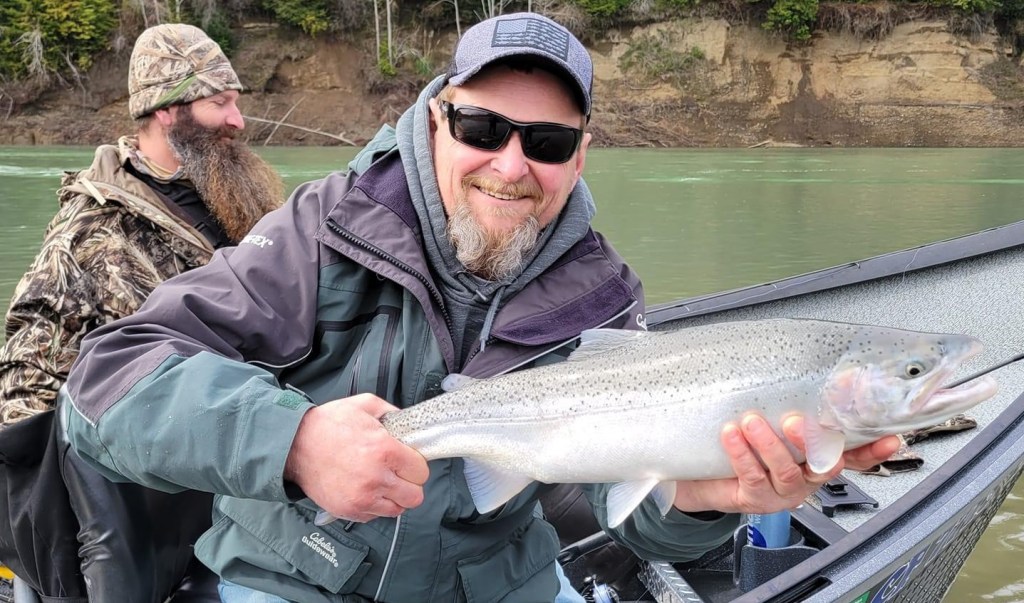
Late fall kings, like the one pictured with angler Ryan Galovic, will begin to make their way into the coastal rivers once the winter rains begin. Anglers will be able to harvest Chinook salmon this fall on the Smith while sections of the Eel will be open to catch and release. Photo courtesy of Kenny Priest/Fishing the North Coast Guide Service

While we wait for rain to fill our coastal rivers with much-needed water and late fall Chinook salmon, the North Coast is not without angling options.
Offshore, the boat-based rockfish and lingcod season will run through the end of the year. For the months of October and December within the Northern Management Area, which includes ocean waters between 42°00’ N. latitude (CA-OR Border) and 40°10′ N. latitude (near Cape Mendocino), fishing for rockfish will only be allowed seaward of the 50-fathom boundary line, and only shelf rockfishslope rockfish and lingcod may be retained. The nearshore fishery will be open Nov. 1, coinciding with the Nov. 2 sport Dungeness crab opener. Crab and rockfish combo trips are uber-popular and you’ll want to take advantage while you can.

Rockfish and federally managed groundfish for diving and shore-based anglers is allowed year-round, in line with current regulations.

If you haven’t got your fill of Pacific halibut, there’s plenty of quota still left on the table. As of Sept. 8, only 18,157 pounds have been harvested against the 38,220 net pound quota. The season closes Nov. 15, so there’s a couple weeks to run some crab and halibut combo trips.

When the rain does begin to fall and the rivers open, the Smith will be popular as it will be the only place in California where you can legally harvest a salmon. You are allowed one Chinook salmon per day and no more than 5 wild Chinook over 22 inches per year. The Smith is currently closed to fishing above Rowdy Creek. Minimum flows are 600 cfs at the Jedediah Smith State Park gauging station for the river to open to fishing. Sections of the Eel and Van Duzen will be open to the catch and release of Chinook salmon in 2024. On the Eel, catch and release is legal from the mouth to Cape Horn dam. The South Fork from its mouth to Rattlesnake Creek is also open to catch and release as well as the Van Duzen from its junction with the Eel River to the end of Golden Gate Drive near Bridgeville. All of these sections are restricted under low-flow fishing closures. The Chetco estuary is another good option as it continues to produce big kings to anglers trolling anchovies. Hopefully the wait for rain won’t be a lengthy one, but if it is, you’ve got options.

Weekend marine forecast
Ocean conditions look to be much improved heading into the weekend. As of Thursday afternoon, Friday’s forecast out 10 to 60 nautical miles is calling for winds out of the northwest 5 to 10 knots with northwest waves 5 feet at 11 seconds. Saturday, winds will be out of the north 10 to 15 knots with north waves 4 feet at five seconds and northwest 4 feet at nine seconds. Sunday, the winds will be 10 to 15 knots out of the north with north waves 4 feet at five seconds and northwest 4 feet at 10 seconds. These conditions can and will change by the weekend. For an up-to-date weather forecast, visit www.weather.gov/eureka/ or https://www.windy.com. You can also call the National Weather Service at (707) 443-7062 or the office on Woodley Island at (707) 443-6484.

Dungeness crab testing getting started
Domoic acid testing in Dungeness crabs is just getting started on the California coast. To date, only samples from Half Moon Bay/San Francisco (Pidgeon and Pillar Point) have been reported. None of the tested crabs exceeded the action level of 30 parts per million. For more information, visit www.cdph.ca.gov/Programs/CEH/DFDCS/Pages/FDBPrograms/FoodSafetyProgram/DomoicAcid.aspx

The Oceans:
Eureka
According to Tim Klassen of Reel Steel Sport Fishing, there hasn’t been any offshore opportunities the past couple weeks due to weather. “It looks like we’ve finally have some decent ocean conditions starting Friday and through the weekend,” said Klassen. “Pacific halibut and deep-water rockfish should be within reach.”

Shelter Cove
According to Jake Mitchell of Sea Hawk Sport Fishing, it was another quiet week at the Cove due to ocean conditions. “The outlook for later this week and the weekend is much improved,” said Mitchell.

Brookings
“Halibut action has slowed, but fish are being caught on calm weather days,” said Andy Martin of Brookings Fishing Charters. “Lingcod action is fair, with limits of rockfish for most boats. Be ready to release king salmon if fishing near the beaches and mouth of the river. Sport crabbing has been good.”

Willow Creek weir counts
For the week ending Sept. 23, a total of 101 adult kings were counted at the Willow Creek weir. The jack count for the week was 49. For the season to date, 285 (adults and jacks) have been counted, including both hatchery and wild. The totals are for only 23 trapping days.

North Coast river closures
Currently, all North Coast rivers subjected to low flow fishing closures, including the Eel, Mad, Redwood Creek, Smith and Van Duzen are closed. Sections of rivers that are open include the main stem Smith River from its mouth to the mouth of Rowdy Creek.

The Department of Fish and Game will make the information available to the public no later than 1 p.m. each Monday, Wednesday and Friday as to whether any river will be closed to fishing. The rivers can be opened up at any time. The low flow closure hotline for North Coast rivers is 707-822-3164. NOTE: The main stem Eel from the South Fork to Cape Horn Dam, the Mad River from the mouth to 200 yards upstream and the Mattole River will be closed until January 1, 2025.

The Rivers:
Lower Klamath
Water conditions on the lower Klamath continue to be dirty and unfishable, but that should begin to change soon. All the work in the river for dam removal was complete as of Tuesday. The water below the old dam sites is still dirty, but improving. It’s not likely conditions will improve enough for steelhead fishing before the rains come.
The daily bag limit is two hatchery steelhead or hatchery trout per day on both the Klamath and Trinity rivers, with a possession limit of four. Anglers must have a Steelhead Fishing Report and Restoration Card in their possession while fishing for steelhead trout in anadromous waters. The recreational fall salmon fishery is closed to the take of Chinook. More information, can be found here.

Chetco/Rogue
|According to Martin, salmon fishing has been good at times in the Chetco estuary, with numerous fish caught daily, including some large adults and plenty of jacks. “Fish to 35 pounds or bigger are being caught each week, with lots of fish over 20 pounds. Salmon also are holding in the tidewater areas of the river now. The bay is crowded, and most fish are being caught near the end of the jetties, so be ready for combat fishing. Kings also are being caught on the Rogue Bay.”

Kenny Priest operates Fishing the North Coast, a fishing guide service out of Humboldt specializing in salmon and steelhead. Find it on Facebook, Instagram, YouTube and fishingthenorthcoast.com. For up-to-date fishing reports and North Coast river information, email kenny@fishingthenorthcoast.com

Low-Flow River Information for the North Coast – 2025/2026

Chris Hall, left, and Raj Desai with a late season steelhead taken on the South Fork Eel River earlier in March. Photo courtesy of Fishing the North Coast


Low Flow River Closures begin Sept. 1 and run through April 30, 2026.
North Coast rivers that are regulated by low flow closures, including the Eel River, Mad River, Mattole River, Redwood Creek, Smith River and Van Duzen River will begin angling restrictions on September 1st, and run through April 30th 2026. As a reminder, in 2022, a low-flow angling restriction was added to the section of the Eel River from the mouth to Fulmor Road (Eel estuary) at its paved junction with the south bank of the Eel River. When a low-flow closure occurs in this section of the Eel, it will be closed to hook-and-line fishing; other legal fishing methods are allowed during this timeframe.

The low flow closure hotline for North Coast rivers is no longer in service. You can now find river openings and closures in real time online at https://wildlife.ca.gov/Fishing/Inland/Low-Flow/North-Coast. The rivers can be opened up at anytime. Rivers will not automatically open to fishing once minimum flows are reached. NOTE: The main stem Eel from the South Fork to Cape Horn Dam, the Mad River from the mouth to 200 yards upstream and the Mattole River will be closed until January 1, 2026.

Section of river that is open to fishing is the main stem Smith River from the mouth of Rowdy Creek to its mouth.

Areas subject to low flow closures:

Mad River: The main stem Mad River from the Hammond Trail Railroad Trestle to Cowan Creek. Minimum flow: 200 cfs at the gauging station at the Highway 299 bridge. The Mad River from the mouth to 200 yards upstream is closed until Jan. 1, 2025.

The main stem Eel River: New in 2022, a low-flow angling restriction was added to the section of the Eel River from the mouth to Fulmor Road at its paved junction with the south bank of the Eel River, Sept. 1 through April 30. The stream flow will be monitored as follows: Minimum Flow: 350 cubic feet per second at the gauging station near Scotia.

The South Fork of the Eel River: The South Fork of the Eel River downstream from Rattlesnake Creek and the Middle Fork Eel River downstream from the Bar Creek. Minimum flow: 340 cfs at the gauging station at Miranda.

Van Duzen River: The main stem Van Duzen River from its junction with the Eel River to the end of Golden Gate Drive near Bridgeville (approximately 4,000 feet upstream of Little Golden Gate Bridge. Minimum flow: 150 cfs at the gauging station near Grizzly Creek Redwoods State Park.

Mattole River: The main stem of the Mattole River from the mouth to Honeydew Creek. Minimum flow: 320 cfs at the gauging station at Petrolia.

Redwood Creek: The main stem of Redwood Creek from the mouth to its confluence with Bond Creek. Minimum flow: 300 cfs at the gauging station near the Highway 101 bridge.

Smith River: The main stem Smith River from the mouth of Rowdy Creek to its confluence with Patrick Creek; the South Fork Smith River from the mouth upstream approximately 1000 ft to the County Road (George Tyron) bridge and Craigs Creek to its confluence with Jones Creek; and the North Fork Smith River from the mouth to its confluence with Stony Creek. Minimum flow: 600 cfs at the Jedediah Smith State Park gauging station.

Salmon stymied by shifting Klamath mouth

Image

Photo Caption: The Klamath River mouth, seen here from the overlook on the north side of the river, has been opening and closing since the weekend, making it difficult for salmon to enter the river. Large swells are predicted for the weekend and hopefully the mouth can blow wide-open allowing what’s left of the fall run to make their way upriver. (Photo courtesy of Sara Borok, Klamath River Environmental Scientist)

Fishing the North Coast
by Kenny Priest/For the Times-Standard

Low Flow closures on North Coast rivers start Tuesday

Along the lines of the ’80s TV commercial for Wendy’s where the old lady shouts, “Where’s the beef?” Klamath salmon anglers have been wondering, “Where’s the salmon?” In truth, no one really knows. What we do know is 11,538 have been harvested below the 101 bridge and another 1,009 have been caught by sport anglers above the bridge. Throw in approximately 54,000 fish that have been harvested by the Yurok tribe and what you’re left with is a lot of missing fish. Sure, there’s a few fish that have squirted through and are now entering tributaries like the Trinity, Shasta, and Scott rivers, but with an in-river return at well over 250,000 predicted, the numbers aren’t adding up. A big part of the problem has been the mouth of the river. Flowing to the south and running narrow and shallow, conditions have been less than ideal for huge pushes of fish to enter the river. And with last week’s storms and big tide swings, it went from bad to worse. Since the weekend, it’s been opening and closing and has created a lake that can be felt all the way to Blakes’ riffle. At the moment, very few fish are entering the lower river and guides are lucky to catch a few a day.

According to Sara Borok, an Environmental Scientist on the Klamath River, we’ve been down this road before. “Back in 2001 we also had a south mouth that hampered the fish coming into the river. “It blew open on September 21 and we had a huge surge of fish pour in,” Borok said. “Although there’s no way to know for sure, my guess it there are still quite a few fish in the ocean waiting for the right conditions to enter.” With big swells again predicted for the weekend, there’s a chance the mouth can finally blow out enough to allow the remaining kings to enter the system and start their journey upriver. Let’s hope so.

Weekend marine forecast
If you’re hoping to fish offshore this weekend, Saturday will be your best bet. South winds are forecasted 5 to 15 knots with swells to 8 feet at 11 seconds.  Sunday isn’t looking as good with south winds to 20 knots and waves out of the west to 14 feet at 14 seconds. For up-to-date weather forecasts, visit http://www.weather.gov/eureka/. You can also call the National Weather Service at (707) 443-7062 or the office on Woodley Island at (707) 443-6484.

HASA meeting
A general membership meeting will be held Oct. 2 at 7 p.m. in Scott McBain’s office at 980 7th Street in Arcata. According to Cliff Hart, President of HASA, discussions will include urgent issues related to Pacific Halibut. “All fisherman and fisherwomen from the North Coast are invited to come and give feedback. We NEED to hear from you. If you can’t make the meeting, please email your comments about the current Pacific Halibut situation and what options you would like to see to: hasa6191@gmail.com. We are in an unfortunate situation where we will lose some halibut fishing. We don’t like any of the options dealt, but we have the ability to recommend. Public comment is open with PFMC, and we may call upon you to write letters and emails.” Hart added. The due date is 10/9/13. For more information, visit http://www.dfg.ca.gov/marine/pacifichalibut.asp

The Oceans:

Eureka
According to Tim Klassen of Reel Steel Sport Fishing, the rough ocean we’ve had this week has kept the boats off the water. “The last fishable day was Sunday and we were able to run to the Cape for Rockfish. Since then, nobody’s been out. Friday and Saturday are looking fishable, but it’s coming back up again on Sunday. Hopefully we’ll be able to go one of those days and drift for halibut as the bite has been pretty good. Last Thursday we were able to limit out our four customers” Klassen said.

Crescent City
Little if any angling is happing offshore out of Crescent City reports Chris Hegne’s of Englund Marine. “We’ve had some pretty rough seas this week and no one’s been out. The weekend isn’t looking much better,” Hegnes added.

Low Flow River Closures begin Oct. 1
North Coast rivers that are regulated by low flow closures, including the Eel River, Mad River, Mattole River, Redwood Creek, Smith River and Van Duzen River will begin angling restrictions on October 1st, except for the Mad River, which went into effect September 1st. The Department of Fish and Game will make the information available to the public by a telephone recorded message updated, as necessary, no later than 1 p.m. each Monday, Wednesday and Friday as to whether any stream will be closed to fishing. The rivers can be opened up at anytime. The low flow closure hotline for North Coast rivers is (707) 822-3164. NOTE: The main stem Eel from the South Fork to Cape Horn Dam and the Mattole River will be closed until January 1, 2014

Areas subject to low flow closures:

Mad River: The main stem Mad River from the Hammond Trail Railroad Trestle to Cowan Creek. Minimum flow: 200 cfs at the gauging station at the Highway 299 bridge.

The main stem Eel River from the paved junction of Fulmor Road with the Eel River to the South Fork Eel River. Minimum flow: 350 cfs at the gauging station near Scotia.

The South Fork of the Eel River downstream from Rattlesnake Creek and the Middle Fork Eel River downstream from the Bar Creek. Minimum flow: 340 cfs at the gauging station at Miranda.

Van Duzen River: The main stem Van Duzen River from its junction with the Eel River to the end of Golden Gate Drive near Bridgeville (approximately 4,000 feet upstream of Little Golden Gate Bridge. Minimum flow: 150 cfs at the gauging station near Grizzly Creek Redwoods State Park.

Mattole River: The main stem of the Mattole River from the mouth to Honeydew Creek.

Minimum flow: 320 cfs at the gauging station at Petrolia.

Redwood Creek: The main stem of Redwood Creek from the mouth to its confluence with Bond Creek. Minimum flow: 300 cfs at the gauging station near the Highway 101 bridge.

Smith River: The main stem Smith River from the mouth of Rowdy Creek to its confluence with Patrick Creek; the South Fork Smith River from the mouth upstream approximately 1000 ft to the County Road (George Tyron) bridge and Craigs Creek to its confluence with Jones Creek; and the North Fork Smith River from the mouth to its confluence with Stony Creek. Minimum flow: 600 cfs at the Jedediah Smith State Park gauging station.

The Rivers:

Lower Klamath
According to Mike Coopman of Mike Coopman’s Guide Service, with the mouth opening and closing since the weekend, very few fish are coming in. The big swells aren’t helping much either,” Coopman said.

Alan Borges of Alan’s Guide Service, who’s also working the lower river, reports guides are still struggling to catch fish in any numbers. “The ones we are catching are fresh with sea lice. Hopefully the ocean calms a bit and we can truly see if there are any good numbers of fish left to come in,” Borges added.

Lower Trinity
Curt Wilson of Curt Wilson Fishing Guides reports the rain and fluctuating flows brought a good amount of fish up the Trinity early this week. “The last few days, steelhead have taken over the show around the Willow Creek area. It seems as we are finally seeing the lack of kings we have been hearing about down low really catch up with us. Hopefully a few more decide to show up. The Willow Creek weir counted 140 fish on Tuesday, but most of them were steelhead,” Wilson added.

Find “Fishing the North Coast” on Facebook for up-to-date fishing reports and North Coast river information. Questions, comments and photos can be emailed to kenny@fishingthenorthcoast.com.