Another Storm, Another Miss: North Coast Still Waiting on a Real Rise

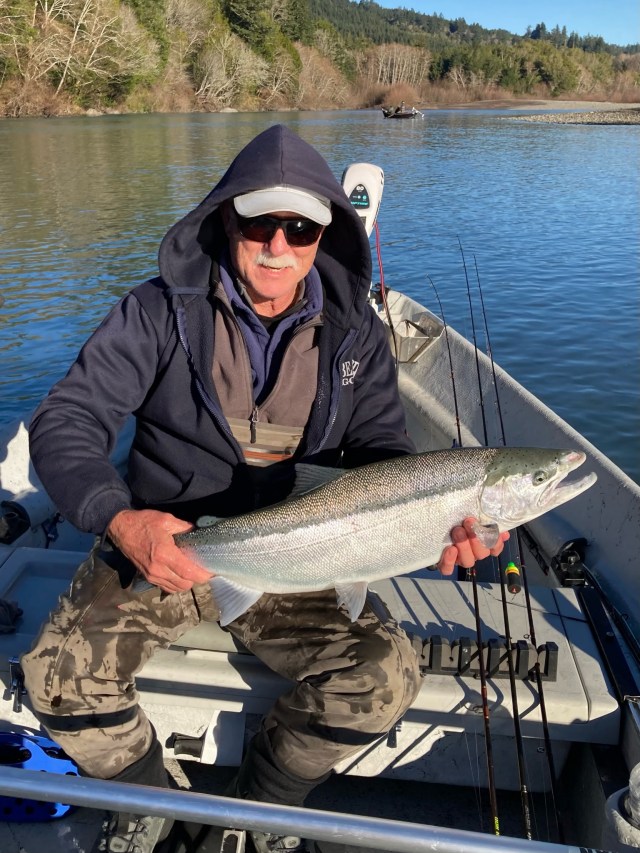
Sol Gallaway with a Smith River king landed last Friday. Photo courtesy of Fishing the North Coast Guide Service.

Another week, another dismal atmospheric river has come and gone. The storm door cracked open back in early October, but it hasn’t been kicked open much farther since. Instead, we’ve seen a parade of modest systems — just enough rain to bump flows, but not nearly enough to produce the kind of full-blown rises anglers hope for this time of year. It’s been one little storm after another, keeping the rivers barely high enough to remain open and allowing salmon to trickle in rather than charge upriver in big bunches.

Despite the lack of a true gully-washer, the small rises we’ve had have created windows of very fishable conditions. Those brief lifts in flow have turned out some pretty good scores for boats and bank anglers who were able to time their outings around the modest pulses of water. Fish continue to move on each rise, albeit in smaller and smaller numbers.

For now, the pattern remains the same: light rains, marginal rises, and steady but unspectacular fishing. Anglers will be watching closely for a stronger system that could finally open the door all the way and push the bulk of the late-fall fish into the rivers as well as some early-arriving steelhead. Until then, the trickle continues — and so does the opportunity for those willing to watch the gauges and take advantage when conditions line up.

Weather ahead
According to the Eureka’s National Weather Service, moderate to locally heavy rainfall ended late Wednesday with the passing of the front. “A chillier airmass has moved in behind the front. Overnight lows will bring chances for interior frost and some freezing temperatures, but values will be close to climatological norms. After the recent rains, and building high pressure, the environment will be favorable for poorly modeled radiational fog over at least the next couple of mornings. An additional system is possible early next week, but ensembles continue to trend this system northward. Even high-end precipitation amounts are only showing 0.25 amounts clipping Del Norte County. After the passage of an associated cold front, cooler overnight lows will return Tuesday morning. Precipitation chances are currently not forecast to trend higher until mid to late next week.”

CDFW awaits new domoic acid test results for North Coast crab
The California Department of Fish and Wildlife conducted additional domoic acid sampling late last week, deploying a vessel out of Eureka to collect crabs for both retesting and initial toxicity checks. The effort included a retest of the Trinidad area, which previously returned elevated domoic acid levels. Under state health guidelines, any area that tests high must produce two consecutive clean results, collected at least one week apart, before restrictions can be lifted.

According to a CDFW, test results from the most recent round of sampling are expected to be available on Nov. 20 or Nov. 21. These findings will help determine whether the Trinidad zone is trending toward reopening and will provide the first assessment of crab condition in the Eureka area.

Shelter Cove update
“It’s been a little slow without being able to fish for crab, but things are picking up,” said Jake Mitchell of Sea Hawk Sport Fishing.Rock fishing has been really good lately, and the lingcod action has been excellent as well. Haven’t been going too far, just around the Old Man and the Hat.”

Brookings update
According to Andy Martin of Brookings Fishing Charters, lingcod and rockfish action is good out of Brookings when the weather cooperates. “Last weekend produced limits,” said Martin. “Winds calm down this weekend, although the swell is borderline at 10 feet.” 

The Rivers:
As of Thursday, the main stem Eel, South Fork Eel, Van Duzen, Mad, and Smith were open to fishing. Only Redwood Creek remained closed due to low flows. The low-flow closure telephone hotline for North Coast rivers is no longer in service. You can now find river openings and closures online at https://wildlife.ca.gov/Fishing/Inland/Low-Flow/North-Coast.

Low-flow information for all North Coast rivers is available here.

NOTE: The main stem Eel from the South Fork to Cape Horn Dam, the Mad River from the mouth to 200 yards upstream and the Mattole River will be closed until January 1, 2026.

Mad
The Mad was on a slight rise as of Thursday morning and is forecast to reach 1,100 cfs in the afternoon. It’s forecast to drop through the weekend and into early next week before the rain returns mid-next week. There are reportedly fresh salmon making their way into the river. Minimum flow: 200 cfs at the gauging station at the Highway 299 bridge. cnrfc.noaa.gov/graphicalRVF.php?id=ARCC1

Main Eel
Following Tuesday’s rise, the main stem was on drop Thursday and flowing just above 4,000 cfs. It’s predicted to drop through the weekend and could be fishable next week when flows will dip below 2,000 cfs. The next rise is predicted for the end of next week. There should be some late arriving kings around as well as some fresh coho. Minimum Flow: 350 cubic feet per second at the gauging station near Scotia. cnrfc.noaa.gov/graphicalRVF.php?id=SCOC1

South Fork Eel
The South Fork was running at 1,000 cfs Thursday morning and it looks like it won’t reach 1,200 cfs as predicted. It will be on the drop through the weekend and all next week. Last weekend, with flows under 1,000, the river remained off color. Minimum flow: 340 cfs at the gauging station at Miranda. cnrfc.noaa.gov/graphicalRVF.php?id=MRNC1

Van Duzen
The Van Duzen was on a very slight rise Thursday morning, but it won’t amount to much. Flows were right around 575 cfs and will be on the drop through mid-next week. It’s predicted to get down to 200 cfs late next week prior to the next rain event. It should be fishable by the weekend. Minimum flow: 150 cfs at the gauging station near Grizzly Creek Redwoods State Park. cnrfc.noaa.gov/graphicalRVF.php?id=BRGC1

Smith
The Smith was on a slow rise Thursday morning, but likely to peak at less than predicted. As of noon it was around 2,290 cfs and may not go much above 2,300 cfs. Rain last Sunday brought flows up Monday and the fishing was decent. Some fresh fish were caught, but the majority are now dark and there’s some nice coho around. The ensemble forecast shows the river dropping through next Tuesday, with the next small rise predicted for Wednesday. Minimum flow: 600 cfs at the Jedediah Smith State Park gauging station. cnrfc.noaa.gov/graphicalRVF.php?id=CREC1

Eel River Chinook salmon returns
According to the Friends of the Eel website, the first Chinook salmon arrived at the Van Arsdale Fisheries Station (VAFS) on Wednesday, November 5. Salmon arrivals were steady throughout the week and peaked on Thursday, November 6, with 111 arrivals. Over the week (November 3 – 9), 251 Chinook salmon (female 73, male 85, unknown 27, jack 66) were observed migrating upstream through the fish passage facility at Cape Horn Dam. The season total for upstream migrating Chinook salmon stands at 251 (female 73, male 85, unknown 27, jack 66), through Sunday, November 9. For more information, visit https://eelriver.org/the-eel-river/#fishcount.

Nov. 28 and 29 free fish days in Oregon
The Oregon Department of Fish and Wildlife is waiving all fishing licensing requirements on the Friday and Saturday after Thanksgiving to encourage people to experience fishing with friends and family during the long holiday weekend. All fishing, crabbing and clamming in Oregon will be free for both Oregon residents and non-residents. No licenses, tags or endorsements are needed on those days, but all other fishing regulations apply. Visit https://myodfw.com/articles/2025-free-fishing-days-and-events

Chetco/Elk/Sixes
“Salmon fishing has slowed on the Chetco,” said Andy Martin of Wild Rivers Fishing. “After a decent weekend, catch rates dropped significantly to begin the week. A few late fish are expected after the next rain, but many anglers will turn their attention to the Dec. 1 steelhead opener. A few steelhead have already been released. 

The Elk and Sixes need a big rain event to jumpstart the action. Expect decent fishing on the Elk after the next rise to 4 feet. The river was 2.3 feet on Wednesday.”

Kenny Priest operates Fishing the North Coast, a fishing guide service out of Humboldt specializing in salmon and steelhead. Find it on Facebook, Instagram, YouTube and fishingthenorthcoast.com. For up-to-date fishing reports and North Coast river information, email kenny@fishingthenorthcoast.com.
Last Call for Kings — Steelhead Season on Deck

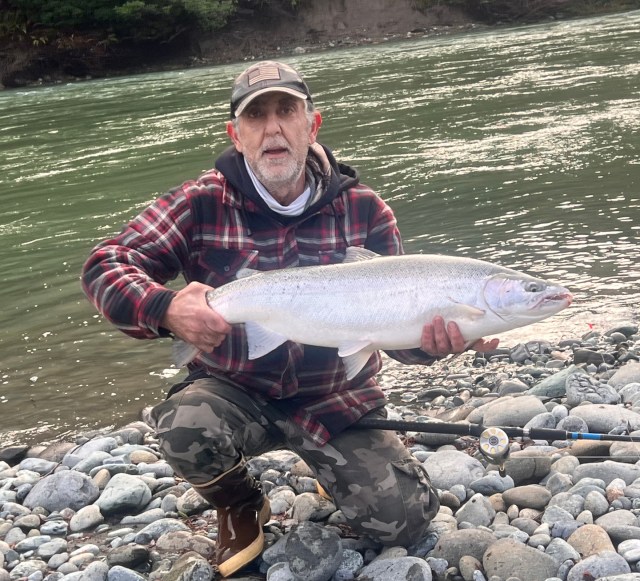
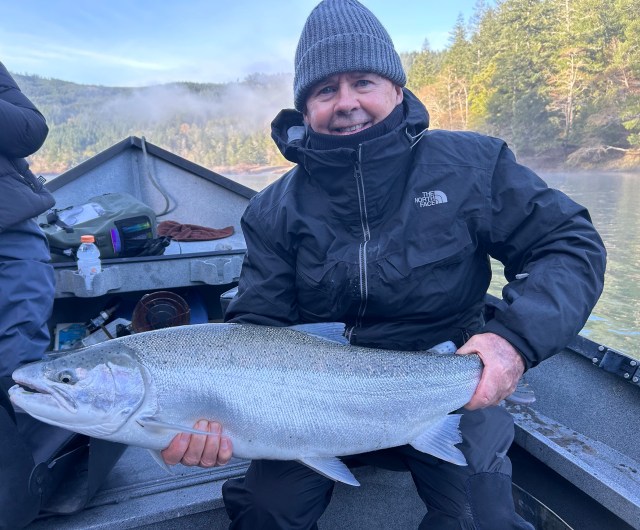
Ferndale resident Iver Skavdal with a nice king caught last week on the Smith River. Photo courtesy of Alan’s Guide Service

As another weakening storm approaches the North Coast, it’s safe to say we’re now on the backside of the late-fall coastal king salmon run. This fall still hasn’t delivered the kind of big storm needed to give the rivers a full blowout, and most have been teetering between open and closed. On the bright side, salmon returns to the coastal rivers appear strong. Plenty of kings have been caught on the Smith, from the tidewater up to the forks, over the past few weeks, and schools of traveling salmon have been spotted pushing through the smaller coastal streams as well.

If conditions hold, anglers should have another week or two of opportunity to hook a bright king. We’re also starting to see good numbers of coho moving into the rivers, which is usually a sign the king run is winding down.

With the salmon now taking care of business in their home tributaries, we’ll turn our attention to what’s next — the first signs of the winter steelhead run.

Weather ahead
According to the US National Weather Service Eureka, 2 to 3 inches of rain is most likely across Mendocino and Lake Counties with only about 1 inch of rain in Humboldt Bay and Crescent City. “Rain amounts may peak over 4 inches in some isolated high mountain areas in the King Range and Trinity Alps. Some showers could linger Thursday evening into early Friday. Additional rainfall will most likely be no more than 0.1 inches with less than 10% chance of additional total rainfall over 0.2 inches. A drier and cooler air mass will quickly build behind the front with mostly clear skies by Friday afternoon. Another, weak rain event is expected later in the weekend. Current rain amounts will most likely be less than 0.5 inches, focused along the North Coast.”

2025 Recreational Pacific Halibut Fishery to Close Nov. 15
The 2025 recreational Pacific halibut fishery will close after Saturday, Nov. 15, according to state and federal fishery managers. As of Oct. 26, California anglers had harvested 19,110 net pounds of halibut — about 49 percent of the state’s 39,280-pound share of the Area 2A quota, which is jointly managed with Washington and Oregon.

Of California’s allocation, 500 pounds are reserved for the waters south of Point Arena. Despite the underage, the fishery will still close as scheduled under the season structure approved earlier this year.

Shelter Cove update
“Rock fishing has been excellent and the lingcod bite has gotten really good the last week or so,” said Jake Mitchell of Sea Hawk Sport Fishing. “We’ve been fishing the Old Man lately. There’s been some decent albacore fishing out of Fort Bragg the last few days, but no Cove boats made the trek.”

Brookings update
According to Andy Martin of Brookings Fishing Charters, boaters have been able to get out of Brookings this week for lingcod and rockfish, although choppy seas have limited success for lings to some extent. “Quality rockfish are as close as Chetco Point. Saturday’s forecast looks fishable,” said Martin.

The Rivers:
As of Thursday, the main stem Eel, South Fork Eel, Van Duzen, and the Smith were open to fishing. The Mad, and Redwood Creek remained closed due to low flows. The low-flow closure telephone hotline for North Coast rivers is no longer in service. You can now find river openings and closures online at https://wildlife.ca.gov/Fishing/Inland/Low-Flow/North-Coast.

Low-flow information for all North Coast rivers is available here.

NOTE: The main stem Eel from the South Fork to Cape Horn Dam, the Mad River from the mouth to 200 yards upstream and the Mattole River will be closed until January 1, 2026.

Mad
The Mad was around 165 cfs as of Thursday morning and is forecast for a steep rise throughout the day, peaking at 3,100 cfs in the evening. Minimum flow: 200 cfs at the gauging station at the Highway 299 bridge. cnrfc.noaa.gov/graphicalRVF.php?id=ARCC1

Main Eel
The main Eel as flowing at 1,690 cfs as of Thursday morning and starting to rise. With the rain, it’s predicted to peak at 8,460 cfs Friday night and will likely be muddy It should drop into fishable shape late in the weekend or the first of next week. Minimum Flow: 350 cubic feet per second at the gauging station near Scotia. cnrfc.noaa.gov/graphicalRVF.php?id=SCOC1

South Fork Eel
The South Fork opened to fishing Thursday morning as flows were 470 cfs and rising quickly. It should be fishable throughout the weekend, with the next, smaller rise forecast for Monday. Minimum flow: 340 cfs at the gauging station at Miranda. cnrfc.noaa.gov/graphicalRVF.php?id=MRNC1

Van Duzen
The Van Duzen has been open since mid-last week. It was on a steep rise Thursday morning and expected to peak at nearly 5,000 cfs later in the evening. It should drop in to fishable shape by later in the weekend before the next rise begins Monday morning. Minimum flow: 150 cfs at the gauging station near Grizzly Creek Redwoods State Park. cnrfc.noaa.gov/graphicalRVF.php?id=BRGC1

Smith
Flows and fishing both peaked last Thursday as the river peaked at over 11 feet on the Jed Smith gauge. Since then, it’s been getting low and clear. Back bouncing roe in the spots that have current has been the ticket this week and will be the case through the weekend. A slight rise is predicted for Friday, but it’s predicted to remain under 7 feet. There are likely a few bright kings still making their way in, along with some darker fish. Quite a few coho have been caught this week. Minimum flow: 600 cfs at the Jedediah Smith State Park gauging station. cnrfc.noaa.gov/graphicalRVF.php?id=CREC1

Nov. 28 and 29 free fish days in Oregon
The Oregon Department of Fish and Wildlife is waiving all fishing licensing requirements on the Friday and Saturday after Thanksgiving to encourage people to experience fishing with friends and family during the long holiday weekend. All fishing, crabbing and clamming in Oregon will be free for both Oregon residents and non-residents. No licenses, tags or endorsements are needed on those days, but all other fishing regulations apply. Visit https://myodfw.com/articles/2025-free-fishing-days-and-events

Chetco/Elk/Sixes
“The Chetco has been fair for salmon, but slower than expected considering this week’s prime conditions,” said Andy Martin of Wild Rivers Fishing. “Many of the salmon have already moved upriver to spawn. Spawning salmon can be seen throughout the upper river. Leaves challenged anglers over the weekend, making it difficult to run plugs as the biggest number of kings move through. By Monday, the action had slowed, but anglers back-bouncing roe or bobber fishing were catching a mix of bright and dark salmon. This week’s rain will help for the weekend, although the lower river could get muddy.

The Elk and Sixes had a brief window on Sunday and Monday, but will fish well again with rain late this week. The Elk was slower than expected, but plenty of fish should still be coming. The Sixes fished well with good flows to begin the week.”

Kenny Priest operates Fishing the North Coast, a fishing guide service out of Humboldt specializing in salmon and steelhead. Find it on Facebook, Instagram, YouTube and www.fishingthenorthcoast.com. For up-to-date fishing reports and North Coast river information, email kenny@fishingthenorthcoast.com.

Prime Weekend for Late Fall Kings

Matt Vanoli landed a bright king while fishing the Smith River Wednesday. Excellent conditions are on tap for the next few days on the Smith. Photo courtesy of Michael Poly.

If you haven’t gotten in on the late fall king action yet, this should be your weekend. River conditions are lining up nicely for both the Smith and Chetco — and with the run possibly winding down, now’s the time to go.

Earlier rain put plenty of water back into both systems. Boats were back on the Smith by Wednesday, while the Chetco was still too muddy. That should change soon — the Smith is prime right now, and the Chetco should come around by Saturday. It may start off a bit high, but by Sunday it should be in great shape and fishing well into next week.

Closer to home, the main stem Eel could be fishable by late in the weekend or early next week, depending on how dirty the creeks get. It’s forecast to peak around 7,940 cfs Friday but was already dropping Thursday and running below projections — a good sign. The South Fork was a little off-color Thursday but could be in shape by the weekend, with flows expected just under 1,200 cfs Saturday morning. The Van Duzen has one more rise coming Friday, but if it falls short, it could be fishable by the weekend too.

Weather ahead
According to the US National Weather Service Eureka, high pressure and upper-level ridge will build in quickly Friday over the West Coast in the wake of the front. Any lingering showers are expected to dissipate Friday morning as the flow aloft shifts to northwest and dryer airmass moves in. Dry and seasonably high temperatures are expected on Friday.

Dry offshore regimen will promote a drying and warming trend this weekend through at least early next week. Ensemble and deterministic models’ guidance’s are in a good agreement with the high pressure persisting over the area this weekend. High pressure breakdown begins to shift eastward on Tuesday as an upper-level trough approaches.”

The Rivers:
As of Thursday, all North Coast rivers subjected to low flow fishing closures were open to fishing. This includes the main stem Eel, South Fork Eel, Mad, Redwood Creek, Smith, and Van Duzen. The low-flow closure telephone hotline for North Coast rivers is no longer in service. You can now find river openings and closures online at https://wildlife.ca.gov/Fishing/Inland/Low-Flow/North-Coast. Low-flow information for all North Coast rivers is available here.

NOTE: The main stem Eel from the South Fork to Cape Horn Dam, the Mad River from the mouth to 200 yards upstream and the Mattole River will be closed until January 1, 2026.

Mad
The Mad was down to 1,375 as of Thursday morning and dropping. It’s predicted to rise early Friday morning, peaking at 2,980 cfs. Minimum flow: 200 cfs at the gauging station at the Highway 299 bridge. cnrfc.noaa.gov/graphicalRVF.php?id=ARCC1

Main Eel
Peaked at 5,960 cfs early Thursday morning, but came in below projections. Another half-inch of rain is forecast for late Thursday, but it remains to be seen if that will be enough to put it back on the rise. It could drop into shape late in the weekend and should be in good shape early next week. The next significant rise is predicted for Thursday. Minimum Flow: 350 cubic feet per second at the gauging station near Scotia. cnrfc.noaa.gov/graphicalRVF.php?id=SCOC1

South Fork Eel
The South Fork opened to angling Tuesday, and peaked at 2,300 cfs Wednesday afternoon. It’s predicted to drop – though it could see a slight bump in flows Friday – through the weekend and into next week. Conditions should be good for the weekend and there are salmon spread throughout the river. Minimum flow: 340 cfs at the gauging station at Miranda. cnrfc.noaa.gov/graphicalRVF.php?id=MRNC1

Van Duzen
The Van Duzen opened to angling Wednesday as flows climbed to 2,530 cfs. It has been on the drop since, with the next rise forecast for Friday where it could reach 2,900 cfs. It’s predicted to drop through the weekend and into next week. Flows should be right around 980 cfs Saturday morning. Minimum flow: 150 cfs at the gauging station near Grizzly Creek Redwoods State Park.
cnrfc.noaa.gov/graphicalRVF.php?id=BRGC1

Smith
The Smith opened back up Tuesday and boats were back on the water Wednesday. Even on the steep rise, plenty of fish were caught. Conditions should be excellent Friday as the river will be on the drop from 10 feet at the Jed Smith gauge. It will continue to drop through mid-next week when the next round of rain is forecasted. Expect clearing conditions this weekend. Minimum flow: 600 cfs at the Jedediah Smith State Park gauging station. cnrfc.noaa.gov/graphicalRVF.php?id=CREC1

Nov. 28 and 29 free fish days in Oregon
The Oregon Department of Fish and Wildlife is waiving all fishing licensing requirements on the Friday and Saturday after Thanksgiving to encourage people to experience fishing with friends and family during the long holiday weekend. All fishing, crabbing and clamming in Oregon will be free for both Oregon residents and non-residents. No licenses, tags or endorsements are needed on those days, but all other fishing regulations apply. Visit https://myodfw.com/articles/2025-free-fishing-days-and-events

Chetco/Elk/Sixes
“The Chetco fished well Monday and Tuesday, before blowing out Tuesday evening,” said Andy Martin of Wild Rivers Fishing. “It was high and muddy Wednesday, and expected to remain blown out Thursday before dropping for the weekend. A mix of bright and dark adults and jacks are being caught, with hatchery and wild fish in the mix. Tuesday’s all-tackle opener lives up to its billing, with a good bite for drift boaters back-bouncing roe. Lots of leaves and muddy water kept everyone away Wednesday. Flows below 4,000 cfs are fishable, with flows below 3,000 ideal. The Ice Box gate is now open for launching and bank fishing access. The Elk and Sixes also blew out Wednesday and were full of leaves. They will be in shape for the weekend, but expect a crowd.”

Kenny Priest operates Fishing the North Coast, a fishing guide service out of Humboldt specializing in salmon and steelhead. Find it on Facebook, Instagram, YouTube and fishingthenorthcoast.com. For up-to-date fishing reports and North Coast river information, email kenny@fishingthenorthcoast.com.

Weekend Rains Briefly Open North Coast Rivers

Brady Smith of Klamath Falls holds a 41-inch king caught Monday on the Smith River with guide Andy Martin. He was fishing a 5.0 MagLip with a tuna wrap. Photo courtesy of Wild Rivers Fishing

The season’s first atmospheric river was forecast to hit the North Coast last Friday and into the weekend, but it came in well under predictions. What was expected to deliver 4 to 6 inches of rain ended up producing just 2 to 2.5 inches. Still, it was enough to briefly open several rivers — the Smith for three days, and the Mad and Van Duzen for just one. The main stem Eel opened Sunday and remains the only North Coast river subject to low-flow closures that’s still open. Across the border, the Chetco is open, though anglers are required to fish with a bobber through Nov. 3.

The good news is there’s plenty of salmon around. Unfortunately, most of the fish caught in North Coast rivers have been dark and past their prime. The Smith produced good numbers Sunday and Monday, but chrome-bright fish were scarce. The Chetco also saw a solid bite, with a more even mix of dark and fresh salmon.

Looking ahead, the next storm is forecast to arrive Tuesday. The Climate Prediction Center’s 8–14-day outlook calls for above-normal precipitation — hopefully the next round of rain will bring more fishable water and a few more bright kings.

The Rivers:
As of Thursday, all North Coast rivers subjected to low flow fishing closures, except the main stem Eel are closed to fishing. This includes the Mad, Redwood Creek, Smith, and Van Duzen. The low-flow closure telephone hotline for North Coast rivers is no longer in service. You can now find river openings and closures online at https://wildlife.ca.gov/Fishing/Inland/Low-Flow/North-Coast.

Low-flow information for all North Coast rivers is available here.

NOTE: The main stem Eel from the South Fork to Cape Horn Dam, the Mad River from the mouth to 200 yards upstream and the Mattole River will be closed until January 1, 2026.

Smith
Fishing was good Sunday and Monday prior to closing Tuesday. Most of the fish were dark, but there were some bright ones caught. There should be more bright fish coming with the next rise, which should happen next Tuesday. The daily bag limit is one Chinook salmon per day and no more than five wild Chinook salmon over 22 inches per year. Minimum flow: 600 cfs at the Jedediah Smith State Park gauging station. cnrfc.noaa.gov/graphicalRVF.php?id=CREC1

Mad
The Mad was open Monday, but quickly closed Tuesday due to low flows. There were reportedly quite a few salmon seen moving up from the tide water. The ensemble forecast shows the river beginning to rise late Tuesday. Minimum flow: 200 cfs at the gauging station at the Highway 299 bridge. cnrfc.noaa.gov/graphicalRVF.php?id=ARCC1

Main stem Eel
The river was open as of Thursday with flows right around 670 cfs and dropping.  With dry weather on tap for the next several days, it may close to fishing later in the weekend of early next week. The next rise, which is forecast for Wednesday could open it back up to fishing. The Eel River is open to catch and release of salmon in 2025/26. Minimum Flow: 350 cubic feet per second at the gauging station near Scotia.
cnrfc.noaa.gov/graphicalRVF.php?id=SCOC1

South Fork Eel
The South Fork didn’t receive enough rain over the weekend to open it up. That could change late next week with the arrival of the next storm. Minimum flow: 340 cfs at the gauging station at Miranda. cnrfc.noaa.gov/graphicalRVF.php?id=MRNC1

Van Duzen
The Van Duzen opened, and closed, last Monday as flows quickly fell below 150 cfs. If the forecast is correct, it could open to fishing next Wednesday. Minimum flow: 150 cfs at the gauging station near Grizzly Creek Redwoods State Park.
cnrfc.noaa.gov/graphicalRVF.php?id=BRGC1

Chetco
“The Chetco River was in good shape for fall kings over the weekend and the beginning of the week, with lots of fish spread throughout the river,” said Andy Martin of Wild Rivers Fishing. “By Tuesday, the river was already low and clear and challenging to drift. Boats were bumping bottom on most riffles on Wednesday. A mix of bright and dark fish were caught early in the week, before action dropped sharply on Tuesday. Fishing was slow Wednesday, and will likely remain so until next week’s rain. Gear restrictions requiring a bobber remain in effect through Nov. 3. Several anglers and some guides were ticketed by state troopers at the beginning of the week.”

Sixes River low flow angling closure to be lifted
Beginning Nov. 3, the Sixes River low flow angling closure will be lifted. ODFW typically closes a portion of the river to angling Oct. 1 to protect wild fall chinook salmon vulnerable to snagging or poaching while staging between Crystal Creek and Hughes House Boat Ramp.

Anglers are reminded the bag limit for wild adult chinook in the Sixes River is one adult chinook per day, 10 for the season. Elk River, just south of Sixes River is closed to retention of wild fall chinook this year. For more information, check the ODFW Recreation Report.

Sport Dungeness crab season delayed on the North Coast
In a press release issued Oct. 24 by CDFW, the recreational Dungeness crab season will open beginning Nov. 1, 2025, except in northern California where it has been delayed due to a public health hazard.

CDFW Statement:
“State health agencies determined that Dungeness crab in northern California have unhealthy levels of domoic acid and recommended delaying the opening of the recreational fishery in state waters from the California/Oregon border (42° 0.00’ N latitude) south to the Sonoma/Mendocino County line (38° 46.125’ N latitude). Following this recommendation, California Department of Fish and Wildlife (CDFW) Director Charlton H. Bonham has delayed the opening of the recreational Dungeness crab fishery in northern California. Recreational take and/or possession of Dungeness crab is prohibited in these closed waters.

In the area between the Sonoma/Mendocino County line and Point Reyes (37° 59.73’ N latitude), state health agencies are advising the public not to consume crab viscera (guts) to avoid potential domoic acid exposure. In addition, the use of crab traps will be temporarily restricted between the Sonoma/Mendocino County line and Lopez Point, Monterey County (36° N latitude, Fishing Zones 3 and 4) when the season opens due to the presence of humpback whales and potential for entanglement from recreational crab traps.

A Fleet Advisory has also been issued for all Fishing Zones for the recreational fishery and crabbers should avoid setting any gear in areas where whales are present. Also, all hoop nets must be serviced every two hours and cannot be left unattended for longer periods.

Recreational take of Dungeness crab by other methods, including hoop nets and crab snares, is not affected by the temporary trap restriction in these areas. Crab traps cannot be used south of Point Arguello.
The delay of the northern recreational fishery shall remain in effect until the Office of Environmental Health Hazard Assessment, in consultation with the State Public Health Officer of California Department of Public Health (CDPH), determines that domoic acid no longer poses a significant risk to public health.

Expired marine flare collection events
The California Product Stewardship Council (CPSC) and the Make the Electronic Marine Flare Switch campaign have partnered with CalRecycle, and the California State Parks and Coastal Commission’s California Boating Clean and Green Program to collect expired marine flares and educate residents about marine flare management safety, including the advantages of reusable distress signals, to protect California communities and the local environment.

Residents and boaters berthing their boats in Alameda County, Del Norte County, West Contra Costa County, Marin County, and Santa Cruz County can take their expired marine flares to their county’s designated marine flare collection events in the fall. Click here for all the Bay Area times and locations.

A collection date for Del Norte has been set for Saturday, November 8, from 10 a.m. to 2 p.m. at 1700 State Street, Crescent City. For more information, visit www.calpsc.org/marineflareswitchcampaign

Shelter Cove
According to Jake Mitchell of Sea Hawk Sport Fishing, rock fishing has been good for the few boats that made it out this week. “Looks like we may have some decent weather at the end of the week,” said Mitchell.”

Kenny Priest operates Fishing the North Coast, a fishing guide service out of Humboldt specializing in salmon and steelhead. Find it on Facebook, Instagram, YouTube and fishingthenorthcoast.com. For up-to-date fishing reports and North Coast river information, email kenny@fishingthenorthcoast.com.
Big Storms on the Way — and So Are the Kings

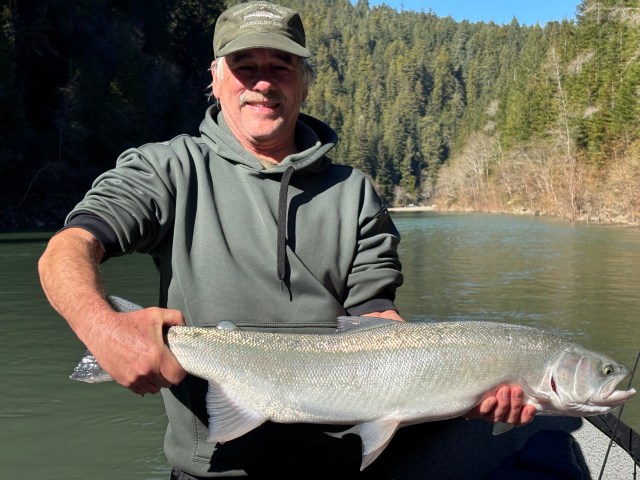
Big kings, like this one caught by Whitney Floyd on the Smith River, should be showing up after this weekend’s storms. Photo courtesy of Seth Waters Fishing

The season’s first major storms are headed for the North Coast, and they’re shaping up to be impressive. According to the National Weather Service office in Eureka, a deep and expansive Aleutian low will drive an atmospheric river–type system into the Pacific Northwest beginning Friday. Multiple disturbances rotating off this low will impact Northern California, bringing moderate to heavy precipitation from late Friday through Sunday.

Oceanic-to-coastal thunderstorms are also possible from Saturday afternoon into Sunday across Northern Humboldt and Del Norte counties. Rainfall totals are forecast to range from 4 to 6 inches in Del Norte County and 1.5 to 3.5 inches in Humboldt and Trinity counties. Another disturbance is expected to pass through on Sunday, with additional systems following into Monday. These will likely carry weak to moderate atmospheric river characteristics, especially on Sunday.

For salmon anglers, that’s welcome news. Fresh-from-the-salt king salmon — big, bright, and full of energy — will begin making their way up all of our coastal rivers starting this weekend. If you notice a line of drift boats heading north on U.S. Highway 101, this is the reason.

Following an early rise Saturday morning, both the Smith and Chetco rivers could be fishable by Sunday, though anglers should expect off-colored water, plenty of debris, and continued rising flows. Fresh kings should be moving through both systems.

As of Thursday, the Smith River is forecast to peak just over 4,000 cfs at the Jed Smith gauge early Monday morning before beginning a steady drop through the week. The Chetco is expected to follow a similar pattern, peaking around 1,500 cfs Saturday before leveling out and offering good conditions Sunday through Tuesday. Another round of storms predicted for next weekend could push Chetco flows above 2,300 cfs, bringing another pulse of fresh fish upriver.

As of Thursday, all North Coast rivers subjected to low flow fishing closures, including the Eel, Mad, Redwood Creek, Smith, and Van Duzen were closed to fishing. The low-flow closure telephone hotline for North Coast rivers is no longer in service. You can now find river openings and closures online at https://wildlife.ca.gov/Fishing/Inland/Low-Flow/North-Coast.
Low-flow information for all North Coast rivers is available here.

NOTE: The main stem Eel from the South Fork to Cape Horn Dam, the Mad River from the mouth to 200 yards upstream and the Mattole River will be closed until January 1, 2026.

Mad River
Predicted to peak at 545 cfs Monday morning. Minimum flows are 200 cfs at the gauging station at the Highway 299 bridge to lift angling restrictions.

Main Eel
Forecasted to reach 1,050 cfs early Monday morning. Minimum flows are 350 cfs on the Scotia gauge to lift angling restrictions.

Van Duzen
Predicted to peak at 340 cfs Monday morning Minimum flows are 150 cfs at the gauging station near Grizzly Creek Redwoods State Park to lift angling restrictions.

South Fork Eel
Flows are predicted to peak at 445 cfs Monday morning. Minimum flows are 340 cfs at Miranda to lift angling restrictions.

Smith
The Smith is likely to see heavy boat traffic this weekend. If the predictions hold, it could open sometime Saturday morning. It’s forecast for a steep rise through Sunday, but could be fishable in the afternoon. Monday is looking like the day. It could be a little dirty and leafy, but fish should be coming. Minimum flows are 600 cfs at Jedediah Smith State Park to lift angling restrictions.

Chetco/Rogue
“The Chetco should be high enough to float with a drift boat by the weekend, although bobber restrictions remain in place until early November,” said Andy Martin of Wild Rivers Fishing. “The estuary has slowed as big schools of kings have moved into the tidewater. Generally, boats can get down river with a little dragging at 800 cfs. Above 1,500 cfs, the lower river is an easy drift, although boats may bump bottom at Willow Riffle and above Moffit Rock. The gate at Ice Box is expected to remain closed until Nov. 3. Flows of 1,000 to 1,500 cfs are expected this weekend and early next week. At flows less than 2,000 cfs, boaters will have to fish next to bank anglers on the lower river. 

If rain comes in a little more than expected, the Elk and Sixes could become fishable, although a big surf could reduce the number of kings that move in from the ocean. The Rogue Bay is slow, with an occasional late king or coho moving through. Steelhead fishing has been disappointing upriver.”

Dungeness crab testing continues
Domoic acid testing in Dungeness crabs has begun on the California coast. To date, samples from Trinidad, Crescent City, and Monterey have been reported. Of the five crabs from Trinidad and Crescent City, one or more have exceeded the action level of 30 parts per million. Crabs tested out of Monterey Bay all came back clean. More information regarding Domoic Acid and the latest test results can be found here.

Expired marine flare collection events
The California Product Stewardship Council (CPSC) and the Make the Electronic Marine Flare Switch campaign have partnered with CalRecycle, and the California State Parks and Coastal Commission’s California Boating Clean and Green Program to collect expired marine flares and educate residents about marine flare management safety, including the advantages of reusable distress signals, to protect California communities and the local environment.
Residents and boaters berthing their boats in Alameda County, Del Norte County, West Contra Costa County, Marin County, and Santa Cruz County can take their expired marine flares to their county’s designated marine flare collection events in the fall. Click here for all the Bay Area times and locations.
A collection date for Del Norte has been set for Saturday, November 8, from 10 a.m. to 2 p.m. at 1700 State Street, Crescent City. For more information, visit www.calpsc.org/marineflareswitchcampaign

Kenny Priest operates Fishing the North Coast, a fishing guide service out of Humboldt specializing in salmon and steelhead. Find it on Facebook, Instagram, YouTube and fishingthenorthcoast.com. For up-to-date fishing reports and North Coast river information, email kenny@fishingthenorthcoast.com.

Storm Door Cracking Open on the North Coast

The Chetco estuary continues to be the hot spot for kings, with plenty of big ones being landed daily. Pictured above is one of the kings caught this week with guide Rye Phillips of Brookings Fishing Charters. Photo courtesy of Brookings Fishing Charters

The good news is we’re starting to see a shift in the weather pattern, bringing with it the second rainstorm of the season. Unfortunately, it looks like it will still fall short of what’s needed to open the coastal rivers to fishing. The one possible exception could be the main stem Eel River, where flows are predicted to surpass the 350 cfs threshold at Scotia.

From the Smith down to the South Fork Eel, roughly three-quarters to an inch of rain is forecast between Friday and Saturday. Another small storm is expected Monday, but it doesn’t appear strong enough to make much of a difference. While this rain will help, our parched rivers will need several inches and a series of consistent storms before they open up. Hopefully this is just the beginning and the storm door has been pushed open.

As a reminder, the low-flow hotline has been disconnected. River openings and closures can now be tracked in real time at wildlife.ca.gov/Fishing/Inland/Low-Flow/North-Coast. Low-flow information for all North Coast rivers is available here.

In the meantime, the Chetco continues to be the bright spot on the coast for fall kings. If you’re looking for big fish, now’s the time to go — before the rains come and the salmon make their move upriver.

Weekend marine forecast
South winds, albeit slight, are in the forecast for Friday and Saturday. As of Thursday afternoon, out 10 nautical miles, Friday’s forecast is calling for winds out of the south 10 to 15 knots with south waves 4 feet at five seconds and northwest 5 feet at 10 seconds. Saturday, winds will be out of the south up to 5 knots with west waves 3 feet at seven seconds and northwest 4 feet at 10 seconds. Sunday, winds will be 5 to 10 knots out of the north with northwest waves 2 feet at five seconds and northwest 6 feet at 10 seconds. These conditions can and will change by the weekend. For an up-to-date weather forecast, visit www.weather.gov/eureka/ or https://www.windy.com. You can also call the National Weather Service at (707) 443-7062 or the office on Woodley Island at (707) 443-6484.

Warnings lifted for some shellfish in Humboldt County
The California Department of Public Health (CDPH) has lifted the shellfish and seafood safety notification today related to certain sport-harvested bivalve shellfish from Humboldt County. The warning no longer applies to scallops, oysters and clams (except for razor clams). An advisory for razor clams in Humboldt County remains in effect.

CDFW Statement:

The safety notification for Humboldt County was issued on September 9, 2025, due to dangerous levels of domoic acid in mussels. This naturally occurring toxin can cause illness or death in humans. Recent testing shows domoic acid has decreased to safe levels in shellfish other than razor clams in this area. 

warning against eating sport-harvested razor clams from Humboldt County remains in effect as razor clams are at high risk for long-term elevated levels of domoic acid. Dangerous levels of naturally occurring domoic acid, also referred to as amnesic shellfish poisoning, have been detected in the razor clams. Razor clams are known to retain domoic acid toxin in their meat and tissues much longer than other species of bivalve shellfish. The annual mussel quarantine also remains in effect, which means that while scallops, oysters, and most types of clams can be harvested from Humboldt County, mussels remain under quarantine. The annual quarantine prohibits the sport-harvest of mussels for human consumption and applies to all species of mussels harvested along the California coast, as well as all bays and estuaries, and will continue through at least October 31.  This warning does not apply to commercially sold mussels, clams, scallops, or oysters from approved sources. State law permits only state-certified commercial shellfish harvesters or dealers to sell these products. Shellfish sold by certified harvesters and dealers are subject to frequent mandatory testing to monitor for toxins. More information can be found here.

The Oceans:
Eureka
“Excellent ocean conditions earlier this week allowed boats to make it down to the Cape for the first time in a while,” said Tim Klassen of Reel Steel Sport Fishing. “We fished down there on Tuesday and the bite was excellent. We landed a really good variety of rockfish along with some nice lings. There’s been just a few boats fishing for halibut, and it sounds like they’re still biting. Most of the action has been north of the entrance. Ocean conditions for the weekend don’t look great, with the south wind returning on Friday.”

Jesse Mela and Shaun Mitchell of Benbow with a couple Albacore landed Monday out of Shelter Cove. Photo courtesy of Jake Mitchell/Sea Hawk Sport Fishing

Shelter Cove
According to Jake Mitchell of Sea Hawk Sport Fishing, the rock fishing was good as usual. He said, “It’s been really quick and easy limits. We also got some nice weather Monday and Tuesday and we were able to get back offshore and look for tuna. It was a 45-mile run but the fish were there and bit pretty good. We ended the day with 36 and the boats that went Tuesday landed between 20 and 30. We fished outside the Knoll.

Brookings
“Lingcod, rockfish and crab action remains good out of Brookings, with halibut biting on calm weather days,” said Andy Martin of Brookings Fishing Charters. “This weekend looks decent. Lingcod are already staging in shallow water for the winter spawn.”

Low flow river closures in effect since Sept. 1
As Sept. 1, all North Coast rivers subjected to low flow fishing closures, including the Eel, Mad, Redwood Creek, Smith, and Van Duzen were closed to fishing. The low flow closure hotline for North Coast rivers is no longer in service. You can now find river openings and closures in real time online at https://wildlife.ca.gov/Fishing/Inland/Low-Flow/North-Coast.

Low-flow information for all North Coast rivers is available here.

NOTE: The main stem Eel from the South Fork to Cape Horn Dam, the Mad River from the mouth to 200 yards upstream and the Mattole River will be closed until January 1, 2026.

The Rivers:
Lower Klamath
The Klamath is back under 3,000 cfs as of Thursday, but the mouth reportedly remains plugged or severely restricted. There hasn’t been much in the way of new fish entering the lower river for quite some time. Rain is on the way, hopefully it will be enough to blow it out. There should be quite a few more kings, along with coho, still waiting to make their way into the river. Fishing pressure has been very light.

The daily bag limit is two hatchery steelhead or hatchery trout per day on both the Klamath and Trinity rivers, with a possession limit of four. Anglers must have a Steelhead Report/Restoration Card in their possession while fishing for steelhead trout in anadromous waters. Both the Klamath and Trinity rivers are open to fishing, but take and possession of Chinook salmon is prohibited. More information, can be found here.

Chetco/Rogue
According to Martin. salmon fishing has been good at the mouth of the Chetco, but the estuary is crowded with upwards of 30 boats a day along the jetties. “Salmon to 30 pounds are being caught daily, with wild and hatchery adults and lots of jacks. Salmon also are biting bobbers and eggs in the tidewater. 
The Rogue Bay is still a solid bet, with late kings, lots of wild coho and a few hatchery coho. Crowds also have thinned out.”

Kenny Priest operates Fishing the North Coast, a fishing guide service out of Humboldt specializing in salmon and steelhead. Find it on Facebook, Instagram, YouTube and fishingthenorthcoast.com. For up-to-date fishing reports and North Coast river information, email kenny@fishingthenorthcoast.com.

Rains Tease Salmon Anglers, But Rivers Stay Closed

Late fall kings, like the one pictured with angler Craig Nunley, will begin to make their way into the coastal rivers once the winter rains begin. Anglers will be able to harvest Chinook salmon this fall on the Smith while sections of the Eel will be open to catch and release. Photo courtesy of Andy Martin of Wild Rivers Fishing

With more than an inch of rain falling across most coastal watersheds, late-fall salmon anglers were quick to take notice. After such a long summer dry spell, the excitement is understandable —but it will take far more than an inch to open the rivers. None came close to fishable levels, so the wait continues for enough rain to get flows rising, salmon moving, and rivers open.

In the meantime, offshore options remain strong. The boat-based rockfish and lingcod season runs through year’s end, and NOAA recently opened all depths from the Oregon/California border south to Point Conception. With Dungeness crab season set to open Nov. 1, rockfish/crab combos will soon be popular.

Pacific halibut is also still in play, with just 16,176 pounds of the 39,280-pound quota taken. The season closes Nov. 15, leaving a couple more weeks for halibut/rockfish/crab combos.

When the rivers do open, the Smith will draw the most attention as the only North Coast river open to salmon harvest — one Chinook per day, with no more than five wild fish per year. The Smith must reach 600 cfs at Jedediah Smith State Park to open, and remains closed above Rowdy Creek. The Eel and Van Duzen will allow catch-and-release for Chinook in 2025, with sections subject to low-flow closures.

The Chetco estuary is another good option as it continues to kick out big kings for trollers working anchovies. Until the rain comes, anglers still have plenty of solid options.

Weekend marine forecast
Northerly winds will return Friday, but ocean conditions remain sporty. As of Thursday afternoon, Friday’s forecast out 10 nautical miles is calling for winds out of the north 5 to 10 knots with northwest waves 7 feet at 11 seconds and west 2 feet at 16 seconds. Saturday, winds will be out of the north 10 to 15 knots with north waves 3 feet at five seconds and northwest 5 feet at nine seconds. Sunday, the winds will be 10 to 15 knots out of the north with north waves 5 feet at seven seconds and west 3 feet at 12 seconds. These conditions can and will change by the weekend. For an up-to-date weather forecast, visit www.weather.gov/eureka/ or https://www.windy.com. You can also call the National Weather Service at (707) 443-7062 or the office on Woodley Island at (707) 443-6484.

Ruth Lake Fall Bass tournament this Saturday
The Alderpoint Volunteer Fire Department is hosting the Fallen Fire Fighters Memorial Bass Tournament on Saturday October 4th at Ruth Lake. Check in is Friday night between 4:30 p.m. and 6:30 p.m. at Ruth Lake Marina or at Journey’s End between 6:30 p.m. and 8:30 p.m. This is a catch and release tournament with a 13-inch minimum length. Blast off is 6 a.m. or at first safe light. For more information, call Thomas Bruce at 707-223-6258 or Roger Coleman Jr. at 707-223-3858.

The Oceans:
Eureka
According to Tim Klassen of Reel Steel Sport Fishing, there hasn’t been any offshore opportunities the past couple weeks due to weather. “It looks like we’ve finally have some decent ocean conditions starting next Monday and Tuesday,” said Klassen. “Pacific halibut and rockfish should be within reach.”

Shelter Cove
According to Jake Mitchell of Sea Hawk Sport Fishing, not a lot of effort the last few days due to weather. “When we got out earlier in the week, it was good fishing,” said Mitchell. “We fished in close by the whistle over the weekend and it was quick easy limits on the rockfish and lingcod.”

Brookings
Halibut season runs through Oct. 31 out of Brookings reports Andy Martin of Brookings Fishing Charters. “Rough weather has kept boats closer to shore, away from the halibut grounds,” said Martin. “Lingcod and rockfish action, long with sport crabbing, has been good.”

Willow Creek weir counts
For the week ending Sept. 23, a total of 345 adult kings were counted at the Willow Creek weir. The jack count for the week was 148. For the season to date, 1,280 (adults and jacks) have been counted, including both hatchery and wild. The totals are for only 17 trapping days. In 2024, 720 kings (adults and jacks) were trapped over 57 trap days.

Low flow river closures in effect since Sept. 1
As of Sept. 1, all North Coast rivers subjected to low flow fishing closures, including the Eel, Mad, Redwood Creek, Smith, and Van Duzen were closed to fishing. The low flow closure hotline for North Coast rivers is no longer in service. You can now find river openings and closures in real time online at https://wildlife.ca.gov/Fishing/Inland/Low-Flow/North-Coast.

NOTE: The main stem Eel from the South Fork to Cape Horn Dam, the Mad River from the mouth to 200 yards upstream and the Mattole River will be closed until January 1, 2026.

The Rivers:
Lower Klamath
After reaching 3,600 cfs Wednesday, the Klamath is back on the drop. The increase in flows has reportedly opened the mouth back up. There should be fresh steelhead and salmon making their way into the lower river. Fishing pressure remains light.

The daily bag limit is two hatchery steelhead or hatchery trout per day on both the Klamath and Trinity rivers, with a possession limit of four. Anglers must have a Steelhead Report/Restoration Card in their possession while fishing for steelhead trout in anadromous waters. Both the Klamath and Trinity rivers are open to fishing, but take and possession of Chinook salmon is prohibited. More information, can be found here.

Chetco/Rogue
According to Martin, salmon fishing picked up at the mouth of the Chetco before this week’s rain. “Stormy weather, with a rough bar and gusting south winds, stalled action for a few days, but conditions are expected to be prime by week’s end. A mix of wild and hatchery adults and jacks are being caught. A few jacks also have been caught upriver on bobbers. Despite the rain, the Chetco is still well below drifts levels for boats above tidewater. 
Coho salmon fishing has been good on the Rogue Bay, where kings also are still showing up in the catch. Fishing has slowed, however, as the main long run blasts upstream.”

Kenny Priest operates Fishing the North Coast, a fishing guide service out of Humboldt specializing in salmon and steelhead. Find it on Facebook, Instagram, YouTube and fishingthenorthcoast.com. For up-to-date fishing reports and North Coast river information, email kenny@fishingthenorthcoast.com.

All-Depth Groundfish Fishing Now Open Statewide

Fresno resident Jerry Urzua landed a nice lingcod on a recent trip out of Shelter Cove. Lingcod, as well as rockfish, cabezon, greenlings can now be harvested at all depths through Dec. 31st. Photo courtesy of Jake Mitchell/Sea Hawk Sport Fishing

Just in time for the ever-popular crab/rockfish/halibut combo trips starting in November, NOAA Fisheries announced on Sept. 18 that in state and federal waters between the Oregon/California border and Point Conception (34° 27′ N. Lat.), anglers may now take the RCG Complex (rockfish, cabezon, greenlings) and lingcod at all depths through December 31, 2025.

New scientific data show stronger-than-expected numbers of quillback rockfish off California, prompting the California Fish and Game Commission to take emergency action on August 28 to reopen access in state waters. NOAA Fisheries / NMFS matched those changes in federal waters effective Sept. 18, 2025.

Key changes for recreational anglers:

  • Two-fish sub-bag limit on canary rockfish statewide.
  • Vermilion and sunset rockfish combined: both species count toward the same sub-bag limit.
  • Prohibited species remain closed: no retention of quillback rockfish, bronzespotted rockfish, cowcod, or yelloweye rockfish.
  • Management area realignment: the Lopez Point boundary has been removed, creating the new Central Groundfish Management Area from 37° 11′ N. (Pigeon Point) to 34° 27′ N. (Point Conception).
  • Descending devices required: all vessels taking or possessing federal groundfish must carry one to minimize barotrauma and safely return fish to depth.

For the most up-to-date regulations, visit wildlife.ca.gov/Fishing/Ocean/Regulations/Groundfish-Summary.

Weekend marine forecast
Some rough ocean conditions are on tap for the next several days. As of Thursday, the forecast out 10 nautical miles for Friday is calling for winds out of the north 20 to 25 knots with northwest waves 9 feet at nine seconds. Saturday is calling for winds from the northwest 5 to 10 knots and northwest waves 9 feet at 15 seconds. Sunday the winds will be out of the south 5 to 10 knots and northwest waves 7 feet at 12 seconds. These conditions can and will change by the weekend. For an up-to-date weather forecast, visit www.weather.gov/eureka/ or www.windy.com. You can also call the National Weather Service at 443-7062 or the office on Woodley Island at 443-6484.

Ruth Lake Fall Bass tournament coming Oct. 4
The Alderpoint Volunteer Fire Department is hosting the Fallen Fire Fighters Memorial Bass Tournament on Saturday October 4th at Ruth Lake. Check in is Friday night between 4:30 p.m. and 6:30 p.m. at Ruth Lake Marina or at Journey’s End between 6:30 p.m. and 8:30 p.m. This is a catch and release tournament with a 13-inch minimum length. Blast off is 6 a.m. or at first safe light. For more information, call Thomas Bruce at 707-223-6258 or Roger Coleman Jr. at 707-223-3858.

CDPH lifts warning for sport-harvested Del Norte County Bivalve Shellfish
The California Department of Public Health (CDPH) has lifted the shellfish safety notifications today related to sport-harvested bivalve shellfish from Del Norte County.

CDPH Statement:

“The safety notification for Del Norte County was issued on July 3, 2025, due to dangerous levels of paralytic shellfish poisoning toxins in mussels. These naturally occurring toxins can cause illness or death in humans. Recent testing shows paralytic shellfish poisoning toxins have decreased to safe levels in mussels in this area. 

While this warning has been lifted, the annual mussel quarantine remains in effect, which means that while scallops, clams, and oysters can be harvested from Del Norte County, mussels remain under quarantine. The annual quarantine prohibits the sport-harvest of mussels for human consumption and applies to all species of mussels harvested along the California coast, as well as all bays and estuaries, and will continue through at least October 31. 

safety notification issued September 9, 2025, for sport-harvested mussels, scallops, clams, and oysters from Humboldt County remains in effect due to the presence of domoic acid in mussels. 

This warning does not apply to commercially sold mussels, clams, scallops, or oysters from approved sources. State law permits only state-certified commercial shellfish harvesters or dealers to sell these products. Shellfish sold by certified harvesters and dealers are subject to frequent mandatory testing to monitor for toxins

Paralytic shellfish poisoning toxins affect the nervous system, producing a tingling around the mouth and fingertips within a few minutes to a few hours after eating toxic shellfish. These symptoms are typically followed by loss of balance, lack of muscular coordination, slurred speech and difficulty swallowing. In severe poisonings, complete muscular paralysis and death from asphyxiation can occur.”

You can get the most current information on shellfish advisories and quarantines by calling CDPH’s toll-free Shellfish Information Line at (800) 553-4133 or viewing the recreational bivalve shellfish advisory interactive map. For additional information, please visit the CDPH Marine Biotoxin Monitoring web page. ​​​

The Oceans:
Eureka
It’s been a fairly quiet week for the Eureka fleet since last Saturday’s tuna run. A handful of boats made a 55-mile run south and after several hours of nothing, the bite turned on. One of the local charters boated 24 albies, all between 15 and 25 pounds. It doesn’t look like we’ll see another opportunity for quite a few days. Pacific halibut are still being caught north of the entrance near the 51 line, but the effort has slowed. Weather permitting, the rockfish bite at the Cape is still good.

Tim Klassen of Reel Steel Sport Fishing submitted a proposal at the recent PFMC meeting to open up the Pacific halibut season in April instead of May. According to Klassen, the proposal was approved, and will be voted on at the Nov. Pacific Fishery Management Council (PFMC) meeting. It would then need approval by International Pacific Halibut Commission.

Shelter Cove
According to Jake Mitchell of Sea Hawk Sport Fishing, rock fishing has been excellent with quick limits of rockfish and lingcod every day this week. “Most of the effort was at the Hat,” said Mitchell. “Pacific halibut remains slow and there was a one-day tuna window on Saturday, but the boats that went did not do very well.”

Crescent City
“Not much has changed since last week, the weather hasn’t been great and not many boats are getting out,” said Will Moore of Crescent City’s Englund Marine. “When the boats do get out, the rockfish and lingcod bite is still really good. We haven’t seen the bite slow down at all. Both the California and Pacific halibut effort has dwindled to nothing.”

Brookings
According to Andy Martin of Brookings Fishing Charters, the Pacific halibut fishing is fair out of Brookings. He said, “Winds subside this weekend, but bigger swells could stall the action. Rockfish action is good, with plenty of lingcod in the mix. Sport crabbing remains very good.”

ODFW Hosting Public Meetings on 2026 Bottomfish and Halibut Seasons
The Oregon Department of Fish and Wildlife will hold a series of in-person meetings Oct. 6–8 to discuss the 2026 recreational bottomfish and Pacific halibut seasons with anglers. The Oct. 8 meeting in Newport will also offer a virtual option via Microsoft Teams.

Meeting Schedule:

  • Oct. 6 – Brookings: 5:30–7:30 p.m., Port Meeting Room, Port of Brookings, 16330 Lower Harbor Rd.
  • Oct. 7 – North Bend: 6–8 p.m., North Bend Public Library, 1800 Sherman Ave.
  • Oct. 8 – Newport: 6–8 p.m., Hatfield Marine Science Center, Gladys Valley Marine Studies Building, Classroom 176, 2030 SE Marine Science Dr. (Virtual option available)

Topics for Discussion

  • Review of 2025 bottomfish harvest with lower guidelines and stricter bag limits for black rockfish and canary rockfish.
  • Pros and cons of a year-round fishery vs. a four-fish daily marine species limit with a one-fish sub-bag limit for canary rockfish.
  • Pacific halibut proposals including:
    • Restructuring the Columbia River subarea nearshore fishery.
    • “Frontloading” the Central Oregon Coast quota to the spring all-depth fishery for added flexibility.

ODFW will post meeting materials on its recreational bottomfish and Pacific halibut webpages by Friday, Oct. 3. More information can be found here.

Low flow river closures in effect since Sept. 1
As Sept. 1, All North Coast rivers subjected to low flow fishing closures, including the Eel, Mad, Redwood Creek, Smith, and Van Duzen were closed to fishing. The Department of Fish and Game will make the information available to the public by a telephone recorded message updated, as necessary, no later than 1 p.m. each Monday, Wednesday and Friday as to whether any stream will be closed to fishing. The rivers can be opened up at any time. The low flow closure hotline for North Coast rivers is 707-822-3164. You can also find river openings and closures online at https://wildlife.ca.gov/Fishing/Inland/Low-Flow/North-Coast.
NOTE: The main stem Eel from the South Fork to Cape Horn Dam, the Mad River from the mouth to 200 yards upstream and the Mattole River will be closed until January 1, 2026.

The Rivers:
Lower Klamath
The fishing slowed dramatically this week on the lower Klamath, with the bulk of the run now upriver. The mouth also has been sanding over, which has slowed the numbers of fish making their way in. With some rain in the forecast, the mouth should open back up and we should we some fresh fish enter the system. To date, there hasn’t been much, if any, coho in the river, which typically means the king run is nearing the end.
The daily bag limit is two hatchery steelhead or hatchery trout per day on both the Klamath and Trinity rivers, with a possession limit of four. Anglers must have a Steelhead Report/Restoration Card in their possession while fishing for steelhead trout in anadromous waters. Both the Klamath and Trinity rivers are closed to the take and possession of Chinook salmon. More information, can be found here.

Chetco/Lower Rogue
Salmon fishing is fair on the Chetco, with a handful of nice adults and numerous jacks being caught daily by boaters trolling along the jetties reports Martin. “The estuary has been crowded. Still too early for bobber fishing upriver. 
Salmon also are still being caught on the Rogue Bay, with a mix of wild and hatchery kings, lots of wild coho and a few hatchery coho. Crowds have thinned, but there is still plenty of boat activity. Summer steelhead are beginning to show upriver near Agness.”

Kenny Priest operates Fishing the North Coast, a fishing guide service out of Humboldt specializing in salmon and steelhead. Find it on Facebook, Instagram, YouTube and fishingthenorthcoast.com. For up-to-date fishing reports and North Coast river information, email kenny@fishingthenorthcoast.com.

Big Push of Salmon and Steelhead Follows Klamath Flow Increase

Eureka resident Tim Call landed a nice steelhead on a recent outing on the Klamath River. Photo courtesy of Alan Borges/Alan’s Guide Service

As soon as increased flows hit the lower Klamath, big schools of salmon and steelhead charged upriver. Fishing was excellent earlier in the week, and small pulses of fish should continue moving in over the next few weeks. Flows peaked at 4,172 cfs Wednesday and are now dropping but will remain high through the holiday weekend, around 3,100 cfs Saturday morning. Angling pressure has been light so far, but expect that to change as the holiday crowd arrives.

The daily bag limit is two hatchery steelhead or hatchery trout per day on both the Klamath and Trinity rivers, with a possession limit of four. Anglers must have a Steelhead Report/Restoration Card in their possession while fishing for steelhead trout in anadromous waters. Both the Klamath and Trinity rivers are closed to the take and possession of Chinook salmon. More information, can be found here.

Yurok gill net quota reached
On Monday, the Yurok Tribe announced that their fall personal subsistence gill net quota has been reached within the Yurok Reservation. Tribal fishery employees will continue to gill net for the 300 elder’s fish quota.

Weekend marine forecast
Conditions are looking excellent the next few days for those looking to hit the tuna grounds. Out 10 to 60 nautical miles, Friday’s forecast is calling for southeast winds up to 5 knots and waves out of the northwest 2 feet at seven seconds and south 2 feet at 16 seconds. Saturday is calling for north winds 5 to 10 knots and waves north 1 foot at 6 seconds and south 3 feet at 16 seconds. Sunday, winds will be out of the south 10 to 15 knots and waves north 3 feet at 5 seconds and northwest 2 feet at 10 seconds. These conditions can and will change by the weekend. For an up-to-date weather forecast, visit www.weather.gov/eureka or www.windy.com. You can also call the National Weather Service at 443-7062 or the office on Woodley Island at 443-6484.

Pikeminnow Fishing Derby ends Saturday
There are just a few days remaining to bring home some cash as the Eel River Pikeminnow Fishing Derby ends after Sunday, Aug. 31. Visit https://tribresearch.org/pikeminnow/ to learn more, sign up for the derby, and submit your catch to the contest before it ends.

Saturday is statewide Free Fishing Day
The last chance of the year to fish for free arrives over the Labor Day holiday weekend. Free Fishing Day is offered by the California Department of Fish and Wildlife Saturday, Aug. 30. While no fishing license is required on free fishing days, all fishing regulations, such as bag and size limits, gear restrictions, report card requirements, fishing hours and stream closures remain in effect. Every angler must have an appropriate report card if they are fishing for steelhead or sturgeon anywhere in the state or salmon in the Smith River system. For more information, visit wildlife.ca.gov/Licensing/Fishing/Free-Fishing-Days

Bay Area ocean salmon season reopens Sept. 4
The ocean sport salmon season will re-open on Sept. 4 in two Bay Area subareas.

  • Point Reyes to Pigeon Point (San Francisco Subarea):
    • September 4-7 & 29-30; October 1-5 & 27-31 – Minimum size limit: 20 inches total length. Two salmon of any species except coho
  • Pigeon Point to Point Sur (Monterey Subarea)
    • September 4-7 & 29-30 – Minimum size limit: 20 inches total length. Two salmon of any species except coho

Fall Harvest Guideline: 7,500 Chinook. In-season action may be taken to close remaining September – October days when the total harvest is approaching a statewide limit of 7,500 Chinook salmon. More information can be found here.

The oceans:
Eureka
Tuna anglers reported Thursday that the warm water is now at least 60 miles out of Eureka. They also reported the fishing wasn’t very good. Tim Klassen of Reel Steel Sport Fishing, along with many others were planning on heading out Friday, but plans are likely changing for some. “The weather looks excellent for Friday and Saturday, hopefully we get a good SST shot to see where the water is,” said Klassen. The Pacific halibut bite has been good when we can get out. Quite a few limits are being caught near the 55-line. Cape Mendocino has been producing some really good rock fishing, and it should be an easy ride down there the next few days.”

Shelter Cove
“Rock fishing remains solid, with limits coming every day,” said Jake Mitchell of Sea Hawk Sport Fishing. “Most of the effort this week was around the Old Man. Pacific halibut has been slow, although there were a couple caught this week. Boats will be trying for albacore the next couple days for the first time in a week. We haven’t had a good satellite shot in a week or so, we’re expecting to close to 50 miles out.”

Crescent City
According to Chris Hegnes of Crescent City’s Englund Marine, the fishing effort has slowed. He said, “There’s been a couple boats out for tuna, but the fishing hasn’t been. Most guys are headed north to Charleston. The rockfish and lingcod bite remain excellent, no change there. The California halibut bite has slowed down as well as the effort. There have been a couple Thresher sharks caught off of South Beach last few weeks.”

Brookings
“The best halibut fishing of the season is happening right now,” said Andy Martin of Brookings Fishing Charters. “Boats are focusing on 200 to 250 feet of water off of Bird Island. Combinations of squid and herring are working best. Lingcod and rockfish action also is good, while sport crabbing has improved in recent weeks.” 

Low Flow River Closures begin Sept. 1
North Coast rivers that are regulated by low flow closures, including the Eel, Mad, Mattole, Redwood Creek, Smith and Van Duzen begin angling restrictions on Sept. 1 and will run through April 30 2026. As a reminder, in 2022, a low-flow angling restriction was added to the section of the Eel River from the mouth to Fulmor Road (Eel estuary) at its paved junction with the south bank of the Eel River. When a low-flow closure occurs in this section of the Eel, it will be closed to hook-and-line fishing; other legal fishing methods are allowed during this timeframe.

The Department of Fish and Game will make the information available to the public by a telephone recorded message updated, as necessary, no later than 1 p.m. each Monday, Wednesday and Friday as to whether any stream will be closed to fishing. The rivers can be opened up at any time. The low flow closure hotline for North Coast rivers is 707-822-3164. NOTE: The main stem Eel from the South Fork to Cape Horn Dam and the Mattole River will be closed until January 1, 2026.

Areas subject to low flow closures:

Mad River: The main stem Mad River from the Hammond Trail Railroad Trestle to Cowan Creek. Minimum flow: 200 cfs at the gauging station at the Highway 299 bridge. The Mad River from the mouth to 200 yards upstream is closed until Jan. 1, 2026.

The main stem Eel River: New in 2022, a low-flow angling restriction was added to the section of the Eel River from the mouth to Fulmor Road at its paved junction with the south bank of the Eel River, Sept. 1 through April 30. The stream flow will be monitored as follows: Minimum Flow: 350 cubic feet per second at the gauging station near Scotia.

The South Fork of the Eel River: The South Fork of the Eel River downstream from Rattlesnake Creek and the Middle Fork Eel River downstream from the Bar Creek. Minimum flow: 340 cfs at the gauging station at Miranda.

Van Duzen River: The main stem Van Duzen River from its junction with the Eel River to the end of Golden Gate Drive near Bridgeville (approximately 4,000 feet upstream of Little Golden Gate Bridge. Minimum flow: 150 cfs at the gauging station near Grizzly Creek Redwoods State Park.

Mattole River: The main stem of the Mattole River from the mouth to Honeydew Creek. Minimum flow: 320 cfs at the gauging station at Petrolia.

Redwood Creek: The main stem of Redwood Creek from the mouth to its confluence with Bond Creek. Minimum flow: 300 cfs at the gauging station near the Highway 101 bridge.

Smith River: The main stem Smith River from the mouth of Rowdy Creek to its confluence with Patrick Creek; the South Fork Smith River from the mouth upstream approximately 1000 ft to the County Road (George Tyron) bridge and Craigs Creek to its confluence with Jones Creek; and the North Fork Smith River from the mouth to its confluence with Stony Creek. Minimum flow: 600 cfs at the Jedediah Smith State Park gauging station.

The Rivers
Lower Rogue/Chetco
According to Martin, the first kings of the season have been caught in the Chetco estuary. “Salmon to 25 pounds have been weighed in, along with numerous jacks. Bottom fish anglers are encountering salmon along the coast of Brookings, but the ocean is now closed to both kings and coho. The Rogue Bay has been fair, with lots of boats and a few good days each week. Labor Day Weekend is peak season on the Rogue Bay.”

Kenny Priest operates Fishing the North Coast, a fishing guide service out of Humboldt specializing in salmon and steelhead. Find it on Facebook, Instagram, YouTube and fishingthenorthcoast.com. For up-to-date fishing reports and North Coast river information, email kenny@fishingthenorthcoast.com.

Eureka Tuna Action Falls Short of Expectations

Robin Brown of Benbow shows off a nice albacore caught over the weekend while fishing out of Shelter Cove with Sea Hawk Sport Fishing. Photo courtesy of Jake Mitchell/Sea Hawk Sport Fishing.

Heading into last weekend, anticipation was sky-high for a wide-open tuna bite off Eureka. With flat seas and warm water in place, conditions looked perfect for an epic run. While the action didn’t quite live up to those lofty expectations, there were still some bright spots—and plenty of lessons learned for next time.

The best water was sitting southwest of Eureka near Cape Mendocino, roughly 30 miles from the entrance to Humboldt Bay. Many boats made the run and put in serious effort, but scores were generally modest. The crews that landed the most fish found success drifting live bait immediately after hooking up on the troll—a tactic you can expect to see more of on future trips.

Looking ahead, the next shot might take a little patience. Winds are forecasted through at least Tuesday, which will likely keep the fleet on shore for a few days. The good news? The warm water appears to be holding in place offshore. If that continues, round two could shape up by the middle of next week—and with a few adjustments, the bite could turn on in a big way.

Weekend marine forecast
After some really good conditions earlier in the week, the wind will make a return, sidelining the tuna fleet through the weekend and early next week. On Friday, within 10 nautical miles, winds will be out of the northwest 5 to 10 knots. Waves will be from the northwest 6 feet at seven seconds. Saturday is calling for northwest winds up to 5 knots and waves northwest 4 feet at seven seconds. Sunday’s forecast looks a little better, with winds out of the northwest 5 to 10 knots and waves northwest 3 feet at seven seconds. These conditions can and will change by the weekend. For an up-to-date weather forecast, visit www.weather.gov/eureka or www.windy.com. You can also call the National Weather Service at 443-7062 or the office on Woodley Island at 443-6484.

August 30 is statewide Free Fishing Day
The last chance of the year to fish for free arrives over the Labor Day holiday weekend. Free Fishing Day is offered by the California Department of Fish and Wildlife Saturday, Aug. 30. While no fishing license is required on free fishing days, all fishing regulations, such as bag and size limits, gear restrictions, report card requirements, fishing hours and stream closures remain in effect. Every angler must have an appropriate report card if they are fishing for steelhead or sturgeon anywhere in the state or salmon in the Smith River. For more information, visit wildlife.ca.gov/Licensing/Fishing/Free-Fishing-Days

Pacific halibut quota update
As of August 17, California’s share of Area 2A’s quota, which includes Washington and Oregon, is at 41 percent, with just 16,176 net pounds harvested against the 39,280 net pound quota. (500 pounds are set aside for the area south of Point Arena). The Pacific halibut fishery will run through Nov. 15 or until the quota is reached, whichever is earlier. To view the latest catch projection information, visit wildlife.ca.gov/conservation/marine/pacific-halibut#31670772-in-season-tracking.

Trinity River water release
Beginning Friday, Aug. 22, the Bureau of Reclamation will begin to increase flows to the Trinity River for the Hoopa Valley Tribe’s Ceremonial Boat Dance. Lewiston Dam releases are scheduled to gradually increase from the summer base flow of 450 cubic feet per second and are expected to reach a peak flow of 2,300 cfs on Aug. 25 before gradually returning to summer base flows later in the week.

River recreators can expect a higher volume of water and increased turbidity in the Trinity River during the ceremonial flow. As always, the public is urged to exercise caution when recreating in or around the Trinity River. For more information, contact Reclamation’s Northern California Area Office at 530-247-8500 (TTY 800-877-8339)

An angler aboard Eureka’s Fishy Business is all smiles after boating a couple Tuna Monday. Photo courtesy of Matt Dallam/Northwind Charters

The oceans:
Eureka
“The tuna bite never really exploded over the weekend, but there were some decent scores put up,” said Tim Klassen of Reel Steel Sport Fishing. “If I had to rate the fishing, I’d say it was a 5 out of 10. Some boats got 4 or 5, or less, with some of the top scores in the low twenties. The best bite was southwest of the entrance about 30 to 35 miles. The water was plenty warm, but there wasn’t much bait around. That might have had something to do with the slow bite. We had our best success on live bait stops, and I think that was the case for the other boats as well. Though there weren’t big numbers of fish, they were all really good size. They averaged 15 to 25 pounds with no peanuts in the mix.

The halibut got a little bit of a reprieve with a lot of boats focusing on tuna. The boats that did target halibut did well, with most putting in limits. We ran to the Cape last Friday chasing rockfish, and the bite was really good. Not a ton of variety but we did get limits of rockfish and lingcod. There’s some really big and healthy black rockfish down there now.”

Shelter Cove
The weather laid down for a tuna run on Monday and boats did ok reports Jake Mitchell of Sea Hawk Sport Fishing. He said, “Scores ranged from 5 to 30 fish for boats targeting tuna in the Gorda Valley area. Rock fishing remains solid, but the lingcod are really hit and miss lately.”

Crescent City
“The tuna fishing out of Crescent City has not taken off,” said Will Moore of Crescent City’s Englund Marine. “A few commercial boats went out and didn’t find anything until they got way north. Because of that, there hasn’t been much effort from the sport guys. The California halibut bite has slowed a little, but they’re still here. The same can’t be said for the Pacific Halibut. The rockfish and lingcod fishing continues to sizzle, with easy limits coming for anglers targeting the Sisters and the cans out front. Some really big vermilion are being caught.”

Brookings
“Ocean salmon season closes Sunday on the Southern Oregon Coast,” said Andy Martin of Brookings Fishing Charters. “Fishing has been slow, with a few hatchery coho still being caught and plenty of wild coho. Fishing is already closed for kings. Halibut action improved this week out of Brookings, with a few charters averaging a fish per rod, and two-fish limits some days. The best fishing has been in 250 to 300 feet. Herring and squid combinations are working best. Sport crabbing is good out of Brookings. Lingcod and rockfish also are biting well.”

The Rivers:
Lower Klamath
The river is in good shape as flows have dropped under 2,800 cfs as of Thursday. The water being released from Lewiston is forecast to reach the lower Klamath Sunday morning, raising the cfs’s to just over 3,000. This should bring in some fish from the ocean/estuary and we should see the first real good push of salmon moving upriver. Fishing for steelhead was decent last weekend, with boats hooking 3 to 6 fish a day. The daily bag limit is two hatchery steelhead or hatchery trout per day on both the Klamath and Trinity rivers, with a possession limit of four. Anglers must have a Steelhead Fishing Report and Restoration Card in their possession while fishing for steelhead trout in anadromous waters More information can be found here.

Lower Rogue/Chetco
According to Martin, the Rogue Bay has been fair, with good catches one day and then a couple of slow days. “Large kings to 40 pounds are being caught. The crowds have arrived, with well over 100 boats a day trolling the bay.”

Kenny Priest operates Fishing the North Coast, a fishing guide service out of Humboldt specializing in salmon and steelhead. Find it on Facebook, Instagram, YouTube and fishingthenorthcoast.com. For up-to-date fishing reports and North Coast river information, email kenny@fishingthenorthcoast.com.