Green Rivers and Fresh Fish Give Steelheaders Plenty of Options

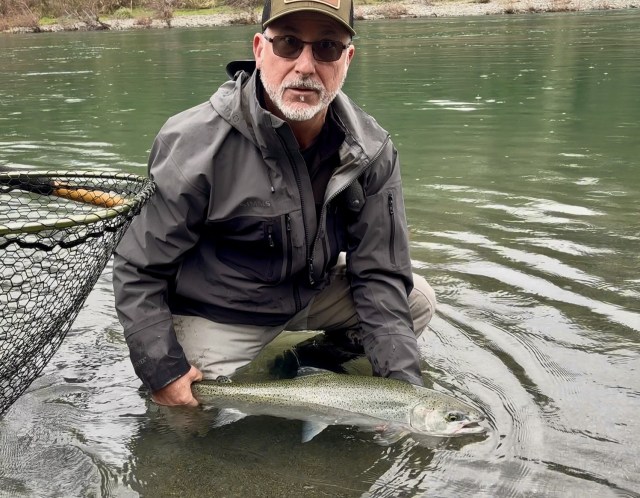
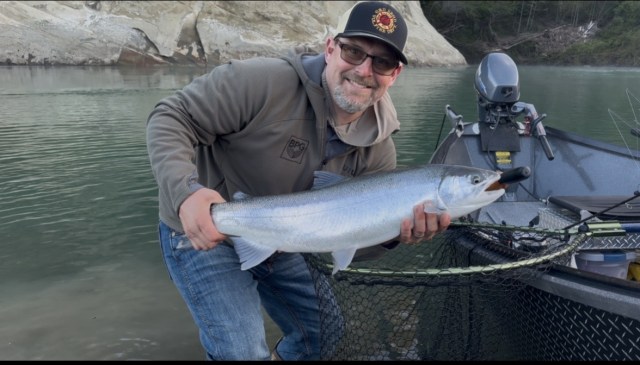
Livermore resident Pete Mccafferty holds a late-season steelhead from the Smith River taken last weekend. Photo courtesy of Fishing the North Coast/Kenny Priest

If you’re looking to do some late-season steelhead fishing this weekend, you’ll have a few pretty good options.

To the north, both the Smith and Chetco rivers are in good shape and should provide some solid action, especially the Chetco. Closer to home, the South Fork Eel and Van Duzen are both green and shaping up to be excellent options through the weekend. The Van Duzen should be particularly good for anglers looking for a strong bank-fishing opportunity.

All of these rivers should have some fresh fish moving through, and there are still plenty of downrunners heading back toward the salt.

Although we’re expecting mostly sunny conditions this weekend and into next week, it looks like the weather pattern may shift again late next week. Rain is back in the forecast, and the 10-day ensemble models are showing rising flows on most coastal rivers.

The rivers to the south and the Mad are predicted to see a bump in flows, though it’s still uncertain how much. The Smith is expected to see a decent rise, but it should do more good than harm. The same goes for the Chetco.

So get out and enjoy the green water while it lasts — it may not stick around forever.

The weather ahead
According to Eureka’s National Weather Service office, “the coastal conditions will dry through the week. High pressure will encourage a weak marine layer to form each night, but increasingly strong north winds during the day will encourage quick clearing each afternoon. Gusty north winds pushing close to shore will most likely bring some gusts close to 20 kts each afternoon near shore and locally higher gusts on ridges. There is high confidence that slightly cooler temperatures will return by early next week as high pressure weakens, but there is little chance of wetting rain until late next week at least when about 20% of ensemble models show a weak trough crossing the area.

Upcoming salmon meetings
March 4-9: PFMC March Meeting in Sacramento, CA. The Council will determine whether any in-season actions are required for fisheries scheduled to open prior to May 16. They will also craft three regulatory alternatives for ocean salmon fisheries in effect on or after May 16. Final adoption of alternatives for public review is tentatively scheduled for March 9.

March 23: PFMC Public Hearing in Santa Rosa, CA at 7 p.m. The Council will receive comments from the public on the three California ocean salmon fishery regulatory alternatives adopted by the Council in March

April 7-12: PFMC April Meeting in Portland, OR. The Council will adopt final regulatory measures for analysis by the STT. Final adoption of recommendations to the National Marine Fisheries Service will also occur and is tentatively scheduled for April 12.
Preseason Report III: Council-Adopted Management Measures and Environmental Assessment Part 3 for 2026 Ocean Salmon Fishery Regulations will be available online in late April at www.pcouncil.org

April 15-16: CDFW Commission Meeting in Sacramento, CA. The Commission will receive an update on ocean salmon sport fishery regulations in effect in 2026. The public may address and/or ask questions of the Commission relating to the implementation of its policies or any other matter within the jurisdiction of the Commission. Agenda and audio available online at https://fgc.ca.gov/Meetings/2026

The Rivers:
Mad
As of Thursday, the Mad is still high and off-color, sitting at 8.8 feet. It will need at least another week of dry weather before it’s green. It’s forecast to drop through the weekend and into next week. It could be green sometime late next week, but another rise is predicted for Thursday.

Main stem Eel

The main Eel is still high and dirty, running at 9,900 cfs at Scotia Thursday. It’s predicted to drop down to a fishable height by next Friday. Unfortunately, this coincides with the next rise, which may or may not muddy up the river. The main stem Eel, from its mouth to the South Fork, is open to fishing all year. From April 1 through Sept. 30, only artificial lures with barbless hooks may be used.

South Fork Eel

After blowing out last week, the South Fork has since dropped back into shape and is in good condition. As of Thursday, it was right around 2,400 cfs at Miranda. It’s forecast to drop all next week and should have some fish around, both fresh and downers.

Van Duzen
The Van Duzen is down to 480 cfs as of Thursday and is in fishable shape. Conditions should be excellent through the weekend especially for bank fishermen. It’s predicted to be a skinny 290 cfs by Monday morning. Looking at the 10-day ensemble forecast, the next rise is forecast towards the end of next week.

Smith
The Smith saw a slight bump in flows from Wednesday’s rain but is now under 9 feet at the Jed Smith gauge. It’s predicted to drop through the weekend, making for some low, clear conditions. Fishing pressure has been very light as most boats are on the Chetco. A rise in flows is predicted for next Thursday, and it will be much needed by then.

Southern Oregon rivers
The Chetco River has produced its best steelhead catches of the season this past week, with many guides getting three to six fish a day side-drifting roe, beads or Corkies reports Andy Martin of Wild Rivers Fishing. “Fish are spread throughout the system, with near-perfect conditions,” said Martin. “Good flows are expected to last through the weekend. 
Many Southern Oregon anglers have shifted their attention to the Rogue River, where early spring king salmon are showing up. A mix of wild and hatchery springers are being caught by plunkers and boaters anchoring on the edges. Tuesday produced well over a dozen springers to a handful of boaters on the lower river. Conditions are prime. Peak season for springers is mid-April through May.”

Kenny Priest operates Fishing the North Coast, a fishing guide service out of Humboldt specializing in salmon and steelhead. Find it on Facebook, Instagram, YouTube and fishingthenorthcoast.com. For up-to-date fishing reports and North Coast river information, email kenny@fishingthenorthcoast.com
Sacramento, Klamath salmon rebound projected for 2026

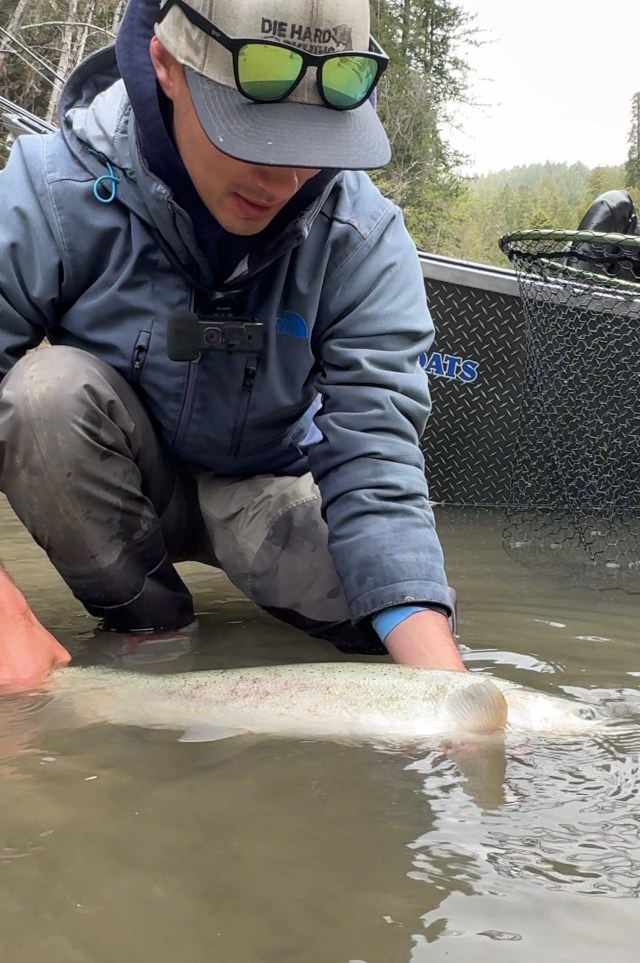
Rylan Pilgrim from Lincoln, CA with a couple Klamath River jacks from a few seasons ago. With an increase in ocean abundance, we should see some type of salmon season on the Klamath/Trinity rivers. Photo courtesy of James Keeling Guide Service

On Wednesday, the California Department of Fish and Wildlife (CDFW) held its annual Salmon Information Meeting, unveiling the 2026 ocean abundance forecasts — and the numbers point toward a rebound, particularly for the Sacramento Basin.

The forecast for Sacramento River fall Chinook — the primary stock harvested in California fisheries — came in at 392,349 adults. For comparison, the 2025 ocean abundance estimate was just 165,655, one of the lowest forecasts since the current assessment method was adopted in 2008. This year’s projection represents a substantial improvement and offers hope for more stable fishing opportunities.

The Klamath River forecast was announced at 176,233 adults, up significantly from last year’s 82,672.
For North Coast anglers, this likely means some type of salmon season in 2026. It almost certainly won’t be a full, unrestricted season, but barring unforeseen issues, there should be opportunities to harvest salmon in both the ocean and the river.

What Happens Next?
These ocean abundance forecasts provide science-based guidance to the Pacific Fishery Management Council as it begins the annual salmon season-setting process.

  • The first PFMC meeting is scheduled for March 4–9 in Sacramento, CA.
  • The Council will determine whether any in-season actions are needed for fisheries opening before May 16.
  • They will also develop three regulatory alternatives for ocean salmon fisheries beginning on or after May 16.
  • Final adoption of alternatives for public review is tentatively scheduled for March 9.

For a complete preseason calendar and public participation opportunities, visit the California Department of Fish and Wildlife ocean salmon preseason webpage.
Additional information on upcoming meetings is available through the Pacific Fishery Management Council’s salmon page at pcouncil.org.
If these forecasts hold, 2026 could mark a meaningful step toward rebuilding opportunity for California salmon anglers — especially after the difficult seasons of the past three years.

The weather ahead
According to Eureka’s National Weather Service office, expect dry weather until late Friday night when the stalled out upper low over the central Pacific edges closer to the coast. “The exact timing and location of trough passage remains uncertain, and there is not a high chance of any major precipitation currently. The NBM model agrees with a 50% probability of >0.25″ and a 25% of >0.5″ in the Humboldt Bay area by Sunday morning. More rain is possible in the King range and interior mountains of Humboldt and Del Norte Co.”

The Rivers:
As of Thursday, all North Coast rivers subjected to low-flow fishing closures were open to fishing. This includes the Mad, main stem Eel, South Fork Eel, Van Duzen, Mattole, Redwood Creek, and Smith rivers. The low-flow closure telephone hotline for North Coast rivers is no longer in service. You can now find river openings and closures online at https://wildlife.ca.gov/Fishing/Inland/Low-Flow/North-Coast. Low-flow information for all North Coast rivers is available here.

Mad
After peaking at over 20 feet Tuesday night, the Mad is back on the drop. As of Thursday, it was back down to 13.5 feet. Will likely need at least 10 days before it’s green, especially with Ruth Lake full and spilling.

Main stem Eel
The main stem Eel was down to 65,500 cfs after reaching 190,000 cfs at Scotia Wednesday morning. It doesn’t look like it will drop down to a fishable flow for at least a couple of weeks, possibly by mid-March.

South Fork Eel
The South Fork Eel surpassed action/monitor stage Tuesday evening, peaking at over 52,000 cfs at Miranda. It’s been dropping quickly since and is back down below 12,000 cfs as of Thursday morning. The 10-day ensemble shows the river dropping to a fishable flow by mid-next week. Above Benbow will be the first area to turn green.

Van Duzen
The Van Duzen peaked at over 21,000 cfs Tuesday but dropped back down to under 3,000 cfs as of Thursday morning. Depending on snowmelt, it could be down to a fishable level by the second week of March.

Smith
The Smith dropped back into plunkable/driftable shape Thursday, with the river sitting at just above 12 feet at the Jed Smith gauge. Conditions look excellent for the weekend with the height hovering around 10 feet. The big rise earlier in the week should pull some fresh fish in from the ocean as well as push some downers from their spawning tributaries.

Southern Oregon rivers
“The Chetco is dropping back into shape with prime conditions expected this weekend after cresting at nearly 28,000 cfs earlier this week,” said Andy Martin of Wild Rivers Fishing. “Flows were down to 15,000 cfs on Wednesday and should be near 5,000 cfs sometime Friday. Steelhead fishing was decent before the big rains and melting snow pushed the Chetco well over its banks. The Elk also should fish by the weekend, while the Rogue could be in shape by Sunday for late steelhead and early springers.”

Brookings ocean report
After a week of rough weather, the ocean out of Brookings looks to be fishable Saturday and Sunday, although there will be a mixed swell reports Martin. “Lingcod fishing has been good. Sport crabbing has been slow.”

Kenny Priest operates Fishing the North Coast, a fishing guide service out of Humboldt specializing in salmon and steelhead. Find it on Facebook, Instagram, YouTube and fishingthenorthcoast.com. For up-to-date fishing reports and North Coast river information, email kenny@fishingthenorthcoast.com.

Klamath Fall Chinook Return Tops Expectations in 2025

Keira Miles of Eureka with a nice jack salmon landed last fall on the Klamath River. The Jack count on the Klamath river in 2025 came in at 18,574 compared to 7,085 in 2024. This should bode well for a strong return of adults in 2026. Photo courtesy of Alan’s Guide Service.

The Pacific Fishery Management Council released its Review of 2025 Ocean Salmon Fisheries report Wednesday, and the news was considerably better than expected for the Klamath Basin.

Based on an ocean abundance estimate of 82,672 Klamath River fall Chinook believed to be in the ocean last fall, forecasters predicted just 28,554 adults would return to the river in 2025. Instead, the run significantly exceeded expectations, with 51,277 adults returning to the basin.

Of those, 39,860 adults escaped to natural spawning areas — 205 percent above the preseason prediction of 19,417 adults and essentially on par with the 40,700 adult floor escapement goal.

Hatchery returns also improved. An estimated 7,623 hatchery adults returned in 2025, compared to 4,489 in 2024.

Jack (two-year-old) returns surged as well, with 18,574 jacks returning to the Klamath Basin, including 14,513 that escaped to natural spawning areas. In 2024, just 7,085 jacks returned.

Upper Basin tributaries see gains
Spawning escapement to upper Klamath River tributaries — the Salmon, Scott, and Shasta rivers — totaled 9,192 adults, compared to 7,317 in 2024.

  • Shasta River: 5,562 adults
  • Scott River: 2,326 adults
  • Salmon River: 1,304 adults

These tributaries were only minimally affected by hatchery strays, making them key indicators of natural production.

The strong return and escapement numbers occurred despite very limited ocean recreational salmon fishing and salmon closures on both the Klamath and Trinity rivers.

According to the report, an estimated 16 fall Chinook were illicitly harvested by recreational anglers in 2025.

Tribal harvest totaled 3,493 adults — 1,322 by the Yurok Tribe and 2,171 by the Hoopa Valley Tribe — which was 252 percent of the tribal allocation of 1,385 fish.

Dam removal opens new habitat
A major milestone highlighted in the report was the 2024 removal of four dams from the Klamath River, allowing salmon to move upstream from the former site of Iron Gate Dam for the first time in decades.

Newly accessible mainstem and tributary habitats were quickly occupied. Monitoring efforts in Oregon and California estimated that 11,722 adults and 341 jacks returned to areas above the former Iron Gate Dam site in 2025 — a promising early sign following dam removal.

Central Valley salmon update
In the Central Valley, recreational Chinook fishing was open in 2025 with a one-fish daily bag limit from July 16 through October 31 in portions of the Feather and American rivers. Upstream sections closed earlier, with closure dates ranging from September 15 to October 15.

The Feather and American river fisheries harvested an estimated 4,884 Sacramento River Fall Chinook (SRFC), including 3,294 adults and 1,590 jacks.

Recreational fishing was also open on portions of the Mokelumne River from July 16 through October 31. That fishery harvested 386 San Joaquin River Fall Chinook, including 228 adults and 158 jacks.

Under 2025 regulations, projected spawning escapement in the Sacramento River Basin was 147,733 hatchery and natural-area fall Chinook adults. Actual returns exceeded that projection.

A total of 164,763 adult hatchery and natural-area spawners and 65,369 jacks were estimated to have returned to the Sacramento Basin in 2025.

Fall Chinook returns to Sacramento River hatcheries totaled 34,331 adults and 19,465 jacks, while escapement to natural areas reached 130,432 adults and 45,904 jacks.

Next up is the California Department of Fish and Wildlife’s Annual Salmon Information Meeting, which will be held in person at the California Natural Resources Agency Auditorium at 715 P St. in Sacramento on Wednesday, Feb. 25, 2026, at 1 p.m., and will also be livestreamed. The meeting will feature the outlook for this year’s ocean salmon fisheries, in addition to a review of last year’s salmon fisheries and inland spawner returns.

Following the Salmon Information Meeting, California representatives will work together to develop a range of recommended ocean fishing season alternatives at the March 4-9 Pacific Fishery Management Council (PFMC) meeting in Sacramento, CA. Final season recommendations will be adopted at the PFMC’s April 7-12 meeting in Portland, OR.

Salmon Information Meeting details, agenda, informational materials and instructions to view the livestream will be published in advance of the event on CDFW’s Ocean Salmon web page.

The weather ahead
According to Eureka’s National Weather Service office, “showers are expected to diminish Thursday evening as northerly winds aloft bring a drier air mass across the area. This airmass will be very cold, yet how much this is felt at surface will depend on the extent of cloud coverage. Overnight low temperatures may end up warmer than expected if there are more low clouds. Either way, temperatures are forecasted to be cold enough to cause a cold weather advisory for Thursday morning and Friday morning for SW Humboldt, coastal Mendocino, the Russian River Valley, and Southern Lake County.

On Friday, a brief break of precipitation is expected to allow even colder overnight lows if clouds do not inhibit nighttime cooling.

This weekend and into early next week, the active weather pattern continues with the approach of a broad closed upper- level trough and associated frontal system. This system is expected to bring heavy rainfall, heavy mountain snow, and strong southerly winds. The ensemble means for both the GEFS and EPS show a high probability (90-100% chance) of a weak atmospheric river. While this is not particularly strong, it looks like there will be multiple impulses that may overwhelm the rivers and streams. Theres still uncertainties on exact timing of the rain pulses, which will be a big factor in the level of impacts. Strong, southerly winds are also expected with the strongest through Saturday night.”

Klamath River flows set to increase
According to the U.S. Bureau of Reclamation (BOR) a planned sediment flushing flow release will take place one full day at the Keno Dam on the Klamath River, on Feb. 20, at approximately 6:00 am.
“The initial release may spike without advanced warning and will continue to ramp up with increased flows by roughly 4,000 cfs within 24 hours. The BOR will decrease flows, ramping down from the upper 4,000 cfs to 700s by early March. These values are operational targets and may fluctuate with changing conditions and manual operations. Rapid stage increases could occur not only below the Keno Dam but downstream through Big Bend, Hells Corner, Beswick, K’íka·c’é·ki Valley, K’íka·c’é·ki Canyon, Iron Gate, and the Mid-Klamath boating runs, potentially as far as Seiad Valley (roughly 100 miles downstream, where BOR’s flow spikes seem to attenuate).”

The Rivers:
As of Thursday, all North Coast rivers subjected to low-flow fishing closures were open to fishing. This includes the Mad, main stem Eel, South Fork Eel, Van Duzen, Mattole, Redwood Creek, and Smith rivers. The low-flow closure telephone hotline for North Coast rivers is no longer in service. You can now find river openings and closures online at https://wildlife.ca.gov/Fishing/Inland/Low-Flow/North-Coast. Low-flow information for all North Coast rivers is available here.

Mad
As of Thursday, the Mad was muddy, and just above 9 feet (2,500 cfs) and dropping slowly. It is forecast to drop through Saturday before the next round of storms pushes it to roughly 14 feet by early next week. It will need at least a couple of weeks of dry weather before it turns green.

Main stem Eel
The main stem Eel was running at 14,000 cfs as of Thursday and is big and muddy. And it is going to get bigger. Storms beginning this weekend are predicted to increase flows close to 90,000 cfs by mid-next week. Needles to say, it will be some time before we see green water.

South Fork Eel
The South Fork was flowing at 3,400 cfs at Miranda Thursday and rising slowly. It’s predicted to drop Friday and Saturday and get down to 2,200 cfs, which could produce some green water up higher in the watershed. It will be short-lived however, as rain coming Saturday evening will put it back on the rise and blow it back out. The 10-day ensemble prediction has the river peaking at 21,000 cfs Tuesday. If the rain stops mid-next week, it could be fishable towards the end of the first week of March.

Van Duzen
Like the South Fork Eel, the Van Duzen is on the drop following a peak of 1,400 cfs Monday near Bridgeville. As of Thursday, it was below 600 cfs but remains off color. With the rain coming Saturday evening, the river will be on a steep rise Sunday, potentially peaking at 8,000 cfs next Tuesday. Will likely need a couple weeks of dry weather before it starts to fish.

Smith River
The big rains never did reach the Smith, and it’s remained low and clear this week. Despite the lack of water, the fishing has been good for the few boats drifting. But conditions should change starting Saturday night. A big rise is forecast for Sunday, with flows reaching 25,000 cfs (16.4 feet) at the Jed Smith gauge Tuesday. Conditions should be excellent by mid-next week if the forecast holds.

Southern Oregon rivers
Steelhead fishing has been fair on the Chetco, but slower than expected, with drift boats getting one to three fish per day reports Andy Martin of Wild Rivers Fishing. “Major rain is expected this weekend, with the river likely to be blown out all of next week, especially with melting snow after the rain,” said Martin. “The smaller rivers in Southern Oregon are fishing well for steelhead.
Expect the first springers of the season after the Rogue drops following next week’s blowout. Steelhead fishing is slow on the Rogue, but march generally has decent fishing before anglers transition to salmon.”

Brookings ocean update
According to Martin, rough ocean conditions have limited fishing out of Brookings. “A brief window Friday morning is followed by a storm warning with winds to 50 knots.”

Kenny Priest operates Fishing the North Coast, a fishing guide service out of Humboldt specializing in salmon and steelhead. Find it on Facebook, Instagram, YouTubeand fishingthenorthcoast.com. For up-to-date fishing reports and North Coast river information, email kenny@fishingthenorthcoast.com.

Smith River Best Option for Holiday Steelhead

Bay Area resident Francesco Latini with an Eel River winter steelhead taken from a previous season. Photo courtesy of Kenny Priest/Fishing the North Coast

If you’re looking to tangle with a coastal winter steelhead between now and the end of the year, your options will likely be limited to the Smith River. It’s currently the only river on the coast that’s green and fishable, and likely will remain that way as we navigate through these extremely rainy next couple of weeks. Flows through this weekend will be on the upper end of safely drifting, but plunking will be an excellent option. Beginning Monday and through next week, flows are predicted to range from 12 feet on the Jed Smith gauge to 17 feet. Again, these are perfect plunking conditions from either a boat or off the bank.

As for the other coastal rivers from the Mad to the South Fork Eel, it’s looking like we won’t see green water prior to 2025. Two storm fronts will bring rain this weekend, followed by additional rain next week where we could see some potential river flooding.

Weather ahead
According to Eureka’s National Weather Service office, dry conditions will develop and skies will be clear through Thursday. “By Friday, the ridge will quickly be pushed east as a very deep trough develops over the eastern Pacific Ocean. Lower temps and high southerly winds are forecast for Friday bringing a slight chance of rain over Humboldt and Del Norte counties. A more potent front will then approach the region Friday night into Saturday. Widespread rain is expected to expand over the region and stronger southerly winds to develop on Saturday morning.

The Weather Prediction Center has placed much of Northwest California in a marginal risk of extreme rainfall in their day 4 Saturday outlook while the Climate Prediction Center (CPC) is favoring above normal precipitations for Northwest California and the Pacific Northwest in their 6-10- and 8-14-day outlooks. Additionally, the CPC is highlighting our region for heavy precipitation from the 26th through the 27th with flooding possible.”

Mad River Steelhead Reward Program Returns for 2024-25
For the Mad River steelhead fishery in the upcoming 2024-25 season, the California Dept. of Fish and Wildlife (CDFW) will once again attach reward tags to a small subset of hatchery-origin (i.e., adipose-clipped) adult steelhead upon their return to freshwater. This is in effort to estimate the steelhead harvest on the Mad River. According to John Deibner-Hanson, a Northern Region Environmental Scientist for CDFW, a number of fish will be captured in the lower river using tangle nets and affixed with spaghetti tags worth $20, $50 or $100 rewards. Once the tags are applied on their backs behind the dorsal fin, the fish will be released.

Upon capturing a reward tag, anglers will need to follow one of the methods outlined below to answer a series of questions about how the tag was acquired (e.g., caught on fish, found on dead fish, found on bank). Anglers will have until April 15, 2025 to report tags and claim rewards, after which reward tags from this season will expire. To attain accurate harvest estimates, we must assume 100% tag return rates on harvested steelhead, so getting the word out for our tagging program will be vital to its success.

There are three ways an angler may report their tag for reward:

  1. Scan the QR code posted on message boards and signage around the river or carried by CDFW creelers
  2. Visit: https://forms.office.com/g/jjWnw9t7Ss
  3. Return the tag to CDFW at: 50 Ericson Ct., Arcata, CA

Using options 1 and 2 above, anglers will not submit the physical tag, only needing to provide the unique tag number and answering the accompanying questions online. For this reason, anglers are strongly urged to retain the tag after submittal until all rewards have been claimed, as only one reward will be paid for each uniquely numbered tag. For questions, please email MadRiverRewards@wildlife.ca.gov.

The Rivers:
As of Thursday, all North Coast rivers subjected to low-flow fishing closures were open to fishing. This includes the Mad, main stem Eel, South Fork Eel, Redwood Creek, Van Duzen and Smith rivers. The Department of Fish and Game will make the information available to the public by a telephone recorded message updated, as necessary, no later than 1 p.m. each Monday, Wednesday, and Friday as to whether any stream will be closed to fishing. The rivers can be opened at any time. The low flow closure hotline for North Coast rivers is 707-822-3164. NOTE: The main stem Eel from the South Fork to Cape Horn Dam, the Mad River from the mouth to 200 yards upstream and the Mattole River will be closed until January 1, 2025. More information can be found here.

Mad
The Mad was down to 8.8 feet on Thursday and will continue to drop through Friday. The incoming storms will keep it high and off color through next week and likely through the end of the year.

Main stem Eel
The main Eel is dropping, but still high and off color running just above 17,000 cfs Thursday. The next round of storms, including next week, will keep it from being fishable through the end of the year.

South Fork Eel
The South Fork is on the drop, flowing at 3,600 cfs at Sylvandale Thursday. The river was green and in great shape Wednesday above the East Fork, but off color below. The lower river could fish Saturday, with flows down to 2,650 cfs. However, Saturday’s storm is forecast to put it back on the rise in the afternoon, likely blowing it out for the rest of the year.

Van Duzen
The Van Duzen was down under 900 cfs Thursday and will be dropping slowly through Saturday morning. The next round of storms will likely do it in for the rest of the year. Flows are predicted to hit 8,600 cfs Tuesday morning with more rain predicted for most of next week.

Smith
The quick-clearing Smith is in perfect shape as of Thursday, sitting at 10.45 feet on the Jed Smith gauge. It’s predicted to drop through Saturday morning before it goes on the rise throughout the day. Sunday and Monday are looking like fishable conditions before it goes on a bigger rise Tuesday. The 10-day forecast shows the river being just above being driftable, but good conditions for plunking from shore or a boat. There should be some steelhead moving in with the next few storms.

Chetco/Elk
“Plunkers are catching a few steelhead on the Chetco, which has been too high for drift boats the past week and is expected to remain high through Christmas,” said Andy Martin of Wild Rivers Fishing. “Flows could subside enough for a brief period this weekend. A few late kings are being caught on the Elk River, where flows have been low enough to fish, but strong winds have made fishing difficult. More stormy weather is expected through the week.”

Chetco/Rogue steelhead harvest requires Validation and Tag
As a reminder, if you want to harvest a winter steelhead from the Chetco or Rogue River this winter, all anglers will need a harvest tag in addition to a Rogue-South Coast Steelhead Validation.
To fish for steelhead in the Rogue/So. Coast, all anglers will need:

  • Annual angling license (12 years and older) and combined angling tag
  • OR Daily or multi-day angling license with valid ODFW ID number.

Purchasing daily or multi-day licenses through “guest checkout” doesn’t include the ID number (a full account is required to purchase a validation). Pre-paid daily licenses do not qualify to purchase a validation.

  • AND 2. Rogue-South Coast Steelhead Validation.

To KEEP wild winter steelhead, anglers (regardless of age) will need:

  • All the above

AND Rogue-South Coast Wild Steelhead Harvest Tag:
Wild steelhead kept are recorded here, not the statewide combined angling tag.
Not needed for catch-and-release or keeping hatchery steelhead only.
Bag limit: 1 wild steelhead/day, 3 per season (Dec. 1 – Apr. 30).

Check the sport fishing regulations or myodfw.com to know where and when wild steelhead may be kept. Return or report paper tags to ODFW after each winter steelhead season and before the next begins Dec. 1.
COST: Validation: $2 residents, $4 non-residents.
Harvest Tag: $10 residents, $20 non-residents.
Validation and harvest tag are valid for one full season (Dec. 1 through April 30), even when using daily or multi-day licenses.

Kenny Priest operates Fishing the North Coast, a fishing guide service out of Humboldt specializing in salmon and steelhead. Find it on Facebook, Instagram, YouTube and fishingthenorthcoast.com. For up-to-date fishing reports and North Coast river information, email kenny@fishingthenorthcoast.com.

Coastal King Season Off and Running

Smith and Chetco both kick out big kings

Haley Richards, who grew up in Crescent City but now lives in Salem, Ore., holds a salmon caught over the weekend with guide Rye Phillips of Brookings Fishing Charters.

The season’s first big storms hit North Coast over the weekend and the Smith and Chetco both kicked out good numbers of kings. Both rivers have been loaded with kings in their lower sections for quite some time, and when the rivers finally rose, they were on the move.

On Friday evening, the Smith went well over river level projections, but peaked and was on the drop Saturday morning, providing nearly perfect conditions from the forks to below the 101 Bridge. Fishing was wide-open, with most drift boats putting up double-digit scores on salmon of all sizes and colors. Fishing continued to be excellent through the weekend, but the river dropped quickly.

With the Smith dropping and clearing, the focus Sunday was squarely on the Chetco. After going over river level projections and peaking at 10,000 cfs Friday, it needed Saturday to clear up and by Sunday it was game on with wide-open fishing. By Monday the river had dropped to under 4,000 cfs and was clearing quick. Fishing has been decent all week, with most of the action on the lower end.

Both rivers are now low and clear and in need of rain. And it’s on the way. Large rises are predicted starting Monday, and both should see a push of fresh salmon.

The Rivers:
As of Thursday, the Smith River was the only river open to fishing. But that should change as the rest of the North Coast rivers subjected to low flow fishing closures, including the main stem and South Fork Eel, Mad, Redwood Creek, and Van Duzen, could open to fishing next week. The Department of Fish and Game will make the information available to the public by a telephone recorded message updated, as necessary, no later than 1 p.m. each Monday, Wednesday and Friday as to whether any stream will be closed to fishing. The rivers can be opened up at any time. The low flow closure hotline for North Coast rivers is 707-822-3164. NOTE: The main stem Eel from the South Fork to Cape Horn Dam, the Mad River from the mouth to 200 yards upstream and the Mattole River will be closed until January 1, 2025.

Smith
Fishing slowed this week on the Smith as the river dropped and cleared quickly. Flows were down to 850 cfs by Thursday, and it could close prior to the weekend. If it does close, it will be short lived as the next storm is forecast to hit Sunday night. The river is expected to peak at 7,300 cfs Tuesday morning. Rain is in the forecast for most of the week, so conditions should be good. The daily bag limit is one Chinook salmon per day and no more than five wild Chinook salmon over 22 inches per year. Minimum flow: 600 cfs at the Jedediah Smith State Park gauging station. cnrfc.noaa.gov/graphicalRVF.php?id=CREC1

Mad
Forecast to reach 880 cfs by Tuesday and should have some color. Rain is in the forecast for much of next week. Minimum flow: 200 cfs at the gauging station at the Highway 299 bridge. cnrfc.noaa.gov/graphicalRVF.php?id=ARCC1

Main stem Eel
Flows are predicted to surpass 800 cfs Tuesday morning, and could be fishable. With more rain in the forecast next week, it could remain open to fishing all week. The Eel River is open to catch and release of salmon in 2024/25. Minimum Flow: 350 cubic feet per second at the gauging station near Scotia.
cnrfc.noaa.gov/graphicalRVF.php?id=SCOC1

South Fork Eel
As of Thursday, it looks like the South Fork could rise above the minimum flow requirements by mid next week. Flows are predicted to peak next Tuesday and could remain above the minimum flow threshold all week. Minimum flow: 340 cfs at the gauging station at Miranda. cnrfc.noaa.gov/graphicalRVF.php?id=MRNC1

Van Duzen
If the storm prediction is correct, the Van Duzen should approach 250 cfs by next Tuesday morning. It’s predicted to remain above the minimum flow threshold all week. Minimum flow: 150 cfs at the gauging station near Grizzly Creek Redwoods State Park.
cnrfc.noaa.gov/graphicalRVF.php?id=BRGC1

Chetco/Elk/Sixes
“Salmon fishing has been decent on the Chetco, with hot fishing following last week’s rain, and plenty of fish with tougher conditions as it drops out this week,” said Andy Martin of Wild Rivers Fishing. “Back-bouncing roe is accounting for most of this fish as the river becomes low and clear. Plugs worked well over the weekend. The river crested at 10,000 cfs, and was down to 3,900 cfs the next morning. It is now down to 600 cfs. More rain is expected to begin next week, which should kick the Elk and Sixes into high gear.”

Sixes River low flow angling closure lifted
Beginning Nov. 1, the Sixes River low flow angling closure was lifted according to a press release issued by the Oregon Dept. of Fish and Wildlife. It states, “ODFW closed a portion of the river to angling Oct. 1 to protect wild fall chinook salmon vulnerable to snagging or poaching while staging between Crystal Creek and Hughes House Boat Ramp. With increased flows, salmon are now migrating upstream.

Anglers are reminded the bag limit for wild adult chinook in the Sixes River is one adult chinook per day, 10 for the season. Elk River, just south of Sixes River is closed to retention of wild fall chinook this year.” For more information, check the ODFW Recreation Report.

Sport crabbing update
The sport Dungeness crab season opened Saturday, but the weather failed to cooperate. Boats didn’t make it offshore out of Eureka due to large swells. The ocean finally laid down enough Wednesday, and Tim Klassen of Reel Steel Sport Fishing was one of the boats setting gear for Thursday’s crab trips. With a 24-hour soak, Klassen needed just 4 pots to get 60 crabs. “The crabs were all good size, we only had a couple shorts,” said Klassen. “The crabs were really clean and looked pretty full.”

Inside Humboldt Bay, which is typically a good plan B, was reportedly slow for the handful of boats that braved the weather. Offshore conditions look decent for Friday, but a south wind is predicted for the weekend with seven to eight-foot swells.

Nicole McCain of Carson City NV., holds a nice ling cod caught this week out of Shelter Cove. Photo courtesy of Jake Mitchell, Sea Hawk Sport Fishing

Shelter Cove
According to Jake Mitchell of Sea Hawk Sport Fishing, rock fishing was pretty good over the weekend in marginal conditions. He said, “The lingcod bite was really good. Crabbing started a little on the slow side, but we managed limits and the meat quality was excellent. Conditions look good the next few days before they start to deteriorate towards the end of the weekend.”

Kenny Priest operates Fishing the North Coast, a fishing guide service out of Humboldt specializing in salmon and steelhead. Find it on Facebook, Instagram, YouTube and fishingthenorthcoast.com. For up-to-date fishing reports and North Coast river information, email kenny@fishingthenorthcoast.com.