Storms and Steelhead Headed Our Way

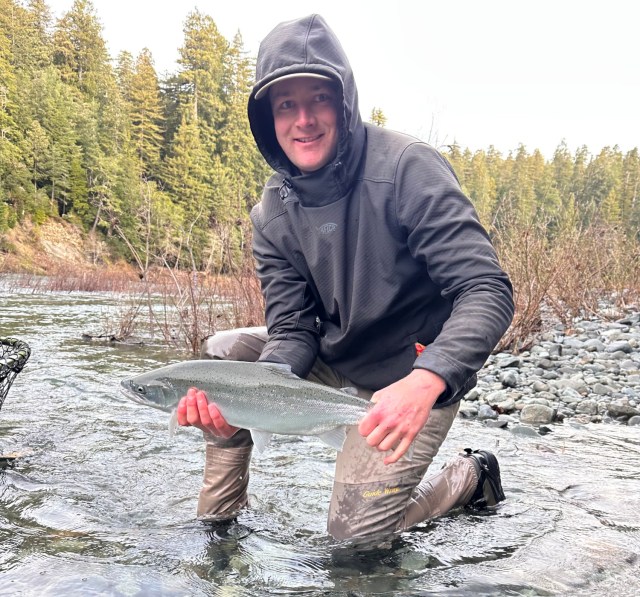
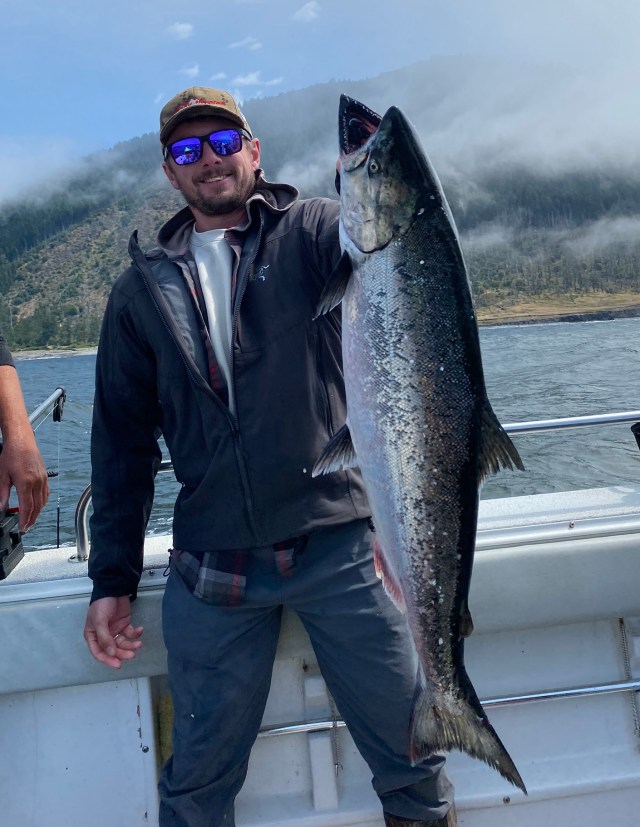
Chris Silkowski of Portland holds a steelhead caught last week on an M2 FlatFish while fishing with guide Rye Phillips of Brookings Fishing Charters.

Winter steelhead season isn’t in full swing yet on the North Coast, but that is about to change. A few storm systems are currently impacting the rivers, putting them all on the rise. According to the National Weather Service, three separate storms will hit the coast between Wednesday and Monday, which is just what we needed. Steady rain and pulse flows should do the trick in enticing the first big wave of winter steelhead from the salt. If the rains come as predicted, the Smith should be in great shape early next week followed closely behind by the Chetco.

The Eel, South Fork Eel, Van Duzen and Mad are all on the rise as of Thursday and will be blown out from some time. Once all the rivers crest and begin to recede to fishable levels, we should see the first wave of winter steelhead. After a stellar late-fall salmon season, seeing the rivers loaded with bright steelhead would be icing on the cake.

Weather ahead

Thursday, showers are expected behind Wednesday’s main front, according to Eureka’s National Weather Service office. “Snow levels will be lower across the area, likely dropping to around 4,000 feet or even slightly lower for much of the area. Models are still not in very good agreement on how much rain will fall with these showers.

The next system starts to move into the area Friday. The models are showing a warm frontal boundary out ahead of the main cold front. Rainfall amounts for Friday look to range from over an inch in the King Range to a quarter of an inch in southern Lake County. This looks like a highly favorable pattern for low elevation snow, with levels down to 2,500 to 3,500 feet across most of the inland areas Friday morning. Breezy south winds are expected, but these look to mainly be over the higher terrain due to the fairly stable temperature profile.

Friday evening and Friday night the cold front is expected to bring strong winds and heavy rain to the area. Rainfall amounts from Friday morning through Saturday afternoon look to be around 2 to 4 inches across much of the area. This may cause some minor flooding due to the fairly short period of time that it is expected to fall over. This flooding is expected to be exacerbated around they bays where streams will have trouble draining during high tide. Sunday there is expected to be some lingering showers around, but overall, it looks like it will be a break in the rain. Another fairly strong system is expected on Monday with additional rain, wind and snow. At this point it looks weaker than the Friday night system, but it is still 5 days out.”

Sport Dungeness crab season now open to CA/OR border
As of Dec. 9, the sport Dungeness crab season is now open from the California/Oregon border (42° 0.00’ N latitude) to the southern boundary of the Reading Rock State Marine Reserve (41° 17.6’ N latitude). State health agencies determined that consuming the meat of Dungeness crab no longer poses a significant threat for domoic acid exposure. More information can be found here.

Commercial Dungeness crab season delay continues
The ocean commercial Dungeness crab season for Mendocino, Humboldt and Del Norte counties remains closed due to poor quality crab. Crab meat quality tests were not conducted due to continued high domoic acid concentrations at one of the northern sampling locations. The season is currently closed until 12:01a.m. Dec. 31, 2024. Another round of testing is anticipated to occur around Dec. 15 to determine whether the fishery may open on Dec. 31, or be delayed an additional 15 days until Jan. 15, 2025. For more information, visit the Marine Management News Blog.

Shelter Cove update
“We only fished a couple days this week, and the rockfish bite was a little tougher, but still good,” said Jake Mitchell of Sea Hawk Sport Fishing. “We spent most of our time just outside the Hat. Crabbing is still going strong, with easy limits of nice crab.”

The Rivers:
As of Thursday, all North Coast rivers subjected to low-flow fishing closures were open to fishing, except for the Van Duzen. (The recording should be updated sometime today) This includes the Mad, main stem Eel, South Fork Eel, Redwood Creek, and Smith rivers. The Department of Fish and Game will make the information available to the public by a telephone recorded message updated, as necessary, no later than 1 p.m. each Monday, Wednesday, and Friday as to whether any stream will be closed to fishing. The rivers can be opened at any time. The low flow closure hotline for North Coast rivers is 707-822-3164. NOTE: The main stem Eel from the South Fork to Cape Horn Dam, the Mad River from the mouth to 200 yards upstream and the Mattole River will be closed until January 1, 2025. More information can be found here.

Mad

The river has been in great shape this week, but that’s going to come to an end sometime Thursday as the river was on the rise. Flows are predicted to peak at 13,400 cfs Saturday afternoon. It will likely be blown out for quite a while, especially with Ruth Lake being full. A few steelhead have been caught, and there’s been quite a few coho around. Look for that to change once the flows come back down.

Main stem Eel
Flows dipped under 3,500 cfs Wednesday and the river was in perfect shape. Unfortunately, Wednesday was probably the last fishable day for a while as lots of rain is in the forecast. Flows are predicted to reach nearly 113,000 cfs early late Saturday. It will be off color for some time if the predictions are correct. There have been a few adult steelhead caught and quite a few coho.

South Fork Eel
River conditions were about perfect as of Wednesday, but that is going to change Thursday. The river is predicted to rise beginning Thursday afternoon, with flows peaking at 32,900 cfs at Miranda Saturday evening. The river has been full of coho as well as some older kings. No big numbers of steelhead have entered the river yet, but that could change after the latest round of storms. A week of dry weather could get it back to fishable shape, but that may not be in the cards.

Van Duzen
The Van Duzen has been closed the last few days due to low flows, but that is changing Thursday. The CDFW recording still said the river was closed, even though flows were well above 400 cfs in the morning. It’s predicted to peak at nearly 33,000 cfs Saturday evening. Will likely be blown out the next couple weeks.

Smith
The Smith had been low and clear, but it’s now receiving some much-needed rain. As of Thursday morning, flows were 4,000 cfs on the Jed Smith gauge and starting to peak. The next round of rain will be more substantial, and should see flows reach roughly 16,500 cfs (13.8 ft.) by Saturday afternoon. If the rain comes as predicted, it should be fishable by Sunday and all next week. We should see the first wave of steelhead by the weekend or early next week.

Eel River Chinook salmon returns
From Nov. 25 through Dec. 1. 497 Chinook salmon (female 162, male 179, unknown 56, Jack 100) were observed moving upstream through the fishway at Cape Horn Dam. The season total for upstream migrating Chinook salmon stands at 713 (female 244, male 249, unknown 78, Jack 142). The last year the Chinook count went over 500 at Van Arsdale Reservoir was during the 2014-15 season. For more information, visit https://eelriver.org/the-eel-river/#fishcount.

Chetco/Elk/Sixes
“A mix of late salmon and early steelhead were caught the past week on the Chetco, but fishing likely will come to a standstill beginning Saturday as heavy rain is expected to blow the river out for several days,” said Andy Martin of Wild Rivers Fishing. “More than a week of high water conditions are expected. There could be a window to fish the Elk between storms, while the Sixes is also expected to be blown out. The number of early steelhead caught by drift boaters and shore-based plungers is promising for the latter part of this month, when the river drops back into shape.”

Brookings rockfish update
According to Martin, sport crabbing has been very good out of Brookings, but catches likely will drop significantly once the commercial crab season begins Monday. “Commercial fishermen may drop pots as early as Friday. Rockfish and lingcod action has been good out of Brookings. High surf conditions and stormy weather begins Friday.”

Kenny Priest operates Fishing the North Coast, a fishing guide service out of Humboldt specializing in salmon and steelhead. Find it on Facebook, Instagram, YouTube and fishingthenorthcoast.com. For up-to-date fishing reports and North Coast river information, email kenny@fishingthenorthcoast.com.

‘Offshore Only’ Rockfish Season Begins Dec. 1

Nearshore season ends Saturday

Redding resident Tyler Somonis holds a nice vermilion rockfish caught Wednesday while fishing out of Crescent City. The nearshore rockfish season will close after Saturday. Photo courtesy of Crescent City Fishing/Steve Huber’s Guide Service.

Following a month of mostly unfishable conditions, the month of December will once again force rockfish anglers back to deep water. With the opening of sport Dungeness crab season and rockfish within reach, hopes were high for a November full of combo trips. But Mother Nature had other plans and failed to provide many fishable days. The past few days have been the best we’ve seen all month.

But now, starting Sunday Dec. 1 within the Northern Management Area, which includes ocean waters between 42°00’ N. latitude (CA-OR Border) and 40°10′ N. latitude (near Cape Mendocino), fishing for rockfish will only be allowed seaward of the 50-fathom boundary line, and only shelf rockfishslope rockfish and lingcod may be retained. Take and possession of nearshore rockfish, cabezon and greenling are prohibited during the offshore fishery.

In the Mendocino Management Area, which includes Shelter Cove and Fort Bragg, all the seasons are the same as the Northern Management Area. The only change is the daily bag limit is two vermilion rockfish per person.

Divers and shore-based anglers will continue to be exempt from boat-based season restrictions affecting rockfish and other federally managed groundfish, which allows for year-round diving and shore-based angling, in line with current regulations. Rockfish season for boat anglers will close statewide after Dec. 31.

Regulation change reminder for 2024
Changes to the sub-bag limits within the 10-fish daily Rockfish, Cabezon, Greenling (RCG) complex bag and possession limit include a new statewide ban on possession of quillback rockfish. Also new in 2024 is the mandatory possession of descending devices . No person shall take or possess any federal groundfish from any boat or other floating device in ocean waters without having a descending device in possession and available for immediate use to assist in releasing rockfish to the depth of capture.

Daily bag limit
In the Northern Management Area, the RCG complex includes all species of rockfishes, Cabezon and Greenlings. You are allowed 10 fish in combination per person EXCEPT:

Minimum size for Cabezon is 15 inches total length and for Kelp and/or rock greenlings it’s 12 inches.

The daily bag limit of lingcod remains at two per person and they must be 22 inches in length. The take and possession of cowcod, bronzespotted rockfish and yelloweye rockfish is prohibited statewide. Petrale sole and starry flounder can be retained year-round at all depths with no size limit.

Important reminder:
In waters where groundfish species or species groups are closed to take or possession but authorized for take or possession in other areas, those species or species groups may be possessed aboard a vessel that is anchored, drifting, or transiting in or through that closed area. While anchored, drifting, or transiting through an area closed to take or possession of these groundfish species or species groups, no gear may be deployed other than for the take of crustaceans with hoop nets, Dungeness crab traps, and dip nets.

For more information about recreational groundfish regulations within the northern management area, visit wildlife.ca.gov/Fishing/Ocean/Regulations/GroundfishSummary#north

Weekend weather and marine forecast
According to the Eureka’s National Weather Service, high pressure will continue to build over the area, bringing mostly clear skies and chilly overnight temperatures. By early next week some warmer valleys could see temperatures in the 70’s. There is no clear end in sight for this pattern yet. Ridging to will likely continue to dominate the west coast for the next seven days.

The weekend marine forecast is looking good for offshore crabbing and/or rockfish. As of Friday, Saturday’s forecast is calling for northeast winds up to 5 knots with northwest waves 3 feet at seven seconds and 2 feet at 12 seconds. Sunday looks similar, with northwest waves 2 feet at 11 seconds and 5 feet at 18 seconds. Conditions early next week also look favorable. These conditions can and will change by the weekend. For an up-to-date weather forecast, visit www.weather.gov/eureka/ or www.windy.com. You can also call the National Weather Service at 443-7062 or the office on Woodley Island at 443-6484.

Eureka/Trinidad sport crabbing
After the storms, boats were finally able to get back on the water Tuesday. And the reports were excellent with boats reporting easy limits of big crab. Boats fishing either side of the entrance in roughly 100 feet of water were averaging 10 to 15 keepers on an overnight soak. Conditions look good through the weekend.

Sport crabbers are also doing well in Trinidad, averaging 10 to 12 per trap for an overnight soak.  The quality has been excellent. Expect the beach to be crowded over the holiday weekend and the last few days of the inshore rockfish season.

Shelter Cove update
“We finally got back on the water Tuesday, and the fishing was excellent,” said Jake Mitchell of Sea Hawk Sport Fishing. “We had limits of rockfish, lingcod, and crab and back at the dock by noon. Rogers Break has been good for rockfish and lingcod, while we’re crabbing off Black Sands Beach. On an overnight soak, we’re getting 10 to 20 keepers per pot.”

The Rivers:
As of Friday, all North Coast rivers subjected to low-flow fishing closures were open to fishing. This includes the Mad, main stem Eel, South Fork Eel, Redwood Creek, Van Duzen and Smith rivers. The Department of Fish and Game will make the information available to the public by a telephone recorded message updated, as necessary, no later than 1 p.m. each Monday, Wednesday, and Friday as to whether any stream will be closed to fishing. The rivers can be opened at any time. The low flow closure hotline for North Coast rivers is 707-822-3164. NOTE: The main stem Eel from the South Fork to Cape Horn Dam, the Mad River from the mouth to 200 yards upstream and the Mattole River will be closed until January 1, 2025. More information can be found here.

Mad
The Mad is dropping quickly and should be at a fishable height by mid-week. There should be some early steelhead making their way into the lower river this week. Current river conditions: cdec.water.ca.gov/river/madStages.html

Main stem Eel
Flows were down to 12,800 cfs Friday as it continues to drop. With a mostly dry week forecasted, it could be fishable by next weekend. Current river conditions: cdec.water.ca.gov/river/eelStages.html

South Fork Eel
The South Fork was just above 3,000 cfs Friday and should be fishable by the first of the week. It’s a little early for steelhead, but there could be some late-arriving salmon around. Current river conditions: cdec.water.ca.gov/river/eelStages.html

Van Duzen
Like the Sf Eel, the Van Duzen should be fishable by the early next week. As of Friday, flows were right around 800 cfs. Current river conditions: cdec.water.ca.gov/river/eelStages.html

Smith
The Smith was just above 9.5 feet at the Jed Smith Park Friday morning. The river is forecast to drop slowly through the week. The salmon run is mostly done for the season, and we should start to see a few early steelhead show up. Current river conditions: cdec.water.ca.gov/river/smithStages.html

Nov. 29 and 30 free fish days in Oregon
The Oregon Department of Fish and Wildlife is waiving all fishing licensing requirements on the Friday and Saturday after Thanksgiving to encourage people to experience fishing with friends and family during the long holiday weekend. All fishing, crabbing, and clamming in Oregon will be free for both Oregon residents and non-residents. No licenses, tags or endorsements are needed on those days, but all other fishing regulations apply. Visit https://www.dfw.state.or.us/news/2024/11_Nov/111324.asp for more info.

Chetco/Elk/Sixes
The Elk River was back in shape on Tuesday, and fresh hatchery kings were spread throughout the river reports Andy Martin of Wild Rivers Fishing. “The Elk River could be low by the end of the week,” said Martin. “The Chetco remains blown out but should fish by the end of the week. Steelhead season opens Dec. 1 on the Chetco, Elk and Sixes. The Chetco also will open to fishing, steelhead only, for the first time this fall above Nook Bar.”

Brookings rockfish update
According to Martin, the ocean out of Brookings calmed down this week, with flat conditions expected this weekend. Lingcod fishing was good before the latest storms.

Kenny Priest operates Fishing the North Coast, a fishing guide service out of Humboldt specializing in salmon and steelhead. Find it on FacebookInstagramYouTube and fishingthenorthcoast.com. For up-to-date fishing reports and North Coast river information, email kenny@fishingthenorthcoast.com.

Atmospheric Rivers Put an End to Late-Fall King Season

Guide Sam Stover of Brookings Fishing Charters holds a hefty Smith River king that was released Saturday after smacking a 5.0 MagLip.

This week’s report will be mostly about water, because there’s a lot more water at the moment than fishing opportunities. In case you haven’t heard, the North Coast is smackdab in the middle of some severe storms that are taking aim at the coast with heavy winds and copious amounts of rain. Several rivers are forecast to exceed monitor and approach flood stage in the coming hours. These high flows will signal the end of the late fall salmon fishing season on the Eel and Smith rivers, and make available spawning habitat that wouldn’t normally be accessible in drier years. With both rivers seeing strong returns of kings, coupled with an abundance of prime spawning habitat, this really bodes well for the future.  While we kick the kings up the tributaries, we now begin to think about winter steelhead. November is typically a little early to see big numbers – but it won’t be long. My hunch is after a few more good storms over the next couple weeks, the uber popular winter steelhead run will be afoot.

Weather ahead
According to the Eureka’s National Weather Service, the atmospheric river storm system will continue to bring prolonged moderate to heavy rainfall tonight through Friday. “An additional 4 to 6 inches with isolated 8 inches is forecast Wednesday night through Friday, with the bulk falling Thursday through Thursday Night. After the passage of the secondary cyclone Thursday, most ensemble guidance shifts the parent trough westward on Friday, which would put Northwestern California in the cold sector and shut off our subtropical moisture tap, marking a change from persistent moderate rainfall to showery rainfall. Rain will likely continue during this period through the weekend, however be generally less, and with more sparse coverage.”

Sport crab trap restrictions stay put, delays for Commercial
In a press release issued Thursday, the California Department of Fish and Wildlife (CDFW) is continuing the temporary recreational crab trap restriction from the Sonoma/Mendocino county line to Lopez Point (Fishing Zones 3 and 4) due to presence of humpback whales and the potential for entanglement from trap gear. They also continued the delay for the recreational opener in the northern portion of Fishing Zone 1 (from the CA/OR border to the southern boundary of the Reading Rock State Marine Reserve) due to unhealthy levels of domoic acid.

“CDFW is continuing the Commercial Dungeness crab fishery delay in Fishing Zones 3-6 due to the presence of humpback whales and risk of entanglement. This delay is necessary due to the high number of entanglements that have occurred this year, four of which involved the commercial fishery. The delay will allow whales to continue their migration to winter breeding grounds and away from the fishing grounds, thereby reducing entanglement risk.  

Given the high abundance of whales and entanglements that have occurred this year, CDFW will assess entanglement risk again in early December. It is expected that the next risk assessment will take place on or before Dec. 5, 2024, at which time Director Bonham will re-evaluate the temporary recreational crab trap restrictions and statewide commercial fishery delay.” More information can be found here.

Mad River Steelhead Reward Program Returns for 2024-25
For the Mad River steelhead fishery in the upcoming 2024-25 season, the California Dept. of Fish and Wildlife (CDFW) will once again attach reward tags to a small subset of hatchery-origin (i.e., adipose-clipped) adult steelhead upon their return to freshwater. This is in effort to estimate the steelhead harvest on the Mad River. According to John Deibner-Hanson, a Northern Region Environmental Scientist for CDFW, a number of fish will be captured in the lower river using tangle nets and affixed with spaghetti tags worth $20, $50 or $100 rewards. Once the tags are applied on their backs behind the dorsal fin, the fish will be released.

Upon capturing a reward tag, anglers will need to follow one of the methods outlined below to answer a series of questions about how the tag was acquired (e.g., caught on fish, found on dead fish, found on bank). Anglers will have until April 15, 2025 to report tags and claim rewards, after which reward tags from this season will expire. To attain accurate harvest estimates, we must assume 100% tag return rates on harvested steelhead, so getting the word out for our tagging program will be vital to its success.

There are three ways an angler may report their tag for reward:

  1. Scan the QR code posted on message boards and signage around the river or carried by CDFW creelers
  2. Visit: https://forms.office.com/g/jjWnw9t7Ss
  3. Return the tag to CDFW at: 50 Ericson Ct., Arcata, CA

Using options 1 and 2 above, anglers will not submit the physical tag, only needing to provide the unique tag number and answering the accompanying questions online. For this reason, anglers are strongly urged to retain the tag after submittal until all rewards have been claimed, as only one reward will be paid for each uniquely numbered tag. For questions, please email MadRiverRewards@wildlife.ca.gov.

The Rivers:
As of Thursday, all North Coast rivers subjected to low-flow fishing closures were open to fishing. This includes the Mad, main stem Eel, South Fork Eel, Redwood Creek, Van Duzen and Smith rivers. The Department of Fish and Game will make the information available to the public by a telephone recorded message updated, as necessary, no later than 1 p.m. each Monday, Wednesday and Friday as to whether any stream will be closed to fishing. The rivers can be opened up at any time. The low flow closure hotline for North Coast rivers is 707-822-3164. NOTE: The main stem Eel from the South Fork to Cape Horn Dam, the Mad River from the mouth to 200 yards upstream and the Mattole River will be closed until January 1, 2025. More information can be found here.

Mad
The Mad is forecast to reach minor flood stage Friday morning, with flows expected to reach nearly 34,000 cfs. More rain is in the forecast next week, fishable conditions won’t be coming any time soon. Current river conditions: cdec.water.ca.gov/river/madStages.html

Main stem Eel
Flows were over 62,000 cfs Thursday and rising. It’s predicted to peak at over 252,000 cfs Friday afternoon, which surpasses action/monitor levels. It’s forecast to be down to 33,000 cfs by early next week, but with more rain it’s not going to drop into fishing shape in the near future. Current river conditions: cdec.water.ca.gov/river/eelStages.html

South Fork Eel
The South Fork was peaking Thursday morning at roughly 24,000 cfs, but that will be short-lived. With another four inches or rain in the forecast, it’s predicted to surpass action/monitor stage Friday morning, peaking at over 59,000 cfs. It will need a week of dry weather before it’s close to fishable. Current river conditions: cdec.water.ca.gov/river/eelStages.html

Van Duzen
Like the rest of the coastal rivers, the Van Duzen is predicted to surpass monitor stage. Flows Thursday morning were 16,000 cfs, with peak flows expected to reach 33,350 cfs early Friday morning. Current river conditions: cdec.water.ca.gov/river/eelStages.html

Smith
The Smith is likely the only river on the coast that is actually on the drop. Flows were just under 30,000 cfs Thursday, with the next rise forecast for Friday morning. It’s predicted to peak Friday at over 46,000 cfs Friday, and will be on the drop through the weekend. Depending on how much rain falls next week, it could drop into fishable shape at some point. The salmon run is likely done for the season and we should start to see a few early steelhead show up. Current river conditions: cdec.water.ca.gov/river/smithStages.html

Nov. 29 and 30 free fish days in Oregon
The Oregon Department of Fish and Wildlife is waiving all fishing licensing requirements on the Friday and Saturday after Thanksgiving to encourage people to experience fishing with friends and family during the long holiday weekend. All fishing, crabbing and clamming in Oregon will be free for both Oregon residents and non-residents. No licenses, tags or endorsements are needed on those days, but all other fishing regulations apply. Visit https://www.dfw.state.or.us/news/2024/11_Nov/111324.asp for more info.

Chetco/Elk/Sixes
“Salmon fishing was decent on the Chetco and Elk, and good on the Sixes River before the latest series of storms,” said Andy Martin of Wild Rivers Fishing. “The Chetco will now likely be blown out until at least Thanksgiving Day, with a crest of more than 40,000 cfs expected. Snow fell at higher elevations before the big storm hit, so that could add to even more runoff. The average size of the kings on the Chetco, Elk and Sixes has been above recent averages. The first couple steelhead of the season also have been released on the lower Chetco.” 

Kenny Priest operates Fishing the North Coast, a fishing guide service out of Humboldt specializing in salmon and steelhead. Find it on Facebook, Instagram, YouTube and fishingthenorthcoast.com. For up-to-date fishing reports and North Coast river information, email kenny@fishingthenorthcoast.com.

Fort Bragg Plugged with Albacore

Garberville resident Tim Bently holds a large albacore caught over the weekend while fishing out of Fort Bragg. Photo courtesy of Dennis Cordova

At most of the coastal ports still holding out hope for late season tuna, the fat lady has already sung. But not in Fort Bragg where the albacore bite has been wide-open when the boats are able to get out. The bite really kicked in last Tuesday, and on fishable days, boats have been catching all they can handle. And the fish are close too. Fifteen to 25 miles offshore has been the general area where the water temps are running 55 to 57 degrees. The fish have been big too, with lots of fish over 20 pounds coming over the rails. One of the local charter boats put in 88 tuna on a trip mid last week, and the sport fleet are reporting scores up to 35 fish. And they’re leaving em’ biting! Even Shelter Cove got in on the bite last Tuesday. A sport boat was heading south to Fort Bragg after hearing the reports, but instead found fish right out front of the Cove 15 miles offshore. They boated 40 fish and were surrounded by jumpers all day.
Earlier in the week, conditions were looking prime for Friday and Saturday, but the forecast has taken a turn for the worse. The updated forecast is now calling for south winds, which isn’t good and can make for a very bad trip.
No one know how much longer these fish will be around, and there’s a large number out there. So, if a weather window opens up, you’ll want to be there.

Weekend marine forecast
As of Thursday, winds are creating small craft advisory conditions in the outer waters due to wind waves. The driving force behind these winds will wane Thursday night due to an incoming warm front. This warm front is forecast to create southerly winds in our area from Friday through Saturday with the strongest forecasted in the northern outer water Friday evening. By Saturday morning, another front will send fairly steep waves into our waters through the weekend.

As of Thursday, the forecast out 10 to 60 nautical miles for Friday is calling for winds out of the south 15 to 20 knots with north waves 4 feet at six seconds and west 2 feet at 12 seconds. Saturday is calling for winds from the south 10 to 15 knots and south waves 5 feet at five seconds and west 11 feet at 12 seconds. Sunday the winds will come from the west up to 10 knots and south waves 3 feet at four seconds and west 7 feet at 11 seconds. These conditions can and will change by the weekend. For an up-to-date weather forecast, visit www.weather.gov/eureka/ or www.windy.com. You can also call the National Weather Service at 443-7062 or the office on Woodley Island at 443-6484.

Dungeness crab domoic acid testing continues
Domoic acid testing in Dungeness crabs continues on the California coast. To date, samples from Half Moon Bay/San Francisco (Pidgeon and Pillar Point), four collection sites off Bodega Bay, Monterey, and Eureka have been reported. Two of the sites, the Russian River and Eureka LP site, have exceeded the action level of 30 parts per million. For more information, visit www.cdph.ca.gov/Programs/CEH/DFDCS/Pages/FDBPrograms/FoodSafetyProgram/DomoicAcid.aspx


Dungeness crab season could open under Fleet Advisory
Along with the emergence of domoic acid, the start to the recreational crab fishery will likely open under a fleet advisory due to the number of humpback whale sightings. Under a fleet advisory, traps are prohibited but hoop nets will still be allowed.

It is anticipated that the delay and trap prohibition for commercial and recreational fishery would be in place until at least the next Risk Assessment, which is expected to occur on or around November 15, 2024. That assessment will inform a potential commercial fishery opener on December 1, 2024, and/or a lifting of the trap restriction for the recreational fishery.

Expired marine flare collection events
In an Oct. 9 press release issued by California Product Stewardship Council (CPSC), the Make the Electronic Marine Flare Switch campaign have partnered with CalRecycle, and the California State Parks and Coastal Commission’s California Boating Clean and Green Program to collect expired marine flares and educate residents about marine flare management safety, including the advantages of reusable distress signals, to protect California communities and the local environment.
Residents and boaters berthing their boats in Alameda County, Del Norte County, Humboldt County, West Contra Costa County, Marin County, the City of Morro Bay, the Port of LA, and the Port of San Diego can take their expired marine flares to their county’s designated marine flare collection events in the fall.

A collection date for Del Norte and Humboldt County has been set for Saturday, November 2, from 10 a.m. to 2 p.m. at 1700 State Street, Crescent City. For more information, visit www.calpsc.org/marineflareswitchcampaign

The Oceans:
Eureka
According to Tim Klassen of Reel Steel Sport Fishing, there hasn’t been much activity from the Eureka fleet. “I’ve heard a few guys have been out for Pacific halibut, but it sounded slow,” said Klassen. “A couple were reportedly caught. We went out Wednesday and landed one on a short day. There hasn’t been much effort on the deep-water rockfish lately.”

Shelter Cove
According to Jake Mitchell of Sea Hawk Sport Fishing, rock fishing has been good with easy limits in the deep water. He said, “Most of the effort has been outside of the Hat. There hasn’t been any tuna action since last Sunday when boats went southwest 15 to 30 miles. Scores tanged from zero to 12, with only a couple boats landing over 10. Some boats will likely try again Friday.”

Brookings
Halibut continue to be caught on calm-weather days out of Brookings, although catch rates have dropped reports Andy Martin of Brookings Fishing Charters. “Plenty of nice fish were brought in over the weekend,” said Martin. “Rockfish action has been very good, while lingcod fishing has been slow to fair. Sport crabbing is now closed. There is a weather window Thursday and Friday before stormy weather is expected on Saturday.”

North Coast river closures
Currently, all North Coast rivers subjected to low flow fishing closures, including the Eel, Mad, Redwood Creek, Smith and Van Duzen are closed. Sections of rivers that are open include the main stem Smith River from its mouth to the mouth of Rowdy Creek.

The Department of Fish and Game will make the information available to the public no later than 1 p.m. each Monday, Wednesday and Friday as to whether any river will be closed to fishing. The rivers can be opened up at any time. The low flow closure hotline for North Coast rivers is 707-822-3164. NOTE: The main stem Eel from the South Fork to Cape Horn Dam, the Mad River from the mouth to 200 yards upstream and the Mattole River will be closed until January 1, 2025.

The Rivers:
Main Eel
Over three-quarters of an inch of rain is predicted between Saturday night and Monday. Flows are predicted to peak at 575 cfs early Tuesday morning at Scotia. Could potentially open up to fishing. Minimum flows are 350 cfs to lift angling restrictions.

South Fork Eel
Currently closed to fishing as flows were just above 25 cfs. If the forecast holds, not enough rain will fall to open it up to fishing. Predicted to reach 278 cfs Monday. Minimum flows are 340 cfs to lift angling restrictions.

Smith River
The Smith was running at 275 cfs as of Thursday and closed to fishing above Rowdy Creek, but rain is on the way. Nearly 2 inches is in the forecast starting Saturday. Flows are predicted to peak at 700 cfs, which could open it to fishing. Minimum flows to lift angling restrictions are 600 cfs at the Jedediah Smith State Park gauging station.

Eliot Gavin of Eureka landed his first-ever salmon while drifting the Trinity River with guide Damon Albright. The salmon was safely released after a quick photo.

Lower Klamath/Trinity
Water conditions on the lower Klamath have improved, but the season is pretty much done for the fall. On the Trinity, the steelhead fishing has reportedly been excellent throughout the river. There’s plenty of half-pounders in the mix and some nice adults.

The daily bag limit is two hatchery steelhead or hatchery trout per day on both the Klamath and Trinity rivers, with a possession limit of four. Anglers must have a Steelhead Fishing Report and Restoration Card in their possession while fishing for steelhead trout in anadromous waters. The recreational fall salmon fishery is closed to the take of Chinook. More information, can be found here.

Chetco/Lower Rogue
According to Martin, salmon are spread throughout the Chetco, but low water has limited opportunities for drift boaters. “Ambitious bank anglers are catching fish just above the tidewater. There is a mix of dark and bright adults and jacks. The Chetco estuary is still producing good numbers of fish. Around 30 kings were landed Tuesday, with a few fish in the upper 40s. Rain is coming, but the river could still be low next week.”

Kenny Priest operates Fishing the North Coast, a fishing guide service out of Humboldt specializing in salmon and steelhead. Find it on Facebook, Instagram, YouTube and fishingthenorthcoast.com. For up-to-date fishing reports and North Coast river information, email kenny@fishingthenorthcoast.com.

Low-Flow River Information for the North Coast – 2024/2025


Low Flow River Closures begin Sept. 1 and run through April 30, 2025.
North Coast rivers that are regulated by low flow closures, including the Eel River, Mad River, Mattole River, Redwood Creek, Smith River and Van Duzen River will begin angling restrictions on September 1st, and run through April 30th 2025. . As a reminder, in 2022, a low-flow angling restriction was added to the section of the Eel River from the mouth to Fulmor Road (Eel estuary) at its paved junction with the south bank of the Eel River. When a low-flow closure occurs in this section of the Eel, it will be closed to hook-and-line fishing; other legal fishing methods are allowed during this timeframe. The Department of Fish and Game will make the information available to the public by a telephone recorded message updated, as necessary, no later than 1 p.m. each Monday, Wednesday and Friday as to whether any stream will be closed to fishing. The rivers can be opened up at anytime. Rivers will not automatically open to fishing once minimum flows are reached. The low flow closure hotline for North Coast rivers is (707) 822-3164. NOTE: The main stem Eel from the South Fork to Cape Horn Dam and the Mattole River will be closed until January 1, 2025.

Section of river that is open to fishing is the main stem Smith River from the mouth of Rowdy Creek to its mouth.

Areas subject to low flow closures:

Mad River: The main stem Mad River from the Hammond Trail Railroad Trestle to Cowan Creek. Minimum flow: 200 cfs at the gauging station at the Highway 299 bridge. The Mad River from the mouth to 200 yards upstream is closed until Jan. 1, 2025.

The main stem Eel River: New in 2022, a low-flow angling restriction was added to the section of the Eel River from the mouth to Fulmor Road at its paved junction with the south bank of the Eel River, Sept. 1 through April 30. The stream flow will be monitored as follows: Minimum Flow: 350 cubic feet per second at the gauging station near Scotia.

The South Fork of the Eel River: The South Fork of the Eel River downstream from Rattlesnake Creek and the Middle Fork Eel River downstream from the Bar Creek. Minimum flow: 340 cfs at the gauging station at Miranda.

Van Duzen River: The main stem Van Duzen River from its junction with the Eel River to the end of Golden Gate Drive near Bridgeville (approximately 4,000 feet upstream of Little Golden Gate Bridge. Minimum flow: 150 cfs at the gauging station near Grizzly Creek Redwoods State Park.

Mattole River: The main stem of the Mattole River from the mouth to Honeydew Creek. Minimum flow: 320 cfs at the gauging station at Petrolia.

Redwood Creek: The main stem of Redwood Creek from the mouth to its confluence with Bond Creek. Minimum flow: 300 cfs at the gauging station near the Highway 101 bridge.

Smith River: The main stem Smith River from the mouth of Rowdy Creek to its confluence with Patrick Creek; the South Fork Smith River from the mouth upstream approximately 1000 ft to the County Road (George Tyron) bridge and Craigs Creek to its confluence with Jones Creek; and the North Fork Smith River from the mouth to its confluence with Stony Creek. Minimum flow: 600 cfs at the Jedediah Smith State Park gauging station.

North Coast Rivers Likely to Remain Closed

Incoming Storm Won’t Pack Enough Punch To Open Rivers

The Chetco estuary continues to be the hot spot for kings, with plenty of big ones being landed daily. Pictured above is Capt. Rye Phillips, right, of Brookings Fishing Charters holding a client’s salmon. Photo courtesy of Brookings Fishing Charters

The good news is we’re about to see a weather pattern shift, bringing with it the first rainstorm of the season. Unfortunately, it looks like it will fall well short of what we need to open up the rivers to fishing. The bulk of the rain is forecast to fall south of the Mad River. The main stem Eel could see up to a half inch on Saturday while the South Fork Eel may see up to three-quarters of an inch. While this will help, the parched rivers will need inches of rain along with consistent storms to open them up. Hopefully this is just the beginning and the storm door has been pushed open. In the meantime, the Chetco continues to be the bright spot on the coast for kings. If you’re looking for big fish, you’ll want to get there before the rains come and they all make their way upriver.

Weekend marine forecast
South winds, albeit slight, are in the forecast for Friday and Saturday. As of Thursday afternoon, out 10 nautical miles, Friday’s forecast is calling for winds out of the south 5 to 10 knots with northwest waves 4 feet at 11 seconds and southwest 2 feet at 14 seconds. Saturday, winds will be out of the southeast 10 to 15 knots with south waves 4 feet at five seconds and west 6 feet at 11 seconds. Sunday, winds will be up to 5 knots out of the northwest with west waves 6 feet at 11 seconds and south 2 feet at 13 seconds. These conditions can and will change by the weekend. For an up-to-date weather forecast, visit www.weather.gov/eureka/ or https://www.windy.com. You can also call the National Weather Service at (707) 443-7062 or the office on Woodley Island at (707) 443-6484.

Expired marine flare collection events
In an Oct. 9 press release issued by California Product Stewardship Council (CPSC), the Make the Electronic Marine Flare Switch campaign have partnered with CalRecycle, and the California State Parks and Coastal Commission’s California Boating Clean and Green Program to collect expired marine flares and educate residents about marine flare management safety, including the advantages of reusable distress signals, to protect California communities and the local environment.
Residents and boaters berthing their boats in Alameda County, Del Norte County, Humboldt County, West Contra Costa County, Marin County, the City of Morro Bay, the Port of LA, and the Port of San Diego can take their expired marine flares to their county’s designated marine flare collection events in the fall.

A collection date for Del Norte and Humboldt County has been set for  Saturday, November 2, from 10 a.m. to 2 p.m. at 1700 State Street, Crescent City. For more information, visit www.calpsc.org/marineflareswitchcampaign

Warnings lifted for some shellfish in Humboldt County
According to a press release issued by the California Department of Public Health (CDPH), shellfish safety notifications have been lifted for sport-harvested mussels, scallops, and most types of clams from Humboldt County. A warning against eating sport-harvested razor clams from Humboldt County remains in effect as razor clams are a high risk for long-term elevated levels of domoic acid. Razor clams are known to retain domoic acid toxin in their meat and tissues much longer than other species of bivalve shellfish. More information can be found here.

Dungeness crab testing continues
Domoic acid testing in Dungeness crabs continues on the California coast. To date, samples from Half Moon Bay/San Francisco (Pidgeon and Pillar Point) and four collection sites off Bodega Bay have been reported. Only the Russian River site exceeded the action level of 30 parts per million. For more information, visit www.cdph.ca.gov/Programs/CEH/DFDCS/Pages/FDBPrograms/FoodSafetyProgram/DomoicAcid.aspx

The Oceans:
Eureka
“Excellent ocean conditions last weekend allowed boats to venture out to the deep water for rockfish where the fishing was excellent,” said Tim Klassen of Reel Steel Sport Fishing. “The Pacific halibut bite was slow over the weekend, but there wasn’t much effort. “Ocean conditions are looking good again this weekend.”

Shelter Cove
According to Jake Mitchell of Sea Hawk Sport Fishing, the deep water rock fishing was really good over the weekend with easy limits, but only a lingcod per rod. “Looks like we have some decent weather coming up this weekend again,” said Mitchell. “Most of the effort was along the edge of the canyon.”

Brookings
Halibut fishing remains decent out of Brookings, while lingcod and rockfish action has been good reports Andy Martin of Brookings Fishing Charters. “Sport crabbing also is good,” said Martin. “The forecast looks promising this weekend.”

North Coast river closures
Currently, all North Coast rivers subjected to low flow fishing closures, including the Eel, Mad, Redwood Creek, Smith and Van Duzen are closed. Sections of rivers that are open include the main stem Smith River from its mouth to the mouth of Rowdy Creek.

The Department of Fish and Game will make the information available to the public no later than 1 p.m. each Monday, Wednesday and Friday as to whether any river will be closed to fishing. The rivers can be opened up at any time. The low flow closure hotline for North Coast rivers is 707-822-3164. NOTE: The main stem Eel from the South Fork to Cape Horn Dam, the Mad River from the mouth to 200 yards upstream and the Mattole River will be closed until January 1, 2025.

The Rivers:
Lower Klamath
Water conditions on the lower Klamath remain off color and unfishable. Conditions should begin to improve soon as dam removal work has finished and water clarity is improving upriver. It’s not likely conditions will improve enough for steelhead fishing before the rains come.

The daily bag limit is two hatchery steelhead or hatchery trout per day on both the Klamath and Trinity rivers, with a possession limit of four. Anglers must have a Steelhead Fishing Report and Restoration Card in their possession while fishing for steelhead trout in anadromous waters. The recreational fall salmon fishery is closed to the take of Chinook. More information, can be found here.

Chetco/Rogue
According to Martin, lots of big salmon are being caught in the Chetco estuary, while a few salmon also have moved into the tidewater. “The good fishing has attracted big crowds, with more than 30 boats crammed into the small area between the jetties. Fish to 40 pounds are being caught daily. With no major rain in the forecast, the estuary fishing is expected to last for another few weeks. Salmon fishing has slowed in the Rogue Bay, but kings and coho are still moving through.”

Kenny Priest operates Fishing the North Coast, a fishing guide service out of Humboldt specializing in salmon and steelhead. Find it on Facebook, Instagram, YouTube and fishingthenorthcoast.com. For up-to-date fishing reports and North Coast river information, email kenny@fishingthenorthcoast.com.

‘Offshore Only’ Rockfish Season Begins Oct. 1

Tim Klassen of Reel Steel Sport Fishing and client hold a nice vermilion rockfish from a recent trip to Cape Mendocino. As of Oct. 1, the inshore fishery will close and the offshore only fishery will take place for the month. Angling for rockfish will only be allowed seaward of 300 feet throughout Oct. Photo courtesy of Tim Klassen/Reel Steel Sport Fishing

After a productive, fun-filled five-month season of nearshore rock fishing, the month of October will force anglers back to deeper water. Beginning Oct. 1 within the Northern Management Area, which includes ocean waters between 42°00’ N. latitude (CA-OR Border) and 40°10′ N. latitude (near Cape Mendocino), fishing for rockfish will only be allowed seaward of the 50-fathom boundary line, and only shelf rockfishslope rockfish and lingcod may be retained. Take and possession of nearshore rockfish, cabezon and greenling are prohibited during the offshore fishery. In the Mendocino Management Area, which includes Shelter Cove and Fort Bragg, all the seasons are the same as the Northern Management Area.

Divers and shore-based anglers will continue to be exempt from boat-based season restrictions affecting rockfish and other federally managed groundfish, which allows for year-round diving and shore-based angling, in line with current regulations.
Just in time for crab/rockfish/halibut combo trips, the Northern Management Area will once again open to inshore fishing on Nov. 1. where take is prohibited seaward of the 20 fathom (120 feet) boundary line.

Weekend marine forecast
Breezy conditions will continue in the outer waters through the weekend. As of Thursday, the forecast out 10 to 60 nautical miles for Friday is calling for winds out of the north 20 to 25 knots with north waves 5 feet at five seconds and northwest 8 feet at 13 seconds. Saturday is calling for winds from the north 20 to 25 knots and north waves 10 feet at eight seconds and northwest 9 feet at 12 seconds. Sunday’s winds will be similar, blowing 25 to 30 knots with gusts to 40 knots and north waves 12 feet at 10 seconds and northwest 5 feet at 11 seconds. These conditions can and will change by the weekend. For an up-to-date weather forecast, visit www.weather.gov/eureka/ or www.windy.com. You can also call the National Weather Service at 443-7062 or the office on Woodley Island at 443-6484.

Low flow river closures in effect since Sept. 1
As Sept. 1, all North Coast rivers subjected to low flow fishing closures, including the Eel, Mad, Redwood Creek, Smith, and Van Duzen were closed to fishing. The Department of Fish and Game will make the information available to the public by a telephone recorded message updated, as necessary, no later than 1 p.m. each Monday, Wednesday and Friday as to whether any stream will be closed to fishing. The rivers can be opened up at any time. The low flow closure hotline for North Coast rivers is 707-822-3164. NOTE: The main stem Eel from the South Fork to Cape Horn Dam, the Mad River from the mouth to 200 yards upstream and the Mattole River will be closed until January 1, 2025.

Pacific halibut quota update
As of September 8, California’s share of Area 2A’s quota, which includes Washington and Oregon, is at 47 percent, with just 18,157 net pounds harvested against the 38,220 net pound quota. (500 pounds are set aside for the area south of Point Arena). The Pacific halibut fishery will run through Nov. 15 or until the quota is reached, whichever is earlier. To view the latest catch projection information, visit wildlife.ca.gov/conservation/marine/pacific-halibut#31670772-in-season-tracking.

The Oceans:
Eureka
According to Tim Klassen of Reel Steel Sport Fishing, boats have been tied up all week due to rough seas. “It looks like it will start to come down by Tuesday or Wednesday,” said Klassen. “The tuna water looks to be long gone, but there are plenty of Pacific halibut left to catch. In the meantime, the California halibut bite in the bay is still pretty good. We ran a trip on Tuesday and caught limits up to 32 inches on live bait.”

Shelter Cove
According to Jake Mitchell of Sea Hawk Sport Fishing, the rockfish bite has been really good. He said, “The lingcod bite has been good as good as well, and seems to be getting better. The Pacific halibut action is decent, a friend of mine landed a 73-pounder Tuesday.”

Crescent City
According to Dan Moore of Crescent City’s Englund Marine, the weather has been a little iffy, but when the boats can get out the rockfish bite has been good. “Limits are still coming pretty easily,” said Moore. “The lingcod bite has been a little tougher. Ocean conditions the last couple weeks have kept boats from targeting Pacific halibut. The perch bite is excellent when the conditions are right.”

Brookings
Halibut fishing has been slow out of Brookings, while lingcod and rockfish action remains good reports Andy Martin of Brookings Fishing Charters. “Crabbing also has improved,” said Martin. “Nice weather the middle of this week could boost halibut catches. Even during last week’s strong winds, limits of rockfish were caught close to the harbor.”

The Rivers:
Lower Klamath
Water conditions on the lower Klamath continue to be dirty and unfishable due dam removal work upriver. There are fish making their way into the river, but most anglers and guides have moved to other rivers. Hopefully water conditions start to improve at some point, but it remains to be seen if it happens before the king run is over.
The daily bag limit is two hatchery steelhead or hatchery trout per day on both the Klamath and Trinity rivers, with a possession limit of four. Anglers must have a Steelhead Fishing Report and Restoration Card in their possession while fishing for steelhead trout in anadromous waters. The recreational fall salmon fishery is closed to the take of Chinook. More information, can be found here.

Customers fishing with Capt. Rye Phillips of Brookings Fishing Charters show some of the kings they caught Tuesday in the Chetco estuary, with fish to 38 pounds. Photo courtesy of Brookings Fishing Charters

Chetco/Lower Rogue
According to Martin, salmon fishing remains fair to good on the Rogue Bay, and good at times on the Chetco estuary. “Days with high catch rates have been followed with slow action the next as the fish move in and out with the tides. Tuesday was good, with most guides getting one to two fish a rod. Lots of fish over 25 pounds are being caught. Ocean anglers are encountering salmon while bottom fishing, indicating plenty of kings are staging near the mouth of the river.”

Kenny Priest operates Fishing the North Coast, a fishing guide service out of Humboldt specializing in salmon and steelhead. Find it on Facebook, Instagram, YouTube and fishingthenorthcoast.com. For up-to-date fishing reports and North Coast river information, email kenny@fishingthenorthcoast.com.

Nearshore Rockfish Season Set to Close Aug. 21

Iowa resident Gina Schmidt holds a nice black rockfish caught on a recent trip out of Crescent City. The nearshore rockfish season will come to a close starting Aug. 21. Photo courtesy of Steve Huber/Crescent City Fishing

First ocean and river salmon, then Pacific halibut, and now in what feels like a knockout blow to our fishing community, CDFW has closed the nearshore rockfish season beginning Monday, Aug. 21 for boat-based anglers. In the Northern Groundfish Management Area (GMA), which runs between the CA/OR border and Cape Mendocino, anglers will only be allowed to fish seaward of 50 fathoms (300 feet). Anglers will be able to target lingcod and deepwater shelf and slope rockfish. Nearshore rockfish, cabezon, and greenlings cannot be targeted, taken or possessed. The reason for the shutdown is the reduced number of quillback rockfish. CDFW took in-season action and prohibited the retention of quillbacks starting Aug. 7. But clearly that wasn’t enough as the harvest limit, at least according to CDFW, has been exceeded in the Northern GMA.

CDFW anticipates that additional action may be needed for this and other GMAs for the remainder of 2023 and in 2024, in response to the most recent quillback rockfish stock assessment indicating the population is in severe decline.

Specific information for groundfish anglers within the Northern GMA:

Some of the more widely-caught nearshore rockfish that are now off limits include: Blue, Black, China, Copper, Brown, Gopher, and Olive.

Some examples of Shelf rockfish include Bocaccio, Widow, Canary, Vermilion, and Chilipepper.

Common Slope rockfish include: Splitnose, Darkblotched, Bank, Aurora, Blackgill, and Sharpchin.

CDFW urges anglers to use best fishing practices to reduce impacts to quillback rockfish and other prohibited groundfish species. These include reducing mortality when releasing fish by utilizing a descending device and relocating to different fishing grounds or switching targets if quillback rockfish or other prohibited species are encountered.

For recreational groundfish regulations, visit wildlife.ca.gov/Fishing/Ocean/Regulations/Groundfish-Summary. You can read the official press release  announcing the depth change here.

Weekend marine forecast
Northerly winds are expected to increase Wednesday afternoon and then remain steady through the weekend. Friday’s forecast is calling for north winds 5 to 15 knots and northwest waves 8 feet at nine seconds and west 3 feet at 13 seconds. Saturday is calling for similar winds and waves. Sunday’s forecast is better, with winds out of the north 5 to 10 knots and northwest waves 6 feet at nine seconds. These conditions can and will change by the weekend. For an up-to-date weather forecast, visit www.weather.gov/eureka/ or www.windy.com. You can also call the National Weather Service at 443-7062 or the office on Woodley Island at 443-6484.

Nicole Schaefer of McKinleyville landed a nice California halibut this week while fishing out of Humboldt Bay. Photo courtesy of Lawrence Sobolewski.

California halibut bite remains steady
The California halibut bite has been consistent, with fish being caught daily. Anchovies are starting to show in the bay, and there seems to be plenty of shiner perch for those wanting live bait. Anglers fishing dead bait and even jigs and swimbaits are having plenty of success. The minimum size is 22 inches and the daily bag and possession limit is two.

Trinity River water release
Beginning Friday, Aug. 18, the Bureau of Reclamation will begin to increase flows to the Trinity River for the Hoopa Valley Tribe’s Ceremonial Boat Dance. Lewiston Dam releases are scheduled to gradually increase from the summer base flow of 450 cubic feet per second and are expected to reach a peak flow of 2,000 cfs on Aug. 20 before gradually returning to summer base flows later in the week.

River recreators can expect a higher volume of water and increased turbidity in the Trinity River during the ceremonial flow. As always, the public is urged to exercise caution when recreating in or around the Trinity River. For more info, visit www.usbr.gov/newsroom/news-release/4598

The Oceans:
Eureka
According to Tim Klassen of Reel Steel Sport Fishing, the rockfish bite at Cape Mendocino has been really good, with plenty of variety. “We made a couple trips down last week, and we’ll try and get a few more in before the closure,” said Klassen. “The tuna water is sitting roughly 36 miles out, but the weather looks marginal this week. There’s a chance you could sneak out a day this week to see what’s out there.”

Shelter Cove
“The weather finally laid down late last week and we were able to make it to Rodgers Break for rockfish,” said Jake Mitchell, of Sea Hawk Sport Fishing. “It was really good and we were even able to get our lingcod limits fairly easily a couple of days.  Sunday and Monday we ran for albacore straight out 25 to 30 miles. Sunday, they didn’t seem to bite very good and we only ended up with six, but we quit a little early. Monday was a little better and we ended up with 28.  Most boats had 15-25 fish. Tuesday was a pretty good too. Boats averaged in the high teens. I heard the low boat had 5 and high boat had 33.”

Crescent City
According to Britt Carson of Crescent City’s Englund Marine, it was another good weekend for California halibut anglers. “Boats did well trolling anchovies along south beach, with some limits reported,” said Carson. “There were also a few Threshers caught. The rockfish and lingcod bite are still really good when they can get out. Unfortunately, that will come to an end after Sunday.”

Brookings
Tuna has been decent out of Brookings on calm weather days reports Andy Martin of Brookings Fishing Charters. “The best fishing is to the north, off of Pistol River or Gold Beach,” said Martin, “Boats venturing uphill to the 125 line are getting 50 fish per boat. Straight out along the border, catches are much lighter. Windy weather likely will keep boats away from the tuna grounds this week. Halibut fishing remains good with a fish per rod in 180 to 250 feet of water. Lingcod and rockfish action has been fair to good. California halibut are biting in front of the harbor.”

The Rivers:
Lower Klamath
Steelhead fishing has slowed on the lower Klamath the last few days as the water temperatures have increased. It’s been best first thing in the morning and it gets tough when the sun comes out. We should see some improvement next week when the water arrives from the Trinity. Fishing pressure continues to be light.  The daily bag limit is two hatchery steelhead or hatchery trout per day on both the Klamath and Trinity rivers, with a possession limit of four. Anglers must have a Steelhead Fishing Report and Restoration Card in their possession while fishing for steelhead trout in anadromous waters. For more information, visit nrm.dfg.ca.gov/FileHandler.ashx?DocumentID=202686&inline

Lower Rogue “The Rogue Bay remains solid for salmon, but expect a crowd,” said Martin. “With fishing slow on other systems, and closed to the south, the word has gotten out about the big salmon run in the Rogue. Anchovies fished behind 360 flashers are working best.”

Kenny Priest operates Fishing the North Coast, a fishing guide service out of Humboldt specializing in salmon and steelhead. Find it on Facebook, Instagram, YouTube and fishingthenorthcoast.com. For up-to-date fishing reports and North Coast river information, email kenny@fishingthenorthcoast.com.

Pacific Halibut Season Closes, Tuna and Rockfish on Deck

Customers of Brookings Fishing Charters hold tuna caught aboard the Papa B on Aug. 3. Photo courtesy of Brookings Fishing Charters

One of the better Pacific halibut seasons came to a close last Friday, with boats catching limits right up until the end. The California Department of Fish and Wildlife announced Friday’s closure late last week with the expectation that quota would be exceeded if the season remained open. And I don’t think they were wrong.

But as the halibut season fades in the rearview mirror, albacore tuna season is dead ahead. The warm water that tuna seek isn’t too far offshore of Eureka, and coupled with south winds starting early next week, it won’t be long. Wednesday’s calm seas provided a window for boats out of Crescent City and Brookings. And we know there’s fish out there. Ports from Charleston to Ilwaco have been hammering the longfins all week. Soon, it will be our turn.

Weekend marine forecast
Winds slowly increase in speed through the end of the week with moderate breezes across the waters by Friday. Friday’s forecast is calling for north winds 5 to 15 knots and north waves 5 feet at six seconds. Saturday is calling for north winds 5 to 15 knots and waves out of the north 6 feet at seven seconds. Sunday gets a little rougher, with winds out of the north 5 to 15 knots and waves northwest 8 feet at nine seconds and southwest 3 feet at 15 seconds. These conditions can and will change by the weekend. For an up-to-date weather forecast, visit www.weather.gov/eureka/ or www.windy.com. You can also call the National Weather Service at 443-7062 or the office on Woodley Island at 443-6484.

CDFW offshore fishing closures/openings

Pacific halibut season closed
The recreational Pacific halibut fishery closed statewide on Friday, Aug. 4 at 11:59 p.m., CDFW announced August 2. Based on the latest catch projections, CDFW expects the 2023 California recreational quota of 39,520 net pounds will be reached by this date. For more information, visit https://wildlife.ca.gov/News/Archive/recreational-pacific-halibut-fishery-closure-2023#gsc.tab=0

Quillback rockfish closed for retention
Retention of quillback rockfish is prohibited statewide in both the recreational and commercial fisheries effective Aug. 7, the California Department of Fish and Wildlife (CDFW) announced July 28. For more info, visit https://wildlife.ca.gov/News/Archive/quillback-rockfish-retention-prohibited#gsc.tab=0

Razor clam fishery reopens
The California Department of Fish and Wildlife (CDFW) has reopened Humboldt County beaches to sport clammers seeking tasty North Coast razor clams, effective August 7, 2023. CDFW reopened the fishery following a recommendation from state health agencies that eating razor clams from this area no longer poses a significant public health threat. In odd-numbered years, between Moonstone Beach and north of the boundary line due west from the Clam Beach south parking lot trailhead (40° 59.67′ N. lat.) is open. The limit is 20 and the first 20 clams dug must be retained as the bag limit regardless of size or broken condition. For more information, visit https://cdfwmarine.wordpress.com/2023/08/07/cdfw-reopens-humboldt-county-razor-clam-fishery/

The Oceans:
Eureka
According to Tim Klassen of Reel Steel Sport Fishing, the halibut season ended on a high note. “The last four days of the season was pretty wide-open action,” said Klassen. “The ocean was too rough over the weekend to head south for rockfish, but excellent conditions look to begin Wednesday. I’m sure there will be plenty of boats headed to the Cape for rockfish. The tuna water is still a little too far out there for us, but we have some southerly winds starting early next week which should bring the warm water closer.”

Shelter Cove
Spending most of this week fishing off the Ranch House, Jake Mitchell, of Sea Hawk Sport Fishing reports a pretty good rockfish bite. “We had easy limits every day, but the lingcod are still hit and miss,” said Mitchell. “A couple of days we had limits while others were a struggle.”

Crescent City
According to Britt Carson of Crescent City’s Englund Marine, one boat did well last Thursday on tuna, landing 16. “If the weather holds, boats will be headed out Wednesday as the warm water looks to be only 25 miles out,” said Carson. “The California halibut bite exploded over the weekend, with plenty of limits being caught along South Beach. They were really thick, and anglers trolling anchovies did really well. The rockfish and lingcod bite are still going strong, with both reefs and the lighthouse giving up plenty of nice limits.”

Brookings
Charter boats out of Brookings found big schools of tuna last week, but had to venture well offshore to get them,” said Andy Martin of Brookings Fishing Charters “The five boats fishing out of the Brookings Fishing Charters office averaged 50 fish a boat last Thursday, fishing halfway between Brookings and Gold Beach, 30 miles offshore. Pockets of warmer water along the border didn’t produce for private boaters from Brookings that headed south instead of turning north. A break in the weather Wednesday and Thursday will give anglers another shot at tuna. Pacific halibut fishing has been good, with the best action in 180 to 240 feet of water. Combinations of herring and squid are working best.”

The Rivers:
Lower Klamath
Steelhead fishing has improved on the lower Klamath, but it’s still not red hot. Fishing pressure has been light, and the few boats out are catching a handful of adults each day. Some more half-pounders are finally starting to show up. Fishing should only get better as we head into the first few weeks of August. The daily bag limit is two hatchery steelhead or hatchery trout per day on both the Klamath and Trinity rivers, with a possession limit of four. Anglers must have a Steelhead Fishing Report and Restoration Card in their possession while fishing for steelhead trout in anadromous waters. For more information, visit nrm.dfg.ca.gov/FileHandler.ashx?DocumentID=202686&inline

Lower Rogue
According to Martin, the Rogue Bay is fishing well, but is crowded. “Most fish are coming on 360 flashers and anchovies. Lots of big fish are being caught, with salmon topping 40 pounds showing up daily at Jots or Lex’s Landing.”

Kenny Priest operates Fishing the North Coast, a fishing guide service out of Humboldt specializing in salmon and steelhead. Find it on Facebook, Instagram, YouTube and www.fishingthenorthcoast.com. For up-to-date fishing reports and North Coast river information, email kenny@fishingthenorthcoast.com.

Low-Flow River Information for the North Coast – 2025/2026

Chris Hall, left, and Raj Desai with a late season steelhead taken on the South Fork Eel River earlier in March. Photo courtesy of Fishing the North Coast


Low Flow River Closures begin Sept. 1 and run through April 30, 2026.
North Coast rivers that are regulated by low flow closures, including the Eel River, Mad River, Mattole River, Redwood Creek, Smith River and Van Duzen River will begin angling restrictions on September 1st, and run through April 30th 2026. As a reminder, in 2022, a low-flow angling restriction was added to the section of the Eel River from the mouth to Fulmor Road (Eel estuary) at its paved junction with the south bank of the Eel River. When a low-flow closure occurs in this section of the Eel, it will be closed to hook-and-line fishing; other legal fishing methods are allowed during this timeframe.

The low flow closure hotline for North Coast rivers is no longer in service. You can now find river openings and closures in real time online at https://wildlife.ca.gov/Fishing/Inland/Low-Flow/North-Coast. The rivers can be opened up at anytime. Rivers will not automatically open to fishing once minimum flows are reached. NOTE: The main stem Eel from the South Fork to Cape Horn Dam, the Mad River from the mouth to 200 yards upstream and the Mattole River will be closed until January 1, 2026.

Section of river that is open to fishing is the main stem Smith River from the mouth of Rowdy Creek to its mouth.

Areas subject to low flow closures:

Mad River: The main stem Mad River from the Hammond Trail Railroad Trestle to Cowan Creek. Minimum flow: 200 cfs at the gauging station at the Highway 299 bridge. The Mad River from the mouth to 200 yards upstream is closed until Jan. 1, 2025.

The main stem Eel River: New in 2022, a low-flow angling restriction was added to the section of the Eel River from the mouth to Fulmor Road at its paved junction with the south bank of the Eel River, Sept. 1 through April 30. The stream flow will be monitored as follows: Minimum Flow: 350 cubic feet per second at the gauging station near Scotia.

The South Fork of the Eel River: The South Fork of the Eel River downstream from Rattlesnake Creek and the Middle Fork Eel River downstream from the Bar Creek. Minimum flow: 340 cfs at the gauging station at Miranda.

Van Duzen River: The main stem Van Duzen River from its junction with the Eel River to the end of Golden Gate Drive near Bridgeville (approximately 4,000 feet upstream of Little Golden Gate Bridge. Minimum flow: 150 cfs at the gauging station near Grizzly Creek Redwoods State Park.

Mattole River: The main stem of the Mattole River from the mouth to Honeydew Creek. Minimum flow: 320 cfs at the gauging station at Petrolia.

Redwood Creek: The main stem of Redwood Creek from the mouth to its confluence with Bond Creek. Minimum flow: 300 cfs at the gauging station near the Highway 101 bridge.

Smith River: The main stem Smith River from the mouth of Rowdy Creek to its confluence with Patrick Creek; the South Fork Smith River from the mouth upstream approximately 1000 ft to the County Road (George Tyron) bridge and Craigs Creek to its confluence with Jones Creek; and the North Fork Smith River from the mouth to its confluence with Stony Creek. Minimum flow: 600 cfs at the Jedediah Smith State Park gauging station.