Sport Crab Opens Saturday South of Reading Rock

Crescent City opener delayed due to domoic acid

Eureka resident Joey Sullivan holds a Dungeness crab caught a couple seasons ago aboard the Reel Steel. The sport Dungeness crab season will open this Saturday statewide, except for Crescent City. Photo courtesy of MackGraphics Humboldt

In a last minute twist to the Dungeness crab season opener, it was announced Wednesday the sport crab season will open statewide Nov. 2 with the exception being from the CA/OR state line (42° 0.00’ N latitude) south to the southern boundary of the Reading Rock State Marine Reserve (41° 17.6’ N latitude) in Humboldt County. State health agencies determined that Dungeness crab in the Crescent City area have unhealthy levels of domoic acid and recommended the delay.

For Trinidad, Eureka, Shelter Cove, and Fort Bragg, it’s business as usual and the use of recreational crab traps will be allowed when the season opens Saturday. The season’s first traps can legally be deployed at 12:01 a.m. Saturday morning. Anglers, weather permitting, will get their first peek into the health and weight of this season’s crop as the pre-season quality tests have not taken place or the results have yet to be made public.

Also, due to the presence of whales, ports to our south will be temporarily restricted to the recreational take of Dungeness crab using crab traps between the Sonoma/Mendocino County line and Lopez Point, Monterey County (Fishing Zones 3 and 4) when the season opens on Saturday. Recreational take of Dungeness crab by other methods, including hoop nets and crab snares, is not affected by the temporary trap restriction in these areas.Sport crabbers should also implement best practices, as described in the Best Practices Guide.

The season runs from Saturday, Nov. 2 through July 30, 2025. The minimum size is 5 ¾ inches measured by the shortest distance through the body from edge of shell to edge of shell directly in front of and excluding the points (lateral spines). The limit is 10 and a valid California sport fishing license is required along with the new annual crab trap validation ($2.98).

CDFW anticipates the next risk assessment will take place on or around Nov. 15, 2024, at which time the Director will re-evaluate risk for the Dungeness crab fisheries. That risk assessment is expected to inform the potential for a statewide commercial fishery opener on Dec. 1, 2024, and the potential to modify the recreational trap restriction.

On the commercial side, the season south of the Sonoma/Mendocino county line was scheduled to open on Nov. 15, 2024.This fishery has been delayed in zones 3, 4, 5 and 6 due to presence of high numbers of humpback whales. More information can be found here.

Top crabbing locations
With offshore conditions looking rough over the weekend, you can still find plenty of crab. One of the top spots to soak a few rings is Crab Park, located at the end of Cannibal Island Road in Loleta. There’s access to launch a kayak or canoe in the estuary of the Eel River. You can also launch your boat at Pedrazzini Park at the end of Cock Robin Island Road and make your way up the estuary towards the mouth of the Eel.

Humboldt Bay also has a few good locations to catch some crab. Out in front of the PG&E plant is a good spot as well as the flat off of the South Jetty parking lot. Another top location is either side of the channel leading into the South Bay. Up north, inside Trinidad Harbor is another popular spot among the locals. You can launch your small boat, kayak or drift boat right off the beach and head out to Prisoner Rock, where the bottom is sandy and 40 to 50-ft deep. Launching here requires a relatively calm ocean, which doesn’t look to be the case for the weekend.

Weekend Marine Forecast
Ocean conditions don’t look good for Saturday’s crab opener. As of Thursday, north winds and six to nine-foot swells are in the weekend forecast. Saturday’s forecast is calling for north winds 5 to 10 knots with northwest waves 9 feet at 11 seconds with a chance of showers. Winds will increase Sunday, coming out of the north 10 to 15 knots with north waves 5 feet at six seconds and northwest 6 feet at 10 seconds. These conditions can and will change by the weekend. For an up-to-date weather forecast, visit weather.gov/eureka or windy.com. You can also call the National Weather Service at (707) 443-7062 or the office on Woodley Island at (707) 443-6484.

Weekend Tides – Humboldt Bay

• Sat., Nov. 2: high: 1:41 a.m. and 12:37 p.m.; low: 7:59 a.m. and 8:56 p.m.

Standard time begins at 2:00 a.m. Sunday
• Sun., Nov. 3: high: 2:23 a.m. and 1:03 p.m.; low: 8:29 a.m. and 9:33 p.m.

Mussel quarantine lifted for most of the California coast​
In a press release issued by the California Department of Public Health (CDPH) Wednesday, the statewide annual quarantine on mussels taken for human consumption by sport-harvesters from California’s ocean waters ends at midnight Thursday, October 31, 2024, for all coastal counties except Del Norte, Marin, and Monterey.

CDPH statement
“CDPH warns against eating sport-harvested bivalve shellfish (including mussels, clams, and scallops) from Del Norte, Marin, and Monterey counties, due to elevated levels of paralytic shellfish poisoning (PSP) toxins detected in mussels from these counties and/or absence of recent data to lift the advisories. The naturally occurring PSP toxins can cause illness or death in humans. Unfortunately, cooking does not destroy the toxins. 

The annual quarantine on sport-harvested mussels for human consumption, which typically runs May 1 through October 31, is intended to protect the public from shellfish poisoning caused by marine biotoxins. There have been no reports of shellfish related poisonings in California during this quarantine period.” More information can be found here.

The Rivers:
As of Thursday, the Smith River was the only river open to fishing. But that should change as the rest of the North Coast rivers subjected to low flow fishing closures, including the main stem and South Fork Eel, Mad, Redwood Creek, and Van Duzen, could open to fishing prior to the weekend. The Department of Fish and Game will make the information available to the public by a telephone recorded message updated, as necessary, no later than 1 p.m. each Monday, Wednesday and Friday as to whether any stream will be closed to fishing. The rivers can be opened up at any time. The low flow closure hotline for North Coast rivers is 707-822-3164. NOTE: The main stem Eel from the South Fork to Cape Horn Dam, the Mad River from the mouth to 200 yards upstream and the Mattole River will be closed until January 1, 2025.

Smith
The Smith opened to fishing last Sunday afternoon after topping out at 1,130 cfs on the Jed Smith gauge. There was a good push of fish moving above Rowdy Creek on the rise. By Monday, conditions were stable and the fishing was excellent with fish stacked in the holes from the forks down. There were lots of jacks being caught, along with some nice adults. Some bright fish were in the mix as well. Flows were on the drop Tuesday and the bite slowed. The river closed to fishing Wednesday, but that was short lived. Rain began to fall Wednesday afternoon, and the river opened back up Thursday. With a couple days of good rain, the Smith is forecast to peak at 7,300 cfs (10.3 feet) on the Jed Smith gauge late Saturday morning. Conditions should be prime for Saturday and Sunday. The daily bag limit is one Chinook salmon per day and no more than five wild Chinook salmon over 22 inches per year. Minimum flow: 600 cfs at the Jedediah Smith State Park gauging station. www.cnrfc.noaa.gov/graphicalRVF.php?id=CREC1
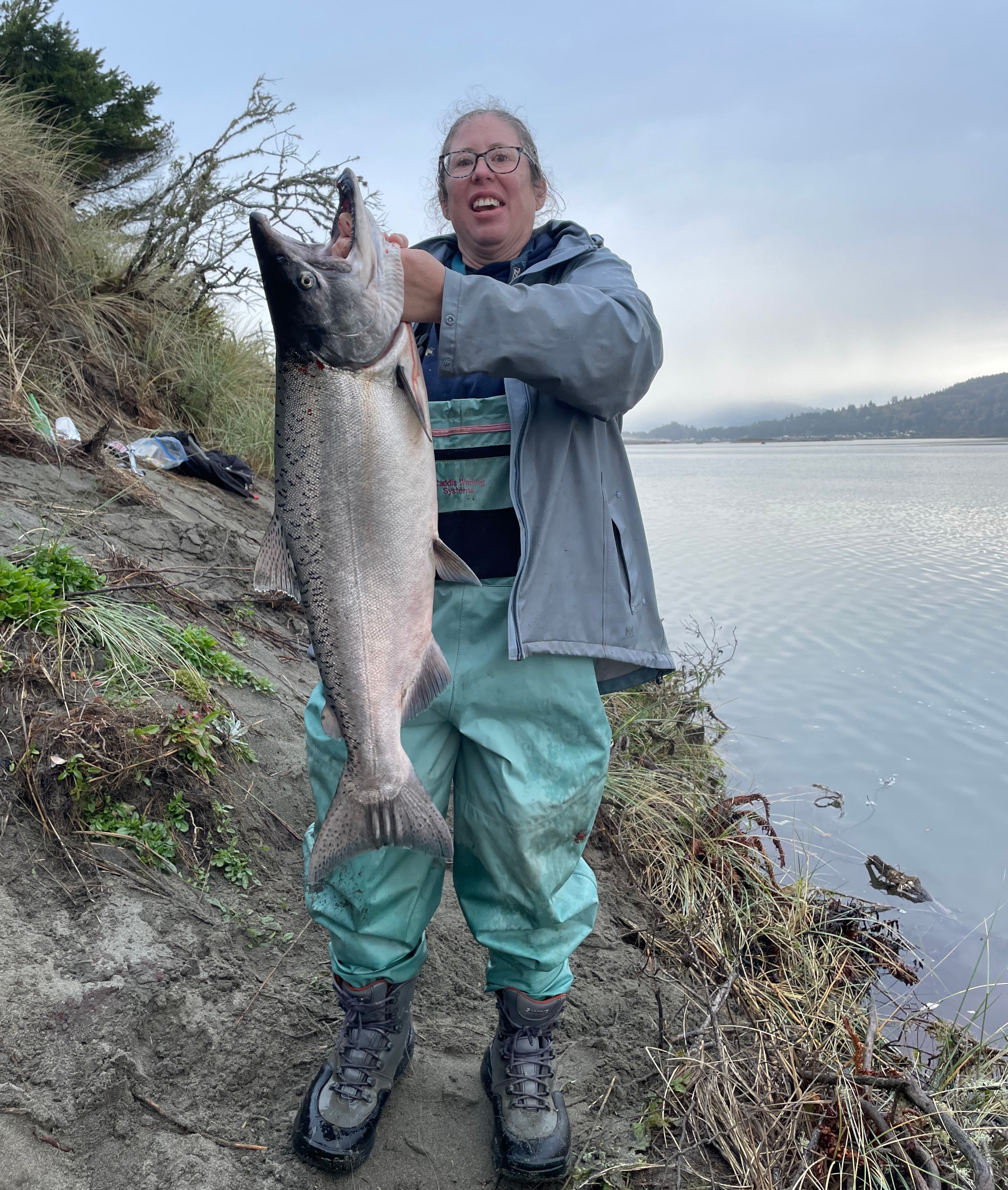
Carrie McNeill landed her first-ever Smith River salmon on Saturday. The king weighed in at 16 pounds. Photo courtesy of Jesse McNeill,

Mad
Forecast to reach 335 cfs by Saturday afternoon and may have some color. Minimum flow: 200 cfs at the gauging station at the Highway 299 bridge. www.cnrfc.noaa.gov/graphicalRVF.php?id=ARCC1

Main stem Eel
Flows are predicted to hit 700 cfs Sunday morning, and could be fishable. The Eel River is open to catch and release of salmon in 2024/25. Minimum Flow: 350 cubic feet per second at the gauging station near Scotia.
www.cnrfc.noaa.gov/graphicalRVF.php?id=SCOC1

South Fork Eel
As of Thursday, it looks like the South Fork could open to fishing by Saturday, but flows are expected to fall under the minimum by Sunday. There’s a good chance it will stay closed. Minimum flow: 340 cfs at the gauging station at Miranda. www.cnrfc.noaa.gov/graphicalRVF.php?id=MRNC1

Van Duzen
If the storm prediction is correct, the Van Duzen won’t reach the flow threshold in order to open to fishing. It’s forecast to peak at 115 cfs Saturday afternoon. Minimum flow: 150 cfs at the gauging station near Grizzly Creek Redwoods State Park.
www.cnrfc.noaa.gov/graphicalRVF.php?id=BRGC1

Chetco
“Big numbers of jacks were caught on the Chetco Sunday and Monday before fishing slowed dramatically Tuesday as river levels dropped,” said Andy Martin of Wild Rivers Fishing. “Lower river holes were plugged full of salmon before the weekend rains, and by Tuesday the fish appeared to have shot upriver. Fresh schools of kings moved into the tidewater on Tuesday evening. Heavy rain this week should result in prime conditions the beginning of next week. Ice Box is expected to open after the big rains. Launch permits are available at the Chetco Outdoor Store.”

Kenny Priest operates Fishing the North Coast, a fishing guide service out of Humboldt specializing in salmon and steelhead. Find it on Facebook, Instagram, YouTube and fishingthenorthcoast.com. For up-to-date fishing reports and North Coast river information, email kenny@fishingthenorthcoast.com.
Low-Flow River Information for the North Coast – 2024/2025


Low Flow River Closures begin Sept. 1 and run through April 30, 2025.
North Coast rivers that are regulated by low flow closures, including the Eel River, Mad River, Mattole River, Redwood Creek, Smith River and Van Duzen River will begin angling restrictions on September 1st, and run through April 30th 2025. . As a reminder, in 2022, a low-flow angling restriction was added to the section of the Eel River from the mouth to Fulmor Road (Eel estuary) at its paved junction with the south bank of the Eel River. When a low-flow closure occurs in this section of the Eel, it will be closed to hook-and-line fishing; other legal fishing methods are allowed during this timeframe. The Department of Fish and Game will make the information available to the public by a telephone recorded message updated, as necessary, no later than 1 p.m. each Monday, Wednesday and Friday as to whether any stream will be closed to fishing. The rivers can be opened up at anytime. Rivers will not automatically open to fishing once minimum flows are reached. The low flow closure hotline for North Coast rivers is (707) 822-3164. NOTE: The main stem Eel from the South Fork to Cape Horn Dam and the Mattole River will be closed until January 1, 2025.

Section of river that is open to fishing is the main stem Smith River from the mouth of Rowdy Creek to its mouth.

Areas subject to low flow closures:

Mad River: The main stem Mad River from the Hammond Trail Railroad Trestle to Cowan Creek. Minimum flow: 200 cfs at the gauging station at the Highway 299 bridge. The Mad River from the mouth to 200 yards upstream is closed until Jan. 1, 2025.

The main stem Eel River: New in 2022, a low-flow angling restriction was added to the section of the Eel River from the mouth to Fulmor Road at its paved junction with the south bank of the Eel River, Sept. 1 through April 30. The stream flow will be monitored as follows: Minimum Flow: 350 cubic feet per second at the gauging station near Scotia.

The South Fork of the Eel River: The South Fork of the Eel River downstream from Rattlesnake Creek and the Middle Fork Eel River downstream from the Bar Creek. Minimum flow: 340 cfs at the gauging station at Miranda.

Van Duzen River: The main stem Van Duzen River from its junction with the Eel River to the end of Golden Gate Drive near Bridgeville (approximately 4,000 feet upstream of Little Golden Gate Bridge. Minimum flow: 150 cfs at the gauging station near Grizzly Creek Redwoods State Park.

Mattole River: The main stem of the Mattole River from the mouth to Honeydew Creek. Minimum flow: 320 cfs at the gauging station at Petrolia.

Redwood Creek: The main stem of Redwood Creek from the mouth to its confluence with Bond Creek. Minimum flow: 300 cfs at the gauging station near the Highway 101 bridge.

Smith River: The main stem Smith River from the mouth of Rowdy Creek to its confluence with Patrick Creek; the South Fork Smith River from the mouth upstream approximately 1000 ft to the County Road (George Tyron) bridge and Craigs Creek to its confluence with Jones Creek; and the North Fork Smith River from the mouth to its confluence with Stony Creek. Minimum flow: 600 cfs at the Jedediah Smith State Park gauging station.

Waiting For Rain – and Late Fall Kings

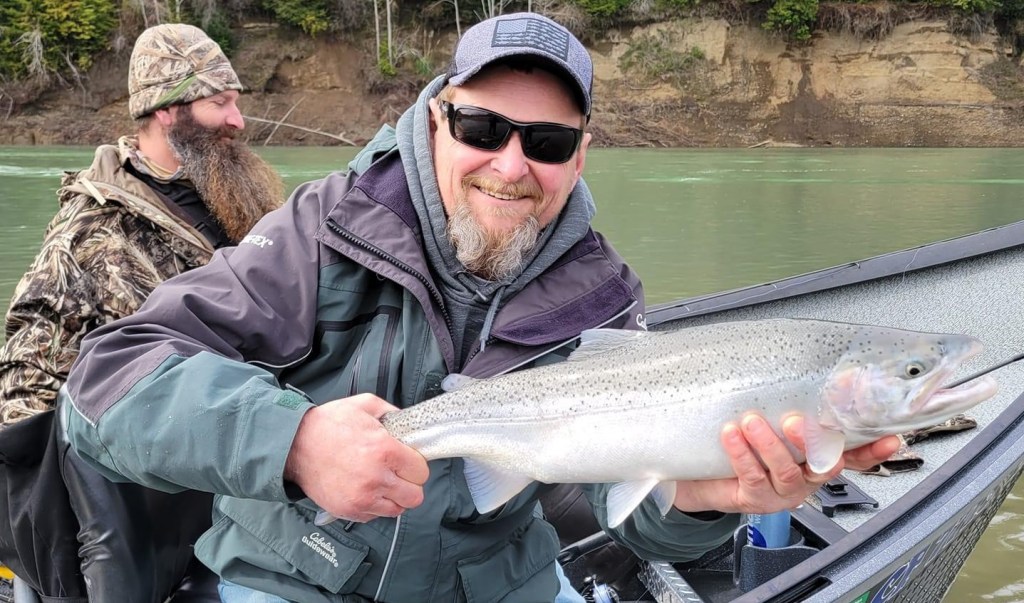
Late fall kings, like the one pictured with angler Ryan Galovic, will begin to make their way into the coastal rivers once the winter rains begin. Anglers will be able to harvest Chinook salmon this fall on the Smith while sections of the Eel will be open to catch and release. Photo courtesy of Kenny Priest/Fishing the North Coast Guide Service

While we wait for rain to fill our coastal rivers with much-needed water and late fall Chinook salmon, the North Coast is not without angling options.
Offshore, the boat-based rockfish and lingcod season will run through the end of the year. For the months of October and December within the Northern Management Area, which includes ocean waters between 42°00’ N. latitude (CA-OR Border) and 40°10′ N. latitude (near Cape Mendocino), fishing for rockfish will only be allowed seaward of the 50-fathom boundary line, and only shelf rockfishslope rockfish and lingcod may be retained. The nearshore fishery will be open Nov. 1, coinciding with the Nov. 2 sport Dungeness crab opener. Crab and rockfish combo trips are uber-popular and you’ll want to take advantage while you can.

Rockfish and federally managed groundfish for diving and shore-based anglers is allowed year-round, in line with current regulations.

If you haven’t got your fill of Pacific halibut, there’s plenty of quota still left on the table. As of Sept. 8, only 18,157 pounds have been harvested against the 38,220 net pound quota. The season closes Nov. 15, so there’s a couple weeks to run some crab and halibut combo trips.

When the rain does begin to fall and the rivers open, the Smith will be popular as it will be the only place in California where you can legally harvest a salmon. You are allowed one Chinook salmon per day and no more than 5 wild Chinook over 22 inches per year. The Smith is currently closed to fishing above Rowdy Creek. Minimum flows are 600 cfs at the Jedediah Smith State Park gauging station for the river to open to fishing. Sections of the Eel and Van Duzen will be open to the catch and release of Chinook salmon in 2024. On the Eel, catch and release is legal from the mouth to Cape Horn dam. The South Fork from its mouth to Rattlesnake Creek is also open to catch and release as well as the Van Duzen from its junction with the Eel River to the end of Golden Gate Drive near Bridgeville. All of these sections are restricted under low-flow fishing closures. The Chetco estuary is another good option as it continues to produce big kings to anglers trolling anchovies. Hopefully the wait for rain won’t be a lengthy one, but if it is, you’ve got options.

Weekend marine forecast
Ocean conditions look to be much improved heading into the weekend. As of Thursday afternoon, Friday’s forecast out 10 to 60 nautical miles is calling for winds out of the northwest 5 to 10 knots with northwest waves 5 feet at 11 seconds. Saturday, winds will be out of the north 10 to 15 knots with north waves 4 feet at five seconds and northwest 4 feet at nine seconds. Sunday, the winds will be 10 to 15 knots out of the north with north waves 4 feet at five seconds and northwest 4 feet at 10 seconds. These conditions can and will change by the weekend. For an up-to-date weather forecast, visit www.weather.gov/eureka/ or https://www.windy.com. You can also call the National Weather Service at (707) 443-7062 or the office on Woodley Island at (707) 443-6484.

Dungeness crab testing getting started
Domoic acid testing in Dungeness crabs is just getting started on the California coast. To date, only samples from Half Moon Bay/San Francisco (Pidgeon and Pillar Point) have been reported. None of the tested crabs exceeded the action level of 30 parts per million. For more information, visit www.cdph.ca.gov/Programs/CEH/DFDCS/Pages/FDBPrograms/FoodSafetyProgram/DomoicAcid.aspx

The Oceans:
Eureka
According to Tim Klassen of Reel Steel Sport Fishing, there hasn’t been any offshore opportunities the past couple weeks due to weather. “It looks like we’ve finally have some decent ocean conditions starting Friday and through the weekend,” said Klassen. “Pacific halibut and deep-water rockfish should be within reach.”

Shelter Cove
According to Jake Mitchell of Sea Hawk Sport Fishing, it was another quiet week at the Cove due to ocean conditions. “The outlook for later this week and the weekend is much improved,” said Mitchell.

Brookings
“Halibut action has slowed, but fish are being caught on calm weather days,” said Andy Martin of Brookings Fishing Charters. “Lingcod action is fair, with limits of rockfish for most boats. Be ready to release king salmon if fishing near the beaches and mouth of the river. Sport crabbing has been good.”

Willow Creek weir counts
For the week ending Sept. 23, a total of 101 adult kings were counted at the Willow Creek weir. The jack count for the week was 49. For the season to date, 285 (adults and jacks) have been counted, including both hatchery and wild. The totals are for only 23 trapping days.

North Coast river closures
Currently, all North Coast rivers subjected to low flow fishing closures, including the Eel, Mad, Redwood Creek, Smith and Van Duzen are closed. Sections of rivers that are open include the main stem Smith River from its mouth to the mouth of Rowdy Creek.

The Department of Fish and Game will make the information available to the public no later than 1 p.m. each Monday, Wednesday and Friday as to whether any river will be closed to fishing. The rivers can be opened up at any time. The low flow closure hotline for North Coast rivers is 707-822-3164. NOTE: The main stem Eel from the South Fork to Cape Horn Dam, the Mad River from the mouth to 200 yards upstream and the Mattole River will be closed until January 1, 2025.

The Rivers:
Lower Klamath
Water conditions on the lower Klamath continue to be dirty and unfishable, but that should begin to change soon. All the work in the river for dam removal was complete as of Tuesday. The water below the old dam sites is still dirty, but improving. It’s not likely conditions will improve enough for steelhead fishing before the rains come.
The daily bag limit is two hatchery steelhead or hatchery trout per day on both the Klamath and Trinity rivers, with a possession limit of four. Anglers must have a Steelhead Fishing Report and Restoration Card in their possession while fishing for steelhead trout in anadromous waters. The recreational fall salmon fishery is closed to the take of Chinook. More information, can be found here.

Chetco/Rogue
|According to Martin, salmon fishing has been good at times in the Chetco estuary, with numerous fish caught daily, including some large adults and plenty of jacks. “Fish to 35 pounds or bigger are being caught each week, with lots of fish over 20 pounds. Salmon also are holding in the tidewater areas of the river now. The bay is crowded, and most fish are being caught near the end of the jetties, so be ready for combat fishing. Kings also are being caught on the Rogue Bay.”

Kenny Priest operates Fishing the North Coast, a fishing guide service out of Humboldt specializing in salmon and steelhead. Find it on Facebook, Instagram, YouTube and fishingthenorthcoast.com. For up-to-date fishing reports and North Coast river information, email kenny@fishingthenorthcoast.com