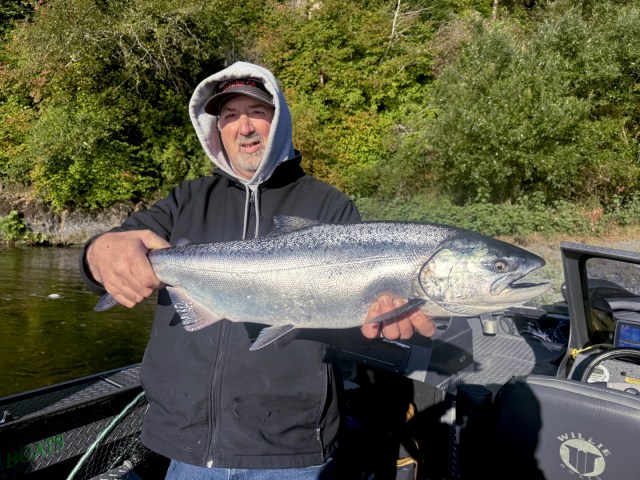
Following some excellent salmon fishing in the Klamath estuary over the past few weeks, adult fall-run king salmon are now beginning to make their way upriver. There are a couple of reasons for the push. First, cool water releases from behind Lewiston Dam began last Friday to help reduce the risk of disease in the salmon. The other factor is the weather. Cooler outside temperatures, along with a fair amount of rain, can do wonders for river temperatures.
Combined, these conditions should produce a steady stream of kings moving upriver and staging in the various holes throughout the lower river. But don’t give up on the estuary just yet—the fishing was reportedly pretty wide-open on Monday. I think it’s safe to say we’re smackdab in the middle of what could be a pretty good run of kings.
According to Dan Troxel, an environmental scientist with the Klamath River Project, 432 adult salmon were harvested from the State Route 96 bridge at Weitchpec downstream to the Klamath mouth during the week ending Aug. 26, counting toward the quota of 1,624 fish. As of last Friday, 1,192 adults remained on the quota. Meanwhile, the spit area closed to fishing as of Thursday, Sept. 3.
With excellent conditions and the Labor Day crowd on the water, I’d expect a big dent to be taken out of the remaining quota in the coming days.
Trinity River quotas began on Sept. 1
Fall regulations for Chinook salmon fishing on the Trinity River went into effect on Sept. 1 and run through Dec. 31, with a sport quota of 1,072 adults. The quota will be split almost evenly: 536 adults for the main stem Trinity downstream of the Old Lewiston Bridge to the State Route 299 West bridge at Cedar Flat, and 536 adults for the main stem Trinity downstream of the Denny Road bridge at Hawkins Bar to the confluence with the Klamath. The main stem downstream of the State Route 299 Bridge at Cedar Flat to the Denny Road Bridge in Hawkins Bar is closed to all fishing Sept. 1 through Dec. 31.
Anglers may keep track of the Klamath and Trinity river quotas by calling 800-564-6479. Klamath and Trinity fishing regulations can be found here.
Trinity River water release
The Bureau of Reclamation approved an increase to flows below Lewiston Dam to reduce the risk of disease for salmon migrating from the ocean to the Klamath and Trinity rivers. Starting Aug. 28 through Sept. 21, flows below Lewiston Dam will increase from approximately 450 cubic feet per second to as much as 1,200 cfs. This is a planned release and does not affect water supply to agriculture, communities, or other environmental obligations. The public is urged to take all necessary precautions on or near the river while flows are increased during this period.
Weekend marine forecast
According to the Eureka’s National Weather Service, “Winds will be light for most of the waters through Saturday. Then, northerlies will strengthen some through the weekend, mainly over the southern water south of Cape Mendocino. The northerlies do not look to fully strengthen again until early next week.”
Out 10 nautical miles north of the cape, Friday’s forecast is calling for south winds 10 to 15 knots and waves out of the northwest 6 feet at 11 seconds. Saturday is calling for north winds up to 5 knots and waves northwest 5 feet at nine seconds and south 2 feet at 11 seconds. Sunday, winds will be out of the north up to 5 knots and waves northwest 4 feet at nine seconds and south 1 foot at 11 seconds. These conditions can and will change by the weekend. For an up-to-date weather forecast, visit www.weather.gov/eureka or www.windy.com. You can also call the National Weather Service at 443-7062 or the office on Woodley Island at 443-6484.
Saturday is statewide Free Fishing Day
The last chance of the year to fish for free arrives over the Labor Day holiday weekend. Free Fishing Day is offered by the California Department of Fish and Wildlife Saturday, Sept. 5. While no fishing license is required on free fishing days, all fishing regulations, such as bag and size limits, gear restrictions, report card requirements, fishing hours and stream closures remain in effect. Every angler must have an appropriate report card if they are fishing for steelhead or sturgeon anywhere in the state or salmon in the Smith and Klamath-Trinity river systems. For more information, visit wildlife.ca.gov/Licensing/Fishing/Free-Fishing-Days.
Del Norte County Razor Clam fishery re-opens
In a press release issued Monday, the CDFW has opened the recreational razor clam fishery in Del Norte County following a recommendation from state health agencies that domoic acid no longer poses a significant threat to human health if consumed.
Statement from CDFW:
“The razor clam fishery was closed on July 31 in Del Norte County due to elevated levels of domoic acid. Clams sampled in July and August 2026 from Crescent Beach, Del Norte County, all had domoic acid concentrations lower than the federal action level, allowing the fishery to reopen. The recreational razor clam fishery in Humboldt County remains closed due to elevated levels of domoic acid. The closure, which began in May 2024, remains in effect until state health agencies determine razor clams no longer pose a health risk.
CDFW will continue to work with the California Department of Public Health and Office of Environmental Health Hazard Assessment as they monitor ocean indicators for domoic acid presence and continue to test razor clams from Northern California. This will determine when the recreational razor clam fishery can be reopened safely in Humboldt County while ensuring razor clams are safe to harvest in Del Norte County.
CDFW reminds clammers that the daily bag limit for razor clams is 20 and the first 20 clams dug must be retained regardless of size or condition. The fishery is open south of Battery Point, Crescent City in Del Norte County. Each person is required to keep a separate container for their clams and is not allowed to commingle their take with another person when digging and transporting clams to shore.
Recreational clam fishery regulations can be found in the Ocean Sport Fishing Regulation Guide; refer to Section 29.20 for general clam regulations and Section 29.45 for specific razor clam regulations.
Health advisory information will be updated on CDFW’s fishery information and health advisories website.
To get the latest information on current fishing season closures related to domoic acid, please call CDFW’s Domoic Acid Fishery Closure Information Line at (831) 649-2883.”
The oceans:
Eureka
This past week was quiet out of Eureka due to ocean conditions according to Tim Klassen of Reel Steel Sport Fishing. “There was some tuna caught last week out of Eureka, but it wasn’t red-hot,” said Klassen. “The fish that were caught were bigger fish. The warm water looks like it’s pushing in, but the chlorophyll looks to be about 70 miles offshore right now. The Pacific halibut bite has been slow with not much effort right now. It’s possible with the warm water moving in that they went out deeper. Ocean conditions are looking good for this weekend, so hopefully we’ll get some better reports.”
Trinidad
“Options are limited, but the option is epic,” said Tony Sepulveda of Shellback Sport Fishing. “No tuna within range. Halibut bite is slow. Salmon season is closed. More giant lingcod than I’ve seen in the better part of decade. We’re starting the morning off by catching live bait for them, then moving in on the remote waters reef and its game on. Multiple fish over 30 pounds this week and more than I can count north of 20. We’re living in the good ole days again.”
Shelter Cove
“The rock fishing has been great,” reports Jake Mitchell of Sea Hawk Sport Fishing. He said, “Most the action has been out in a little deeper water by the Hat. A few boats went out for tuna on Tuesday, but I didn’t hear any reports other than it was slow.”
Crescent City
“The tuna water moved within 30 miles last week, and some boats made the run, but it sounded like not many fish were caught,” said Andrew Williams of Crescent City’s Englund Marine. “The rockfish and lingcod bite are still going strong when the boats can get out. Both the Pacific and California halibut bite have slowed down. A few Thresher’s have been caught the last couple weeks off of South Beach.”
Brookings
Ocean salmon season came to a slow end out of Brookings, with a one-day flurry of wide-open action a few days before the closure, and otherwise very hit-and-miss fishing since mid-August reports Andy Martin of Brookings Fishing Charters. “Brookings had the highest ocean salmon catch totals in Oregon, with more than 6,500 kings landed since the season opened in March, according to ODFW figures,” said Martin. “Around 12,000 kings were landed statewide in the ocean this season. Around 150 kings were caught last week. The best fishing was in July, April and early May.
Lingcod fishing has improved with fish moving into shallow water. The best catch rates of the summer happened late last week and over the weekend, with most boats catching lingcod. Calm weather returns this weekend after a fall-like storm Tuesday night and Wednesday.”
Low Flow River Closures began Sept. 1
North Coast rivers that are regulated by low flow closures, including the Eel, Mad, Mattole, Redwood Creek, Smith and Van Duzen began angling restrictions on Sept. 1 and will run through April 30, 2027. As a reminder, in 2022, a low-flow angling restriction was added to the section of the Eel River from the mouth to Fulmor Road (Eel estuary) at its paved junction with the south bank of the Eel River. When a low-flow closure occurs in this section of the Eel, it will be closed to hook-and-line fishing; other legal fishing methods are allowed during this timeframe.
The Department monitors low flow conditions on Mondays for decision days Tuesday and Wednesday, Wednesday for decision days Thursday and Friday, and Friday for decision days Saturday, Sunday, and Monday and will update this message as needed. Please note that the Department may open waters between regularly scheduled updates in response to changing flow conditions. The department will only close waters on decision days Monday, Wednesday, and Fridays for their respective decision windows.
Anglers are advised to check the Department’s Low Flow Fishing Regulations – North Coast website before deciding to fish in any of these low flow restricted waters, and to clean, drain, and dry all fishing gear to prevent the spread of Aquatic Invasive Species.
The low flow closure hotline for North Coast rivers is 707-822-3164. NOTE: The main stem Eel from the South Fork to Cape Horn Dam and the Mattole River will be closed until January 1, 2027.
Areas subject to low flow closures:
Mad River: The main stem Mad River from the Hammond Trail Railroad Trestle to Cowan Creek. Minimum flow: 200 cfs at the gauging station at the Highway 299 bridge. The Mad River from the mouth to 200 yards upstream is closed until Jan. 1, 2027.
The main stem Eel River: New in 2022, a low-flow angling restriction was added to the section of the Eel River from the mouth to Fulmor Road at its paved junction with the south bank of the Eel River, Sept. 1 through April 30. The stream flow will be monitored as follows: Minimum Flow: 350 cubic feet per second at the gauging station near Scotia.
The South Fork of the Eel River: The South Fork of the Eel River downstream from Rattlesnake Creek and the Middle Fork Eel River downstream from the Bar Creek. Minimum flow: 340 cfs at the gauging station at Miranda.
Van Duzen River: The main stem Van Duzen River from its junction with the Eel River to the end of Golden Gate Drive near Bridgeville (approximately 4,000 feet upstream of Little Golden Gate Bridge. Minimum flow: 150 cfs at the gauging station near Grizzly Creek Redwoods State Park.
Mattole River: The main stem of the Mattole River from the mouth to Honeydew Creek. Minimum flow: 320 cfs at the gauging station at Petrolia.
Redwood Creek: The main stem of Redwood Creek from the mouth to its confluence with Bond Creek. Minimum flow: 300 cfs at the gauging station near the Highway 101 bridge.
Smith River: The main stem Smith River from the mouth of Rowdy Creek to its confluence with Patrick Creek; the South Fork Smith River from the mouth upstream approximately 1000 ft to the County Road (George Tyron) bridge and Craigs Creek to its confluence with Jones Creek; and the North Fork Smith River from the mouth to its confluence with Stony Creek. Minimum flow: 600 cfs at the Jedediah Smith State Park gauging station.
Lower Rogue
According to Martin, the Rogue Bay has been fishing well and should see a large number of new fish with this week’s rain. “Fishing also likely will bust wide open upstream near Agness, and kick into high gear next week in the Grants Pass area because of the rain and cooler water temperatures.”
Kenny Priest operates Fishing the North Coast, a fishing guide service out of Humboldt specializing in salmon and steelhead. Find it on Facebook, Instagram, YouTube and fishingthenorthcoast.com. For up-to-date fishing reports and North Coast river information, email kenny@fishingthenorthcoast.com.
Discover more from Fishing the North Coast with Kenny Priest
Subscribe to get the latest posts sent to your email.
